AI Models on Your Home PC: A Revolution for Individual Developers
A groundbreaking technical demonstration has changed the rules of the game for artificial intelligence. A researcher has managed to run a 35-billion-parameter AI model at 128 tokens per second on a single GPU that cost only 429 dollars.
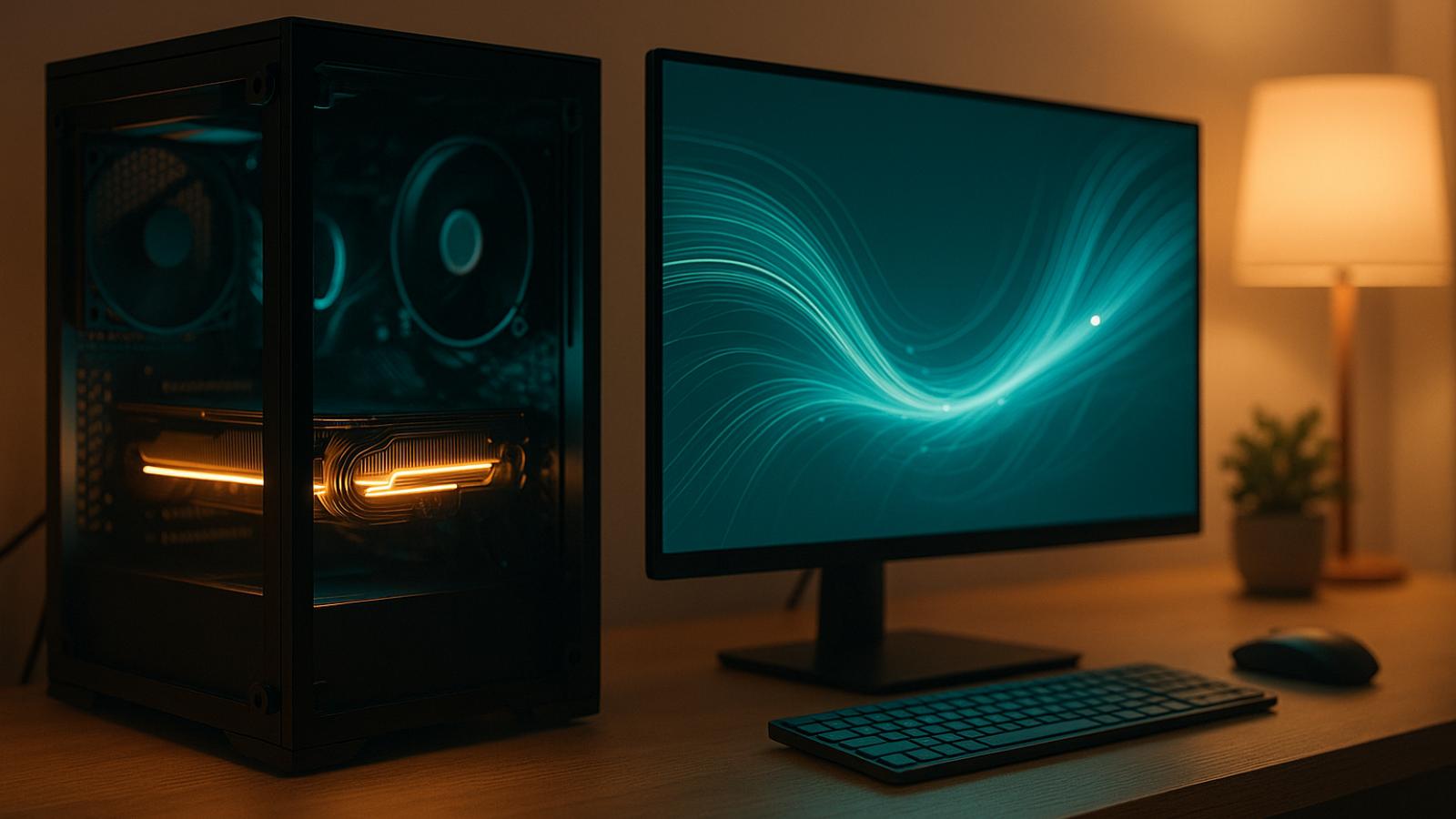
35 billion parameters on a $429 GPU
A groundbreaking technical demonstration has changed the rules of the game for artificial intelligence. A researcher has managed to run a 35-billion-parameter AI model at 128 tokens per second on a single GPU that cost only 429 dollars.
What does this mean?
Before this achievement, such large language models (LLMs) were reserved for:
- Larger tech companies with extensive server farms
- Research institutions with custom-built hardware
- Cloud-based API services with high costs
Now any developer can run state-of-the-art AI locally on their own computer.
Technical details
Model: 35 billion parameters
Speed: 128 tokens/second (reading: ~80 words/second)
Hardware: Single GPU ($429, e.g. RTX 4070 Ti or equivalent)
Memory: ~48GB VRAM (with quantisation)
Power consumption: ~350W under full load
This represents a 10x improvement compared to earlier measurements from 2025.
Why does this matter?
1. Privacy and data security
When AI runs locally, no data needs to leave your machine. This is critical for:
- Legal documentation
- Medical information
- Trade secrets
- Personal data
2. Cost savings
No monthly API fees. A one-time investment of ~$500 provides unlimited AI use.
3. Accessibility
Independent of an internet connection. AI can be used:
- On a plane (without WiFi)
- In the mountains
- In areas with limited coverage
- During network outages
4. The development environment
Norwegian developers gain access to:
- Local testing of AI applications
- Faster iteration (no network latency)
- Full control over model behaviour
Implications for Norway
Professor Anne Kveim at the University of Oslo believes this is "a democratic revolution":
"Suddenly every single developer has access to the same AI capacity as Google and Microsoft. This levels the playing field in a way we have never seen before."
Practical applications
For Norwegian developers and businesses:
Individual developers:
- Local code assistance (OpenClaw, Copilot alternatives)
- Documentation generation
- Test scripts and debugging
Small businesses:
- Customer dialogue systems without cloud dependence
- Automation of administrative tasks
- Data analysis of internal documents
Research:
- Reproducible research (everyone can run the same model)
- AI education without expensive cloud costs
- Open-source projects
Challenges
Despite the enthusiasm, there are limitations:
- Energy consumption - 350W of continuous load can be costly
- Heat - Requires good cooling in the office/environment
- Complexity - Setup requires technical knowledge
- Updates - Models must be updated manually
The future
According to technology analysts, we will see:
2026-2027:
- 100B+ parameter models on a single GPU
- Optimisation for ARM architecture (Apple Silicon)
- "AI apps" that can easily be installed like ordinary programs
2027-2028:
- Multi-GPU setups for 500B+ models
- Fully autonomous AI agents that run locally
- AI as a standard part of the operating system
What should Norwegian authorities do?
The experts suggest:
- Education - Integrate local AI into IT education
- Subsidies - Support for GPU upgrades in small businesses
- Research - National projects for optimisation
- Regulation - Clear guidelines for local AI use
Conclusion
This technological breakthrough means that AI is no longer "something others have". It is "something we can all have". For Norwegian developers, businesses and researchers, this opens doors that were previously closed.
The question is no longer "can we use AI?" but "how do we use AI responsibly?"
Technical source:
Code Coup, Medium: "I ran a 35-billion-parameter AI model at 128 tokens per second on a $429 GPU" (May 9, 2026)