Norway electricity prices winter 2026: southern reservoirs 54% full, the north 90% – what it means for you
South-west Norway has not had less water in its reservoirs at the end of October since 1996, while the north is above normal. We explain the NVE figures, why power is dearest in the south and what support and Norgespris do to your bill this winter.
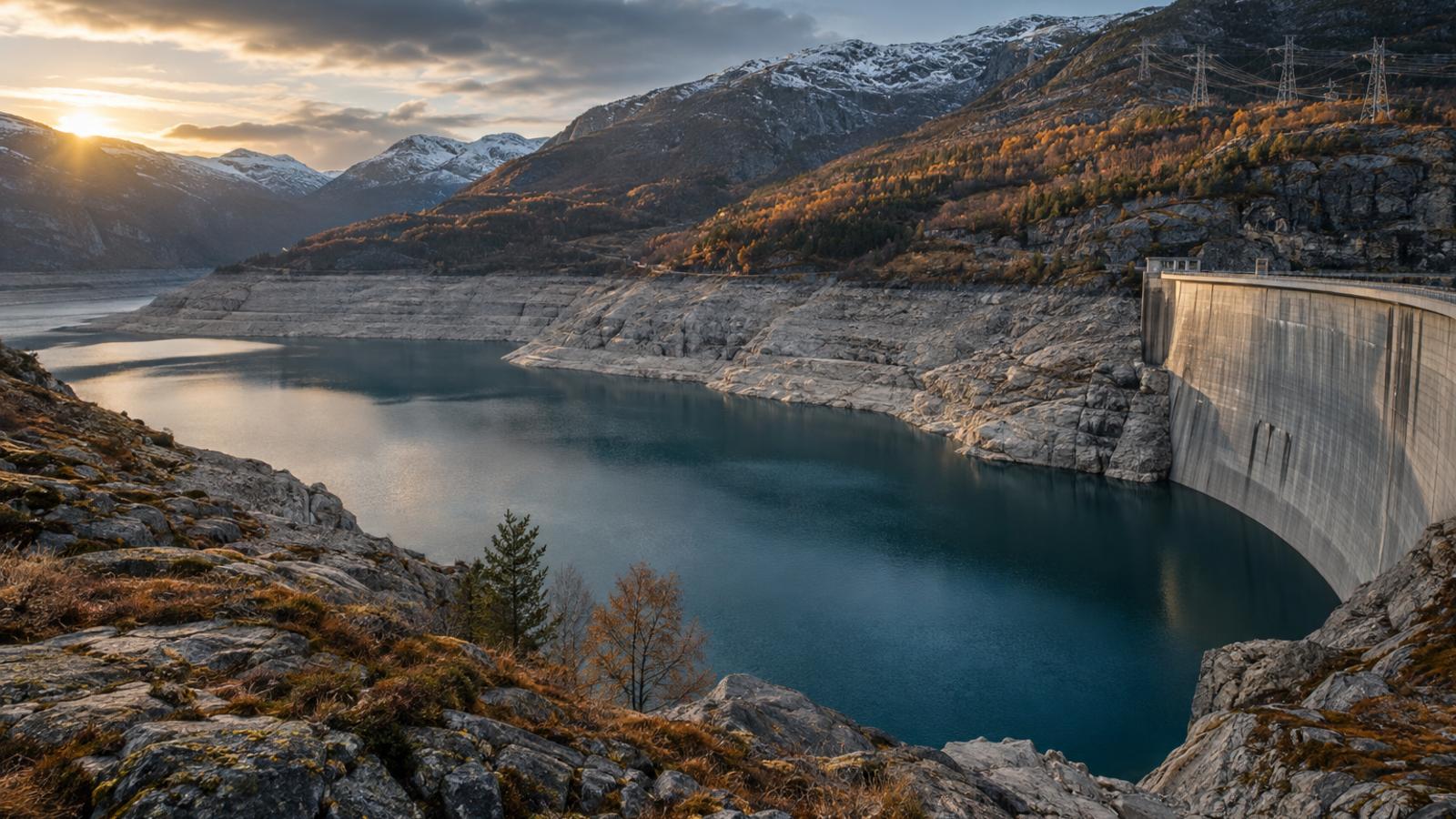
As of 25 October 2026, hydropower reservoirs in south-west Norway were 53.6 per cent full – the lowest level for the time of year since 1996 – while northern Norway stood at 90.5 per cent, according to the Norwegian Water Resources and Energy Directorate (NVE). That gap is the main reason power cost 134 øre/kWh in the south-west in week 43, against 22 øre in the north.
- Norway as a whole: 69.5 per cent full on 25 October, 13.1 percentage points below the median for the week (NVE).
- South-west Norway (NO2): 53.6 per cent – 30.3 points below the median and under the lowest level of the past 20 years.
- Northern Norway (NO4): 90.5 per cent – 9.8 points above the median.
- Week 43 prices: 134 øre/kWh in the south-west, 22 øre in the north (average, excluding VAT; 100 øre = NOK 1).
- Next reservoir figures: Wednesday 4 November at 13:00 Norwegian time.
How full are Norway's reservoirs right now?
Reservoir filling is the share of storage capacity that holds water, measured as energy. NVE's reservoir statistics for week 43 (measured on Sunday 25 October, published on 28 October) put the national figure at 69.5 per cent, or 60.8 of 87.4 TWh.
By price area, the picture was:
- Eastern Norway (NO1): 77.8 per cent, up 3.1 points on the week before.
- South-west Norway (NO2): 53.6 per cent, up 0.6 points.
- Central Norway (NO3): 71.8 per cent, down 0.7 points.
- Northern Norway (NO4): 90.5 per cent, up 0.2 points.
- Western Norway (NO5): 72.4 per cent, down 0.8 points.
The south-west matters most. It holds 34.0 of Norway's 87.4 TWh of storage capacity, roughly 39 per cent, so when those reservoirs are half empty the whole of southern Norway feels it.
Is south-west Norway at a record low?
Not quite, but close. NVE's median for the south-west in week 43 is 83.9 per cent, and the lowest level in the 2006–2025 reference period is 53.8 per cent. This year's 53.6 per cent is therefore 0.2 points below the 20-year minimum. In NVE's longer series, which starts in 1995, the figure for that week was lower only in 1996, at 52.6 per cent.
A year earlier the south-west was at 67.7 per cent, and in 2024 at 84.1 per cent. The reservoirs have been refilling slowly this autumn, from 45.9 per cent in week 35, but from a very low base.
The cause lies in last winter. In its report on the second quarter of 2026, NVE describes historically low snow levels across much of southern Norway in the winter of 2025/26. At the start of the quarter, snow in southern Norway held 17.0 TWh of energy against a historical average of 32.1 TWh – the second year running with so little snow.
Why is electricity dearer in southern Norway than in the north?
NVE's weekly market report for week 43 gives average prices of 128 øre/kWh in eastern Norway, 134 øre in the south-west, 93 øre in central Norway, 22 øre in the north and 126 øre in the west. Spot power in Stavanger was roughly six times the price in Tromsø.
Three things explain the gap:
- Water in storage: with little water in the south, producers hold back. NVE notes that several hydropower producers chose to save water over the weekend so they could generate more when prices are higher.
- Cables to Europe: Norwegian prices follow European price levels through the interconnectors, “particularly into south-west Norway”, NVE writes.
- Grid bottlenecks: prices in two areas diverge when the grid cannot move enough power between them, so cheap northern power does not flow freely south. In the second quarter, maintenance also created bottlenecks between the south-west and the rest of the country, according to NVE.
Why power and hydropower are becoming scarce for other reasons too is the subject of our piece on electricity as the bottleneck for AI in Norway.
Will electricity be expensive this winter?
No public body has issued a winter forecast, so this is an assessment. Low reservoirs in the south, high gas prices and a tight link to Europe all push prices up. NVE says European gas prices have risen further in recent weeks as a result of the war in the Middle East.
Wind, rain and temperature can change the picture from one week to the next, though. Prices fell in every Norwegian area in week 43 because it was windy across the Nordics and on the Continent. The following week went the other way: ENTSO-E data published via hvakosterstrommen.no show the daily price in the south-west climbing from 100 øre on Monday 26 October to 204 øre on Sunday 1 November, excluding VAT. In the north it stayed around 20 øre all week.
What do the reservoir figures mean for household bills?
That depends on the contract. According to the Norwegian government, about 78 per cent of households in the south-west had signed up for Norgespris, the state-backed fixed price, by the end of September. For them, reservoir levels do not affect the power price in 2026.
Spot contract with electricity support
The electricity support scheme covers 90 per cent of the spot price above 77 øre/kWh excluding VAT, hour by hour, according to the government's overview. It is deducted on the grid bill. Nettsak's calculation from hourly prices in week 44 shows a spot customer in the south-west paid 166.8 øre on average, received 82.8 øre in support and was left with 84.0 øre/kWh for the power itself.
Norgespris
Norgespris is a fixed 40 øre/kWh excluding VAT until the end of 2026. In week 44 it was 44 øre cheaper than spot with support in the south-west – around NOK 440 per 1,000 kWh before VAT. For a household using 20,000 kWh a year and 2,000 kWh in a cold winter month, that is about NOK 880 a month. Grid fees, electricity tax and supplier mark-ups come on top either way.
Northern Norway
Here the sums run the other way. With spot prices around 22 øre, Norgespris cost about NOK 180 more per 1,000 kWh in week 44. NVE calculated that a household using 20,000 kWh paid NOK 634 more with Norgespris than on spot in the second quarter of 2026.
EV charging is a big part of winter consumption for many households; see also our piece on Norway's EV VAT changes in 2027.
What happens next?
NVE publishes reservoir figures every Wednesday at 13:00. The week 44 numbers are due on Wednesday 4 November. Statistics Norway (SSB) publishes third-quarter electricity prices on 16 November.
Households must order Norgespris again for 2027, according to the Ministry of Energy's Q&A. The government has proposed 45 øre/kWh and a support threshold of 79 øre, but Parliament has not yet passed the budget. Whether the fixed price pays off next year is covered in Norgespris 2027 at 45 øre: is it worth it?, and you will find more calculations in our Business section.
Frequently asked questions
How full are Norway's hydropower reservoirs in November 2026?
The latest NVE figures, for 25 October 2026, show 69.5 per cent nationally. The south-west was at 53.6 per cent and the north at 90.5 per cent.
Why is power dearer in southern Norway than in the north?
The south has little water in storage and is closely tied to Europe through interconnectors. Limited grid capacity stops cheap northern power from flowing freely south.
What do I pay with electricity support when spot is 200 øre?
You pay 77 øre plus 10 per cent of everything above it – about 89 øre/kWh excluding VAT for the power. Grid fees and mark-ups come on top.
Could Norway ration electricity this winter?
The Ministry of Energy says a severely strained power situation has not occurred since the market was set up in the early 1990s. The law allows Norgespris and support to be adjusted in a shortage, but no such rules have been drawn up.
When are the next figures due?
NVE publishes the week 44 reservoir figures on Wednesday 4 November at 13:00. SSB's quarterly electricity prices follow on 16 November.