Electricity has become AI's biggest bottleneck – and it puts Norway at the center
Not chips, but electricity now limits AI expansion. A single AI query uses up to 1,000 times more power than a normal one, and data centers are moving out of cities toward the power – straight toward Norwegian hydropower.
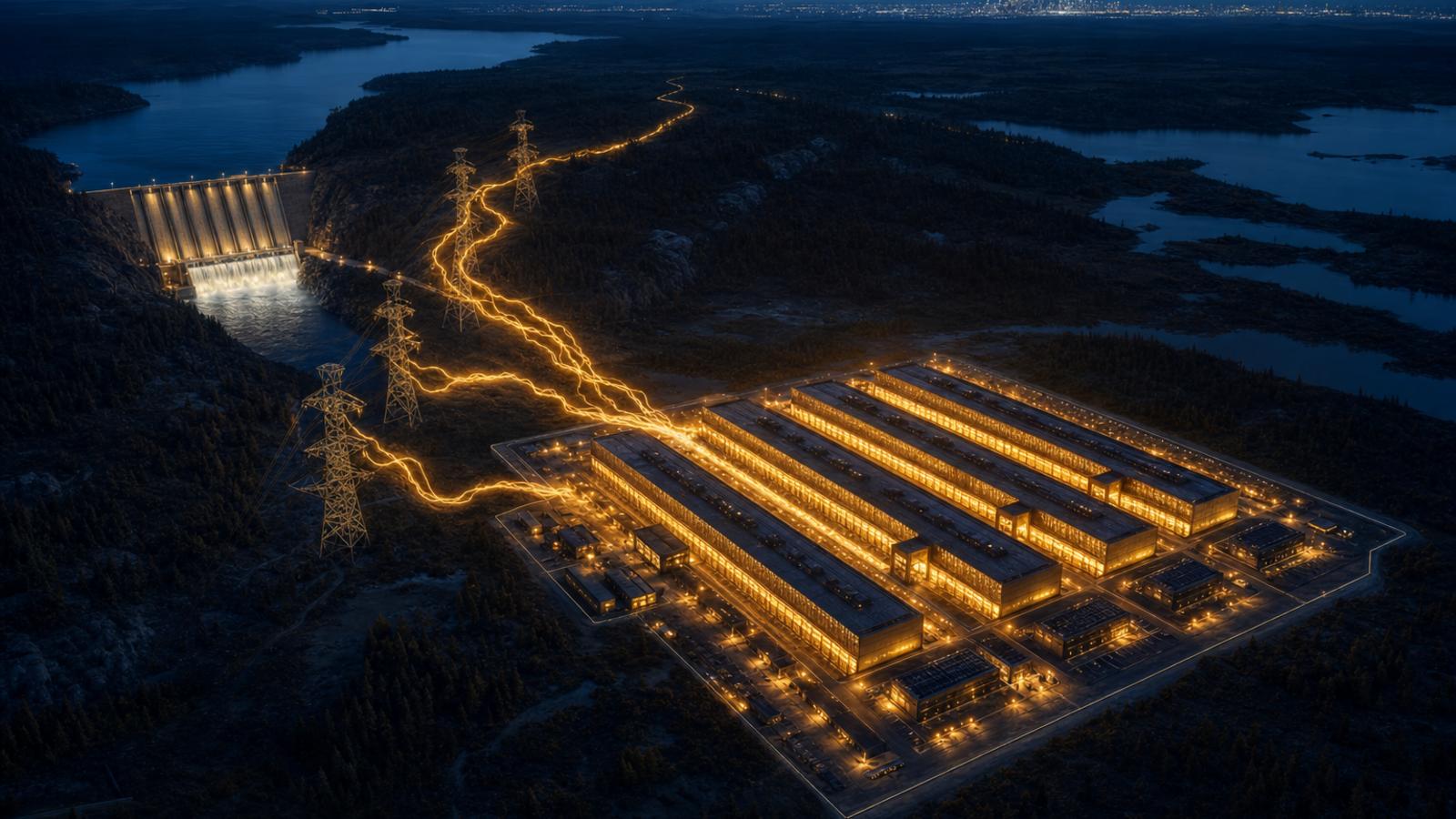
For two years the race for artificial intelligence has been about computer chips. Now the bottleneck has shifted to something far more physical: electricity. In 2026 it is no longer a shortage of chips or capital that slows AI expansion, but a shortage of power. The industry body Uptime Institute now describes electricity as "the single defining constraint" on data-center growth worldwide.
One AI query = 1,000 ordinary searches
The backdrop is explosively growing energy use. A single AI query can draw up to 1,000 times more electricity than an ordinary web search. Data-center racks filled with AI hardware use between 30 and over 100 kilowatts each, versus 7–15 for traditional servers. The European Commission estimates that data-center capacity in Europe will more than double – from 12 to 28 gigawatts by 2030 – with electricity demand rising from 145 to 238 terawatt-hours. Globally, data centers are approaching 1,050 terawatt-hours, enough to make them the world’s fifth-largest "electricity consumer," between Japan and Russia.
Data centers are moving out of the cities
The consequence is that the power grid cannot deliver enough electricity where data centers have traditionally sat. The result: AI facilities are moving out of the cities, toward places with abundant power, and increasingly building their own supply – from gas plants to renewable microgrids – to bypass the overloaded public grid. A modern AI data center is now described by the industry itself as "a small city" – and small cities need their own power stations.
It turns upside down how the internet was built. The "cloud" was supposed to be placeless. AI compute is, on the contrary, bound to one place: wherever there is cheap, stable and abundant electricity.
Norway at the center – and a difficult trade-off
That is precisely why the Nordics, and Norway in particular, end up at the center. Abundant hydropower, a cold climate and political stability make the country one of the world’s most attractive locations for AI data centers, and several large projects have been announced with Norwegian renewable power behind them.
But the same advantage creates a real conflict Norway must now confront: hydropower is not infinite, and every terawatt-hour that goes to an AI data center is electricity that does not go to homes, industry and the electrification of transport – and it affects the price everyone pays. The question of whether Norwegian hydropower should run the world’s chatbots is no longer rhetorical. When the nation’s foremost resource is exactly what the world’s most capitalized industry needs, it brings both great opportunity and a demanding allocation question at the same time.
The energy story behind AI
AI is usually told as a software story. Underneath, it is an energy story. The limit on how far AI can grow is no longer set by how clever the model is or how many chips you can buy, but by how much electricity can be delivered to them – reliably, and at a price that works. And a surprisingly large share of that power lies beneath Norwegian waterfalls.