Do heat pumps pay off in Norway? What you save at minus 10 and with Norgespris, in kroner
The COP on the box is measured at plus 7°C. We explain why efficiency falls in the cold, run the numbers for a 20,000 kWh home on Norway’s 50-øre fixed price, and set out which Enova grants actually exist as of November 2026.
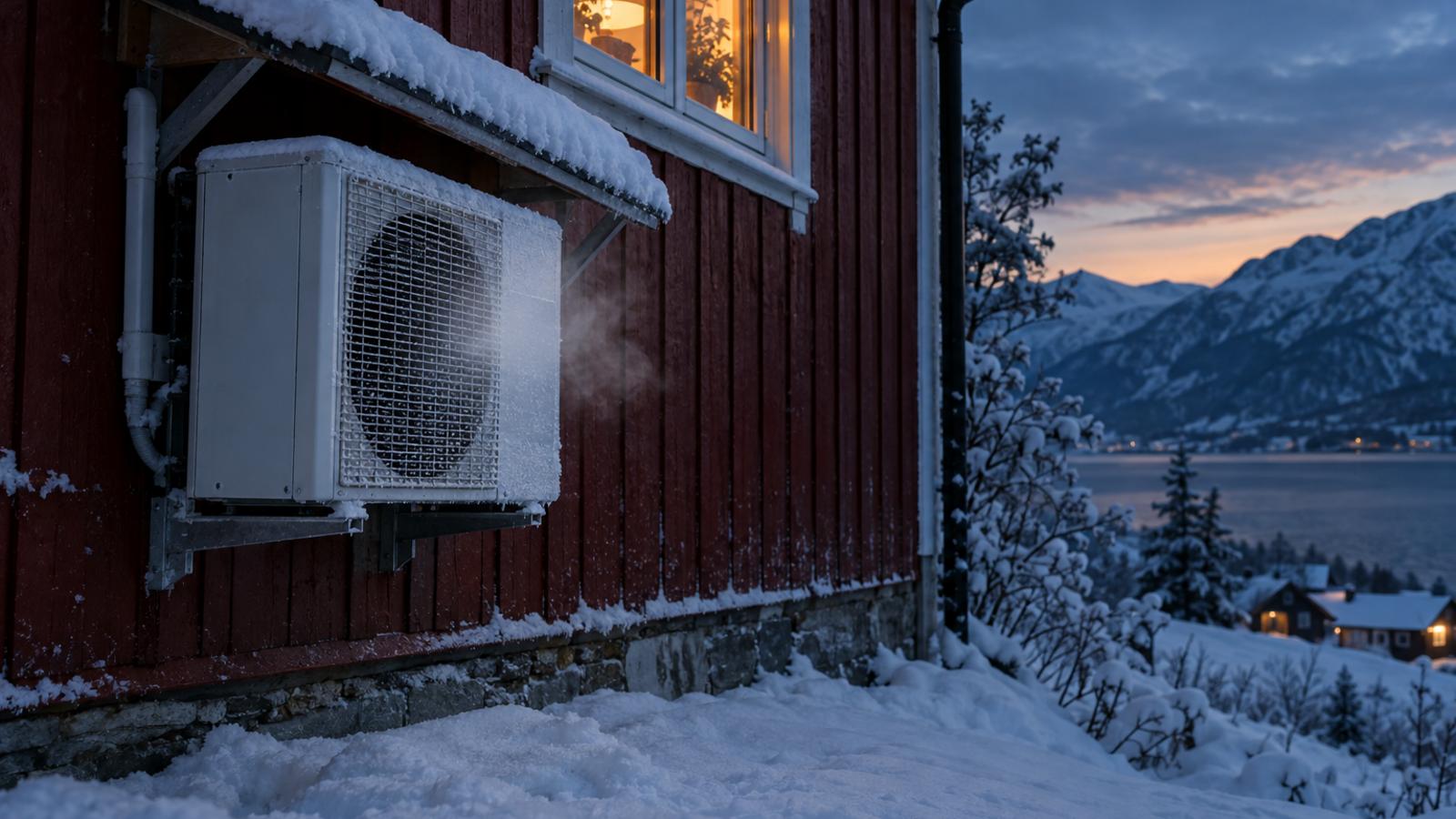
A heat pump still pays off for most Norwegian detached houses heated with panel heaters, but the gain is smaller than the brochures suggest – both at minus 10 and when electricity costs 50 øre under Norway’s fixed-price scheme, Norgespris. Our worked example for a home using 20,000 kWh a year comes to NOK 1,500–2,000 saved annually on the energy price alone.
- COP (coefficient of performance) is the heat delivered divided by the electricity used. According to SINTEF, 1 kWh of electricity yields roughly 3 kWh of heat.
- Statistics Norway (SSB) says real-world heat pumps usually deliver 2–2.5 kWh of heat per kWh, with a range of 1 to 5.
- The COP quoted for air-to-air units is normally measured at 7°C outdoors – not at minus 10.
- As of November 2026, the state agency Enova covers 25 per cent, up to NOK 20,000, for air-to-water and up to NOK 40,000 for ground-source pumps. Air-to-air gets nothing.
- Norgespris is 40 øre per kWh excluding VAT until the end of 2026 – 50 øre where VAT applies.
What is COP, and why does it drop in the cold?
COP is the ratio between the heat a pump delivers and the electricity it consumes. The Norwegian encyclopaedia Store norske leksikon (updated September 2026) notes that space heating typically achieves a COP of 3–4 when the temperature lift is moderate, around 15–25 degrees.
The temperature lift is the key. The colder it is outside, the further the pump has to raise the heat, and the lower the COP. SNL points out that the COP stated for an air-to-air pump is usually based on 7°C outside and 20°C inside – in other words, a mild autumn day.
We worked out the theoretical ceiling using the Carnot formula SNL describes. For heat delivered at 35°C, the ceiling falls from 11.0 at plus 7 to 6.9 at minus 10 and 6.2 at minus 15 – about 38 per cent lower between +7 and −10. Real machines sit well below that ceiling, but they decline in the same way.
SNL also notes that savings do not rise in a straight line: a COP of 3 allows about 67 per cent savings, a COP of 6 about 83 per cent. Moving from 2 to 3 matters more than moving from 3 to 4.
Do heat pumps work at minus 10?
Yes. A University of Oxford study published in the journal Joule in 2023 pooled field data from North America, Asia and Europe. As summarised by the International Institute of Refrigeration (IIR), heat pumps were “two to three times more efficient than oil and gas heating systems” between 0 and roughly −15°C, and about 1.5 times as efficient near −30°C.
There is a limit, though. Sweden’s Energy Agency (updated 19 October 2026) warns that when it gets really cold there is limited heat to extract from the outdoor air. Its advice is to check the efficiency rating for the colder climate zone on the energy label – equivalent to Helsinki – rather than the 7°C figure.
Enova adds that units designed for a southern European climate often struggle with frost build-up, which cuts performance when it is cold and damp.
How much will you save? Our sums for a 20,000 kWh home
Petter Nekså, chief scientist at SINTEF Energy Research, estimates that heat pumps can cut the electricity used for heating by 50–80 per cent compared with panel heaters. That applies to heating, not the whole bill, and an air-to-air unit often heats only part of the house.
We modelled a detached house using 20,000 kWh a year. Our assumption – not a sourced figure – is that an air-to-air pump supplies 6,000 kWh of the home’s annual heat:
- Seasonal COP 2.0: the pump uses 3,000 kWh, saving 3,000 kWh – NOK 1,500 at Norgespris (50 øre).
- Seasonal COP 2.5: saving 3,600 kWh – NOK 1,800.
- Seasonal COP 3.0: saving 4,000 kWh – NOK 2,000.
- At NOK 1 per kWh, the price Enova uses in its examples: NOK 3,000–4,000 a year.
Treat these as a floor: every kWh saved also trims the energy component of the grid tariff, which we have left out. For comparison, SSB found that in 2022 homes of 100–149 square metres with a heat pump used on average 2,700 kWh less energy than similar homes without one.
Payback time is the installed price minus any grant, divided by the annual saving. For every NOK 10,000 the installed pump costs, it takes 5–6.7 years to earn back at Norgespris, and 2.5–3.3 years at NOK 1 per kWh.
Does a heat pump pay off with Norgespris?
According to the Norwegian government, Norgespris is 40 øre per kWh excluding VAT from 1 October 2025 to 31 December 2026. With VAT that is 50 øre – half of Enova’s example price. Each kWh saved is therefore worth half as much, and the payback period roughly doubles.
The fixed price covers only the first 5,000 kWh per month per metering point. A large house that uses more in January pays the ordinary price for the rest. We have previously looked at who gains from Norgespris in 2027.
SINTEF notes that high electricity prices shorten the payback time. Our inference is that the reverse holds now: with a fixed price, a heat pump is more an insurance policy against expensive power than a quick win.
When does it not pay off?
The objections raised on Norwegian forums are often fair. The Swedish Energy Agency says a heat pump does not reduce a building’s energy demand; it lowers the cost of heating. A draughty house needs just as much heat – the pump simply supplies it more cheaply. Insulation and a heat pump are two separate measures.
- Low consumption: a flat or small house has little to save, so payback stretches out.
- Hot water: air-to-air units heat rooms, not tap water.
- Cold inland areas: Enova recommends ground-source systems where winters are very cold, because rock, soil and sea keep a stable temperature.
- Poor maintenance: SSB says performance depends on type, age, use and maintenance.
Why does this matter for Norway?
According to SSB, 41 per cent of all Norwegian households had a heat pump in 2022, up from 27 per cent in 2012, rising to 65 per cent of detached houses. Around 91 per cent of households with a heat pump use air-to-air, and the energy regulator NVE estimated 1.044 million heat pumps in Norwegian homes in 2021.
With that many units, cold-weather efficiency shapes electricity demand on the coldest days. Every kWh not burned in a panel heater is power available for something else – a point worth making when hydropower is in demand, as we covered in our pieces on reservoir levels and winter power prices and on the race for Norwegian hydropower.
Can you get an Enova grant, and what happens next?
Enova covers 25 per cent of approved costs, up to NOK 20,000 for air-to-water, which must be connected to a waterborne heating system. Enova says it suits homes using more than 25,000 kWh a year. A typical detached house can save about 8,800 kWh annually – NOK 4,400 at Norgespris.
For ground-source (brine-to-water) pumps the cap is NOK 40,000, with estimated savings of 11,100 kWh a year. As of November 2026, Enova does not list air-to-air among the measures it supports. Apply before you start: work may begin only once the application is approved.
The government has proposed 45 øre excluding VAT for 2027, with the budget expected to pass in December. Orders open on Tuesday 5 January 2027, and you must order by 14 January to get the price from 1 January.
Frequently asked questions
Do heat pumps pay off in Norway?
Usually, yes, in a detached house heated by panel heaters. With Norgespris the payback takes longer, so the gain is largest in big homes with high consumption.
What does COP mean?
COP is the heat delivered divided by the electricity used. A COP of 3 means 3 kWh of heat per kWh of power, measured at 7°C outdoors for air-to-air units.
Do heat pumps work at minus 10 degrees?
Yes, but with a lower COP than in milder weather. Choose a model rated well for the colder climate zone on the energy label.
Can I get an Enova grant for an air-to-air heat pump?
No. As of November 2026, Enova supports air-to-water (up to NOK 20,000) and ground-source pumps (up to NOK 40,000), but not air-to-air.
How long does a heat pump last?
According to Enova, an air-to-water pump normally lasts 12–15 years and a ground-source system normally 20 years.