AI glasses in Norway: a temporary ban is coming, Oslo and Asker schools already say no – what the law allows
Norway’s government wants to ban AI glasses in selected places such as schools, nurseries, parks and changing rooms – but not outright. Here is what the glasses can do, what the data protection authority says about filming others, where they are already banned and what they cost.
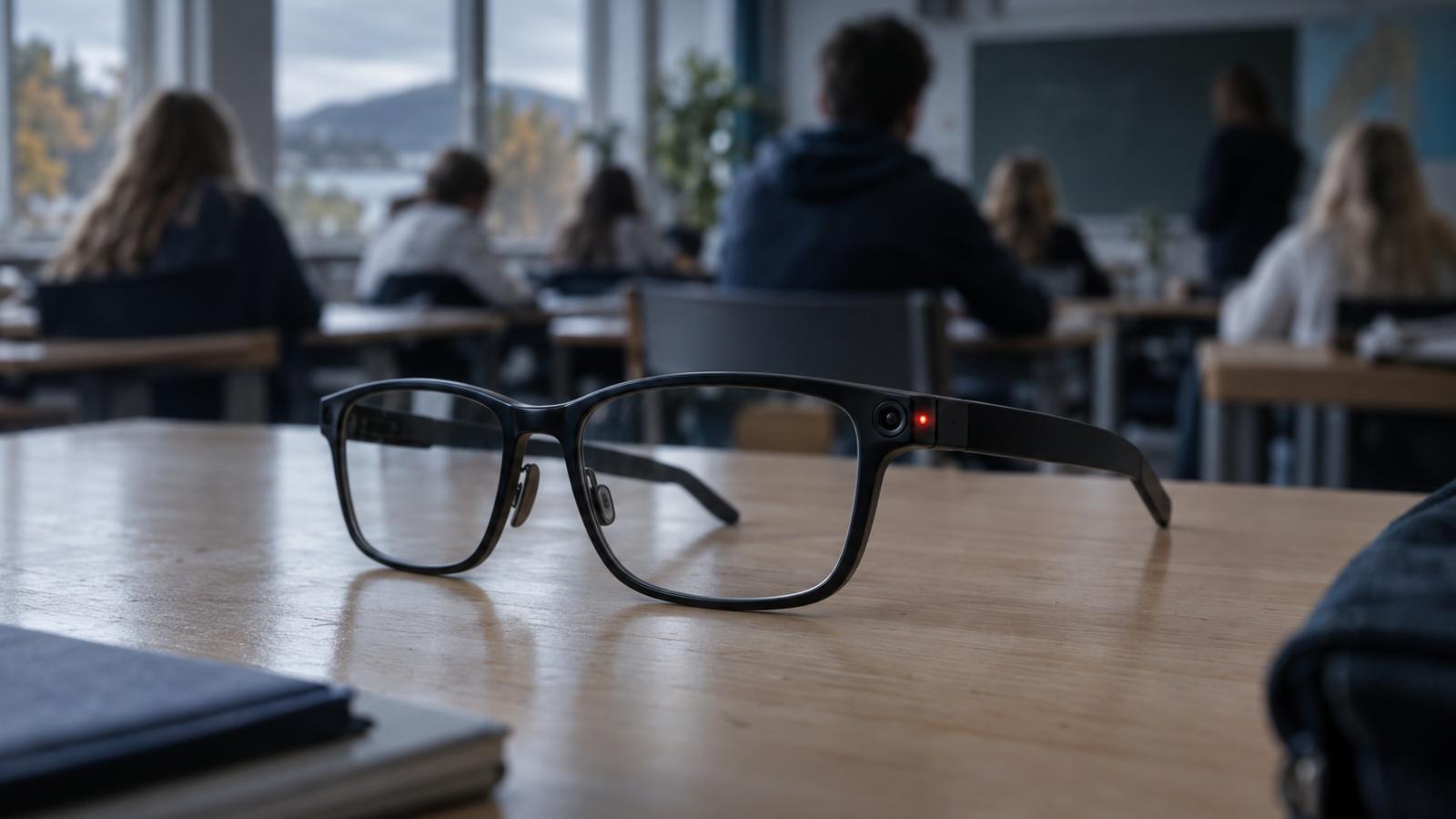
AI glasses are legal to buy and wear in Norway as of October 2026, but on 5 October the government announced it will propose a temporary ban on using them in selected places – such as schools, nurseries, parks and changing rooms. Oslo and Asker have already banned the glasses during the school day, and the Norwegian Data Protection Authority says the same rules apply as when filming with a phone.
- Proposed ban: the government wants a temporary ban on AI glasses in selected places, not an outright ban (5 October 2026).
- No date yet: a bill will come “as soon as possible”. As of 25 October 2026 nothing has been sent out for consultation.
- School bans: Asker bans AI glasses during school and after-school hours; Oslo bans them for the whole school day.
- Filming: the same rules as for a phone camera, according to the Data Protection Authority.
- Parliament: the Socialist Left Party (SV) wants to ban both sale and use; its proposal is with a Storting committee.
- Price: from NOK 2,770 in Meta’s Norwegian online store as of 25 October 2026.
What happened?
Norway’s Minister of Digitalisation and Public Governance, Torgeir Micaelsen (Labour), announced on 5 October 2026 that the government will propose a temporary ban on AI glasses in selected places. His concern: people being photographed, filmed or recorded without knowing it.
Three kinds of places could be covered: places the public visits regularly, such as parks, beaches, museums, shopping centres and events; places for children, such as schools, nurseries, playgrounds and youth clubs; and places where privacy matters most, such as health institutions and gyms with changing rooms and showers. Universities and colleges are also being considered.
The government stresses that it is not planning an outright ban. Private use will remain possible, with exemptions for vulnerable groups and for socially beneficial use in limited cases.
What are AI glasses, and what can they do?
AI glasses are ordinary-looking frames with a built-in camera, several microphones, small speakers and an AI assistant. They pair with a phone and can take photos, record video, make calls and answer questions about whatever the wearer is looking at.
Meta’s glasses are the ones most often cited in Norway. According to Meta’s product page, the latest models have a camera of 12 megapixels or more and record video at up to 3K. The wearer wakes the assistant by saying “Hey Meta”, and a small light on the frame is meant to show when the camera is recording. The Meta Ray-Ban Display adds a small screen in the right lens, but we have not found it on sale in Norway.
In Meta’s Norwegian online store the AI glasses start at NOK 2,770, and Ray-Ban Meta at NOK 5,290 (as of 25 October 2026).
Is it legal to wear AI glasses in Norway today?
Yes. No Norwegian law currently bans AI glasses. In its guidance on smart glasses, published on 1 July 2026, the Norwegian Data Protection Authority (Datatilsynet) puts it simply: filming with smart glasses is like filming with a mobile phone.
Am I allowed to film other people?
As a private individual you are, according to Datatilsynet, generally allowed to film for purely personal use – walking down a high street or through a park, for example. But avoid filming where you would not use your phone, such as hospitals and places of worship.
Sharing is stricter. If you publish footage, the GDPR applies as a rule, and the rule of thumb is to ask the people in it for consent. Sharing footage that is offensive or clearly private is unlawful, and secretly filming people who are undressing can fall under section 298 of the Norwegian Penal Code.
Can the glasses record conversations?
Yes. Datatilsynet points out that smart glasses often have several advanced microphones that pick up background conversations. Secretly recording a conversation you are not part of can be a criminal offence under section 205 of the Penal Code.
Which schools have banned AI glasses?
Asker municipality bans AI glasses during school and after-school hours, treating them as “other private communication devices” under section 5 of its local school regulations. The aim, says the municipality’s director of education Kai Erik Lund, is that pupils and staff can be sure they are not being filmed or recorded without knowing it.
In Oslo the ban covers the whole school day at every level, according to the news agencies NTB and AFP; it was announced on 10 September. “In Oslo, we refuse to allow our children to become extras in Meta’s data collection,” the city’s education commissioner, Julie Remen Midtgarden (Conservative), told AFP.
The education minister, Kari Nessa Nordtun (Labour), has urged every school to ban AI glasses in its rules of conduct, with exemptions for pupils who need them as an aid. It comes on top of Norway’s move to tighten the use of AI in primary schools this autumn.
Can I wear AI glasses at work?
That is up to your employer. As early as 25 August 2026 the government urged public and private organisations to consider their own rules for the glasses. According to NTB, DNB and Equinor are among the companies that have banned them, with Equinor citing risks to information security and the working environment.
Why does this matter for Norway?
The core problem is that people being filmed often do not notice. Karianne Tung, digitalisation minister at the time, warned in August against features such as facial recognition of strangers in public spaces. Meta already uses face technology elsewhere: Facebook wants to scan your face to prove you are human. SV argues in its proposal that the recording light is easily covered, disabled or simply overlooked.
At the same time, the glasses can be a genuine aid. SV’s proposal highlights blind and partially sighted people, who can ask the assistant to describe their surroundings. That is why both the government and SV want exemptions.
What happens next?
The government has promised to bring a bill to the Storting “as soon as possible” but has set no date. It must first decide which technology the ban covers – camera glasses only, or other body-worn devices too.
In parallel, an expert group is to advise on permanent national rules. It was first announced in August, but as of 25 October 2026 neither its members nor a deadline have been made public.
In parliament, SV’s private member’s proposal (Document 8:8 S) is being considered by the Standing Committee on Local Government and Public Administration. SV goes further than the government, seeking a temporary ban on both the sale and the use of body-worn technology that enables covert surveillance.
Frequently asked questions
Are AI glasses banned in Norway?
No, not as of 25 October 2026. The government plans to propose a temporary ban in selected places, but some municipalities, including Oslo and Asker, already ban them during school hours.
Can I post a video I filmed with smart glasses?
Ask the people in it for consent before you publish. Footage that is offensive or clearly private must not be shared.
How can I tell if someone is filming me with AI glasses?
Meta’s glasses have a recording light, but it can be hard to spot, and Datatilsynet notes it may be unclear whether it works.
Will blind and partially sighted people still be allowed to use smart glasses?
Yes. The government wants exemptions for vulnerable groups, and the education minister wants pupils who need the glasses as an aid to be exempt from school bans.