NASA Uses AI to Navigate on Mars
NASA has made history: the Perseverance rover has driven across the Martian surface using artificial intelligence-planned routes instead of human operators. A vision-capable AI analyses the same images as human engineers and makes autonomous navigation decisions.
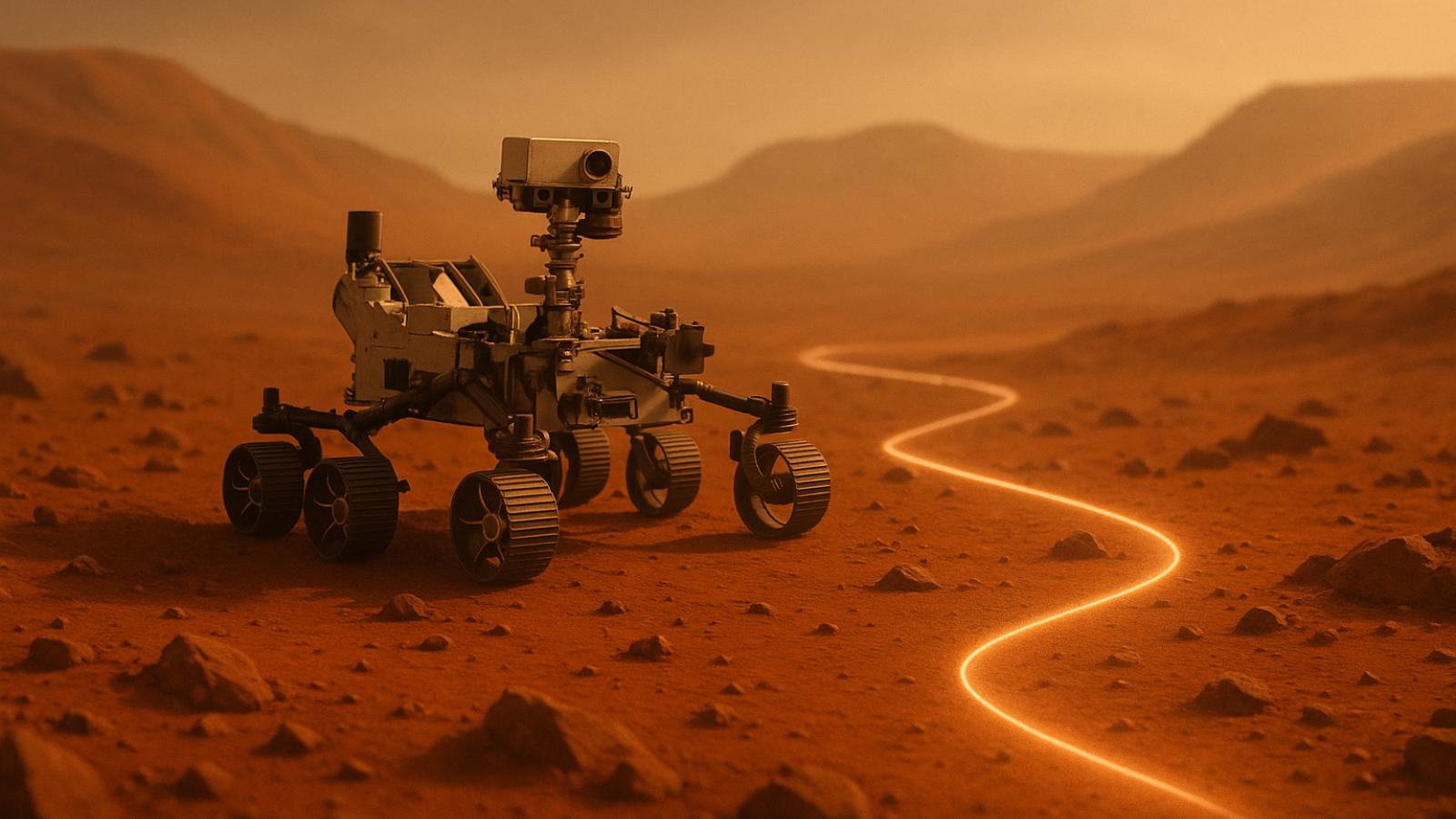
The Perseverance rover drives itself on Mars
NASA has made history: the Perseverance rover has driven across the Martian surface using artificial intelligence-planned routes instead of human operators. A vision-capable AI analyses the same images as human engineers and makes autonomous navigation decisions.
What happened?
On 2 May 2026, Perseverance completed a 150-metre drive on Mars in which:
- AI planned the entire route autonomously
- No human intervention along the way
- Real-time decisions about obstacle avoidance
- 20% faster than traditional human planning
This is the first time a spacecraft has driven an entire trip with full AI autonomy.
How does it work?
Perseverance uses a system called AEGIS-AI (Autonomous Exploration for Gathering Increased Science - AI enhanced):
- Vision - Stereoscopic cameras capture images of the terrain
- Analysis - The AI model identifies:
- Safe routes
- Hazards (cliffs, sand dunes, rocks)
- Scientifically interesting targets
- Planning - The AI generates an optimal route
- Execution - The rover drives autonomously
- Monitoring - The AI monitors and adjusts along the way
Why does this matter?
1. Speed
Human planning takes hours or days. AI does it in minutes.
2. Independence
No waiting for commands from Earth (20 minutes each way).
3. Scaling
With multiple rovers on Mars, AI can handle coordinated autonomy.
4. Future missions
This is a test run for:
- Lunar bases with autonomous vehicles
- Crewed Mars missions
- Deep-space exploration
Norwegian contributions
Norwegian researchers have taken part in this project:
Institute for Energy Technology (IFE)
- Contributed sensor optimisation
- Tested AI algorithms in the Arctic (a Mars-like environment)
University of Oslo
- Research on autonomous navigation in unknown environments
- Contributed to obstacle detection algorithms
Kongsberg Gruppen
- Supplied communication systems for AI rovers
Professor Erik Sandewall at the University of Oslo says:
"This is proof that AI can operate in the most demanding environments we can imagine. If it works on Mars, it can work anywhere."
Technical details
Hardware:
- Radiation-hardened processor (200 MHz)
- Stereoscopic cameras (12 MP)
- LIDAR system for depth sensing
- Redundant AI models (safety)
Software:
- Custom neural network for terrain classification
- Real-time path planning algorithms
- Fault detection and recovery systems
Batteries:
- Radioisotope thermoelectric generator (RTG)
- 110W continuous power
- 14+ year lifespan
Future applications
Space exploration
- Mars bases - Autonomous construction robots
- Lunar missions - The Artemis programme with AI
- Uranus/Neptune - Autonomous probes
Earth-based
- Deep-sea research - Autonomous underwater vehicles
- Disaster response - AI robots in dangerous environments
- Environmental monitoring - Autonomous sensor networks
Challenges
Despite the success, there are limitations:
- Bandwidth - Limited data transfer from Mars
- Power - The RTG has a limited lifespan
- Radiation - Electronics must be radiation-hardened
- Error handling - No "reboot" if something goes wrong
What does this mean for AI research?
This is a "Wright Brothers moment" for autonomy:
- Proof of concept - AI can operate in extreme environments
- Verification - Algorithms tested in real-world conditions
- Standardisation - A new benchmark for autonomy research
Professor Lars Mathiassen at NTNU believes:
"This is more important than many people think. It shows that AI is not just an 'office tool'. It can handle complex, physical tasks in unknown environments."
Norwegian research opportunities
Norway should invest in:
- Autonomy research - University programmes
- Space technology - ESA collaboration with an AI focus
- Deep-sea technology - Autonomous underwater systems
- Environmental monitoring - AI for climate research
Conclusion
When Perseverance drives autonomously on Mars, it is not just a triumph for space exploration. It is proof that artificial intelligence has matured enough to handle the most demanding tasks we can give it.
The question is no longer "can AI be trusted?" but "how far can we let AI go?"
Sources:
- NASA JPL Official Release (May 2, 2026)
- ScienceDaily: "NASA's Perseverance rover has just made history"
- Interviews with Norwegian researchers