The Robot Year of 2026: The Machine in Your Living Room Can Be Controlled by a Stranger
In 2026 humanoid robots left the demo videos behind and started working for money — on factory floors, in warehouses and, for the first time, in ordinary homes. The Norwegian robot NEO is furthest along toward the living room, but behind its friendly facade sit humans who can look straight into your home.
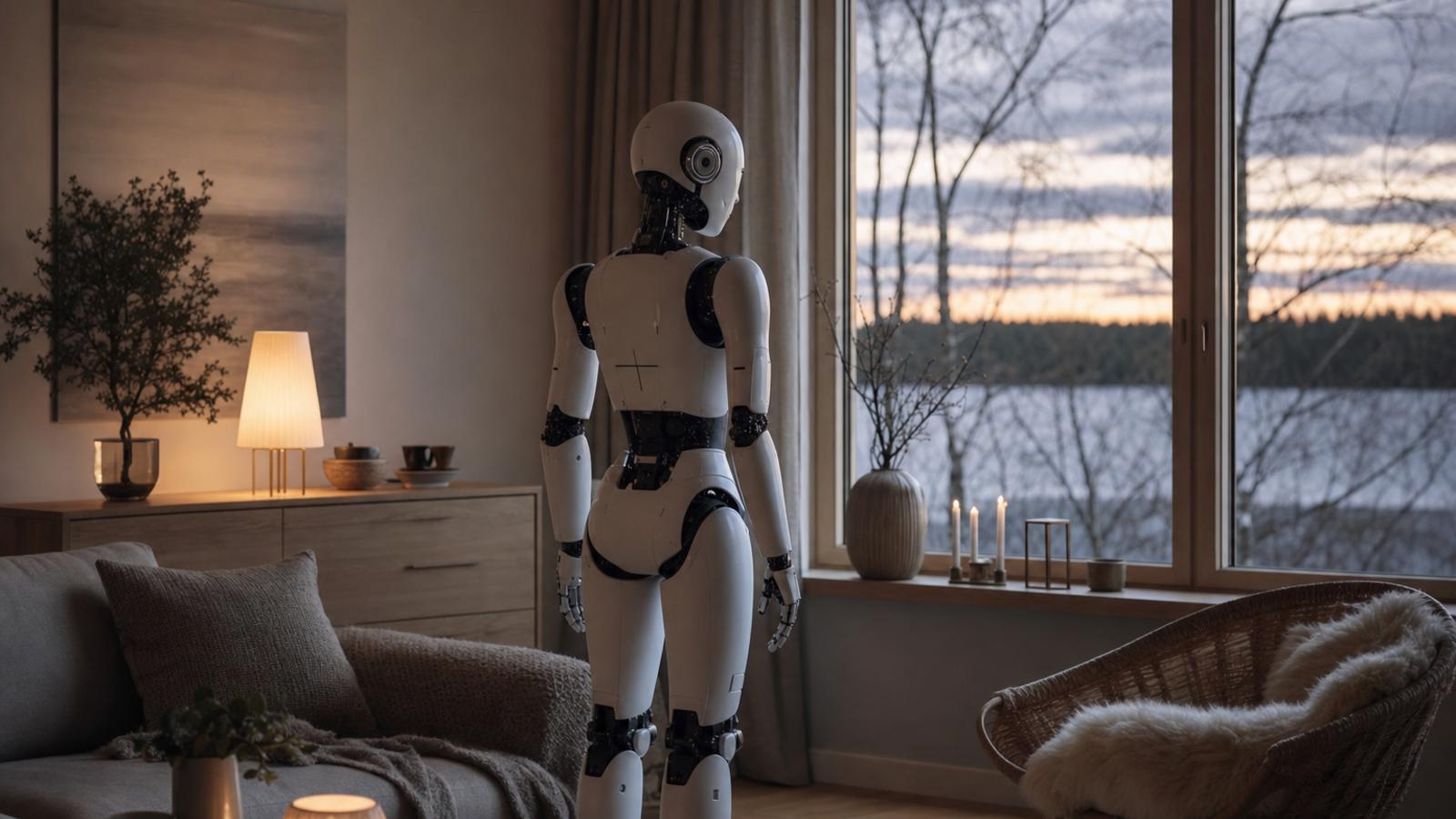
For years, humanoid robots were something you watched on a screen: polished demo videos of a machine folding a sweater or dancing to music, always with a nagging suspicion that the camera had been stopped and started a dozen times. The story of humanoid robots in 2026 is a different one. The robots have started to work — for real money, on real factory floors — and for the first time, an ordinary consumer can pre-order one for the living room. The turning point is here. But it looks rather different from what Silicon Valley promised.
And the most consumer-facing machine in the entire field is Norwegian. That gives the year's robot story a sharp edge: the robot closest to moving in with you is only partly autonomous — and leans on humans somewhere else who can look straight into your home.
From demo video to paid work
The clearest proof that 2026 is the real turning point is found not in a launch video but in an operating ledger. BMW reported that its Figure 02 robot supported the production of more than 30,000 X3 vehicles over roughly ten months at its Spartanburg plant, handling over 90,000 components across some 1,250 operating hours. The automaker is now scaling the successor Figure 03 into logistics and starting its first humanoid pilots at its German plants. This is not a demonstration. It is shift work.
Amazon, GXO, Toyota and Mercado Libre are in the same queue. Agility Robotics, which builds bipedal warehouse robots, has already booked more than $300 million in multi-year "robots-as-a-service" contracts — roughly a thousand machines out with customers. The question is no longer whether the robots can do useful work, but how fast they can be built.
NEO: the Norwegian robot that wants into your home
This is where Norway enters. 1X Technologies — founded in Moss as Halodi Robotics by Bernt Børnich, today with manufacturing both in Hayward, California and in Moss — has done something no one else has dared: marketed a humanoid directly to consumers as a home robot for the private market. The robot is called NEO, costs $20,000 outright or $499 a month, and the first deliveries in the US and Canada are expected in the second half of 2026.
Interest has been formidable. 1X kicked off full-scale production after gathering 10,000 pre-orders in just five days, and the company is aiming for a production rate of 100,000 units a year by the end of 2027. For a firm with Norwegian roots, that is a remarkable position: while American and Chinese giants fight over the factory floor, the Norwegians have taken aim at the hardest room of all — your own.
The catch: a stranger can look into your living room
Then comes the caveat, and it is a big one. At launch, NEO is only around 60–70% autonomous. For anything complicated — clearing a cluttered kitchen counter, handling an unexpected situation — the robot switches into an "Expert Mode" in which a human teleoperator takes over. The operator steers the machine through VR goggles and literally sees through the robot's cameras. In other words: for your robot to learn to fold your laundry, an employee somewhere else in the world can look into your home.
This is a privacy debate straight out of the textbook. A continuous video stream from the most private rooms of a home, transmitted to a third party, is exactly the kind of processing of personal data that the GDPR was built to regulate — and that Norway's Data Protection Authority, Datatilsynet, will have to reckon with. Who are the operators? Where are the recordings stored? What happens when the neighbour, the child or the guest who never consented walks past in the background? Even with technical no-film zones and consent flows, the basic premise stands: the most domestic robot in the world is also the most intimate surveillance camera you can voluntarily let inside.
The timing is brutal. Norway is implementing the EU's AI Act through its own AI law, with key provisions expected from around August 2026 — among them a transparency duty (Article 50) requiring people to be told when they interact with artificial intelligence. A robot that shifts seamlessly between autonomous AI and a hidden human operator lands precisely in the legal grey zone the new rules are meant to clean up.
Tesla Optimus: the promises that slipped again
While 1X delivers, Tesla keeps postponing. On its 22 April earnings call, Elon Musk said Optimus production would only begin at the Fremont plant "late July or August" 2026, and that it would be "quite slow." Musk called the production rate "literally impossible to predict" given the robot's roughly 10,000 unique parts, and admitted the first units are "primarily for learning, not productive tasks." Tesla has missed every single Optimus timeline it has set since 2021. The contrast with the actual delivery figures from BMW and the Chinese makers is telling: hype is not the same thing as production capacity.
China mass-produces — and goes public
It is in China that the volumes truly materialise. Unitree — a rare profitable humanoid maker — won approval for an IPO on Shanghai's STAR Market at a valuation of around $6.2 billion, raising some $618 million. Unitree is aiming to ship up to 20,000 humanoids in 2026, up from around 5,500 the year before.
In the same window, UBTech launched its UWORLD U1, billed as the world's first full-size, mass-produced "ultra-bionic" humanoid. The price is around $17,600, and the company drew more than 13,300 orders on launch day, with a production target above 10,000 units in 2026. Where Tesla talks about robots for "learning," Chinese makers are taking tens of thousands of actual orders. Morgan Stanley doubled its 2026 forecast for Chinese humanoids to around 28,000 units and expects the price per machine to fall from about $50,000 toward roughly $21,000 — a price curve pointing straight at the mass market.
The West bets on the factory floor and the brain
The West's answer is twofold: capital and "brains." Figure AI, the company behind the robot on the BMW floor, raised more than $1 billion in a Series C at a staggering $39 billion valuation — a fifteen-fold jump from $2.6 billion as recently as February 2024. Agility Robotics is going public via a SPAC merger at around $2.5 billion, the largest capital raise in humanoid history.
But the real bottleneck has moved. Getting a robot to walk is largely solved; the hard part now is the hands and the brain — fine motor control and judgment. Here Nvidia has positioned itself as the "physical AI" supplier, the arms dealer of the whole industry. The company offers open humanoid foundation models in its Isaac GR00T line, a Jetson Thor computer to run them onboard the robot, and an open reference design. The strategy is to sell picks and shovels to everyone digging for gold — no matter who ultimately wins the robot race.
How much is hype?
Here it is worth taking a breath. Wall Street's numbers diverge so wildly that the spread itself tells a story of deep uncertainty:
- Goldman Sachs: a global humanoid market of $38 billion by 2035.
- Morgan Stanley: a combined ecosystem of up to $5 trillion by 2050.
- Nvidia's Jensen Huang: a market worth around $40 trillion.
From $38 billion to $40 trillion is three orders of magnitude — the difference between an interesting niche and an upheaval of the entire world economy. The sober voice came from someone who should know better than most. Peggy Johnson, CEO of Agility Robotics — a company that actually earns money from robots today — is blunt about the timeline for the home:
Humanoids in the home are "ten-plus years" away.
It is a striking admission from an industry that sells the future: the very week NEO is taking pre-orders for the living room, one of the most experienced players warns that the real home breakthrough lies far off.
Toward 2030: the factory first, the living room last
The direction for the rest of the decade is coming into focus, and it is less glamorous than the demo videos suggested. The bridgehead is not the living room but the warehouse and the car plant — structured, predictable environments where a robot can earn its keep without having to understand the chaos of a human home. That is where the money is made, and where the machines learn.
At the same time, a geopolitical divide is hardening: China mass-produces cheaply and lists on the stock market at pace, while the West bets on valuations, foundation models and factory contracts. Two different roads to the same destination. And for those of us who will eventually share our homes with these machines, it is the least cinematic questions that matter most: Who sees through the robot's eyes? Where do the recordings end up? And what happens to jobs when a $17,600 machine can work shifts all year round? NEO is coming to your living room long before the answers are in place. That is what makes the robot year of 2026 both so exciting and so unsettling.