390 cosmic collisions: how scientists listen to black holes
Scientists have now captured 390 collisions between black holes and neutron stars – the largest gravitational-wave catalogue ever assembled. Here's how we 'hear' the universe.
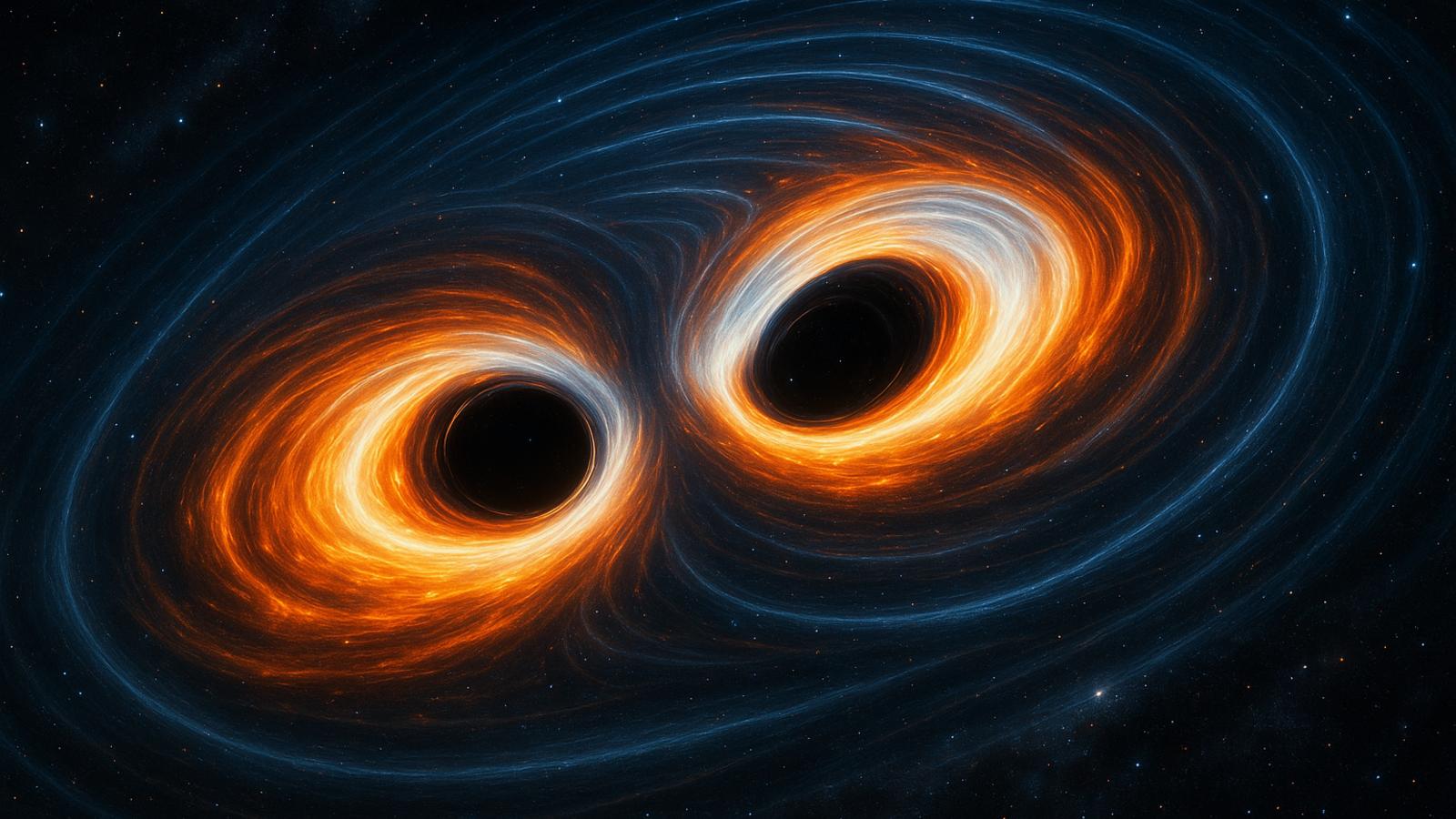
When two black holes merge somewhere far out in the universe, they send a tremor through space itself. The tremor spreads outward at the speed of light, and by the time it finally reaches Earth it is so faint that it moves an instrument by less than the width of a proton. Yet scientists manage to catch it. With the newest catalogue of such gravitational waves, they have now recorded 390 collisions – the largest collection ever assembled.
The catalogue, called GWTC-5, was presented earlier this year by the international collaboration between the LIGO, Virgo and KAGRA detectors. It contains 161 entirely new events and marks the moment gravitational-wave astronomy went from rare sensation to something approaching routine.
Ripples in space itself
Gravitational waves are ripples in time and space. Albert Einstein predicted them back in 1916 as a consequence of the general theory of relativity, but he believed they were far too weak to ever be measured. He was wrong. On 14 September 2015 the LIGO detectors caught, for the first time, the signal from two black holes colliding – a discovery that won the 2017 Nobel Prize in physics and opened an entirely new window on the universe.
Where ordinary telescopes collect light, these detectors "listen" to the vibrations of space. LIGO consists of two facilities in the United States, Virgo sits outside Pisa in Italy, and KAGRA is dug into a mountain in Japan. Together they form a global ear that can pull a single cosmic collision out of the background noise.
390 collisions – and ever more
When the first signals arrived, every one of them was world news. Now they come thick and fast. The new events in the catalogue were captured between April 2024 and January 2025, and after a series of upgrades – and after Virgo was switched back on in 2024 – the detectors now record as many as three to four signals per week. In total, the collaboration has now confirmed around 390 events since 2015.
"Nearly 400 gravitational-wave events have ushered us into a new era of statistical astronomy," says Leo Tsukada, a researcher at the University of Nevada, Las Vegas.
His point matters: with so many events, scientists can stop studying collisions one by one and instead look for patterns across hundreds of them.
The most spectacular signals
Some events still stand out. The signal GW240615, from June 2024, gave the most precise position ever – scientists managed to pin the source down to a patch of just six square degrees of sky. There, two black holes of around 26 and 30 times the mass of the Sun collided, more than three billion light-years away.
Another signal, GW250114 from January 2025, was the clearest ever, with two black holes of 32 and 34 solar masses. And in two events from the autumn of 2024, scientists found signs of "second-generation" black holes – black holes that are themselves the product of earlier mergers. It is like discovering that some of the giants out there have a family history.
What do the waves tell us?
Gravitational waves are not just a spectacle. They have become a measuring instrument. By using the collisions as cosmic distance markers, scientists can work out how fast the universe is expanding – the so-called Hubble constant – in a completely independent way.
"Using gravitational-wave sources, we obtain an independent measurement of the Hubble constant with about 25% improved precision," says Hsin-Yu Chen, a researcher at the University of Texas at Austin.
On top of that, the waves map how many black holes exist and how heavy they are, and they provide ever stricter tests of Einstein's theory. So far, it passes every single time.
Black holes are not the only thing the waves catch. The detectors also register collisions between neutron stars – extremely dense remnants of burnt-out stars – and it was precisely such a collision that, in 2017, was observed for the first time both as gravitational waves and as light. That event confirmed that elements such as gold and platinum are created when such stars merge. The waves thus tie the most violent events in the cosmos directly to the matter we surround ourselves with on Earth. And the list of discoveries will only grow: new and far more sensitive facilities are being planned, both on the ground and out in space, where they will be able to catch waves from even more distant and ancient collisions.
A new window on the universe
For centuries, astronomy meant collecting light. Gravitational waves have added an entirely new sense. Where light tells us what the universe looks like, the waves tell us how it moves – how the heaviest things in the cosmos collide and merge. It complements the exploration being done with rockets and telescopes, from this year's major space projects to the way NASA uses artificial intelligence to navigate on Mars.
With 390 recorded collisions, gravitational-wave astronomy is no longer a promise but a working tool. The details of the new catalogue have been published by the LIGO collaboration and covered by outlets including the Simons Foundation. The next step is even more sensitive detectors – and a universe that grows a little less silent with every passing year.