The Space Year 2026: humans around the Moon and the hunt for dark energy
The world's largest camera has begun filming the entire sky, four humans flew around the Moon for the first time since 1972, and fresh data are making dark energy wobble. These are the big discoveries and missions of the 2026 space year.
The middle of 2026 will be remembered as a turning point for observational astronomy. In the space of a few months, the world's largest digital camera has begun filming the entire southern sky night after night, four humans have flown around the Moon for the first time in more than half a century, and the James Webb Space Telescope has pushed back the frontier of how far into the past we can see. At the same time, something is stirring in the foundations of physics: new data hint that dark energy — the force driving the universe apart — may not be constant after all. This is spaceflight in 2026, a year already on course to become the busiest in the history of spaceflight.
The Vera Rubin Observatory awakens astronomy
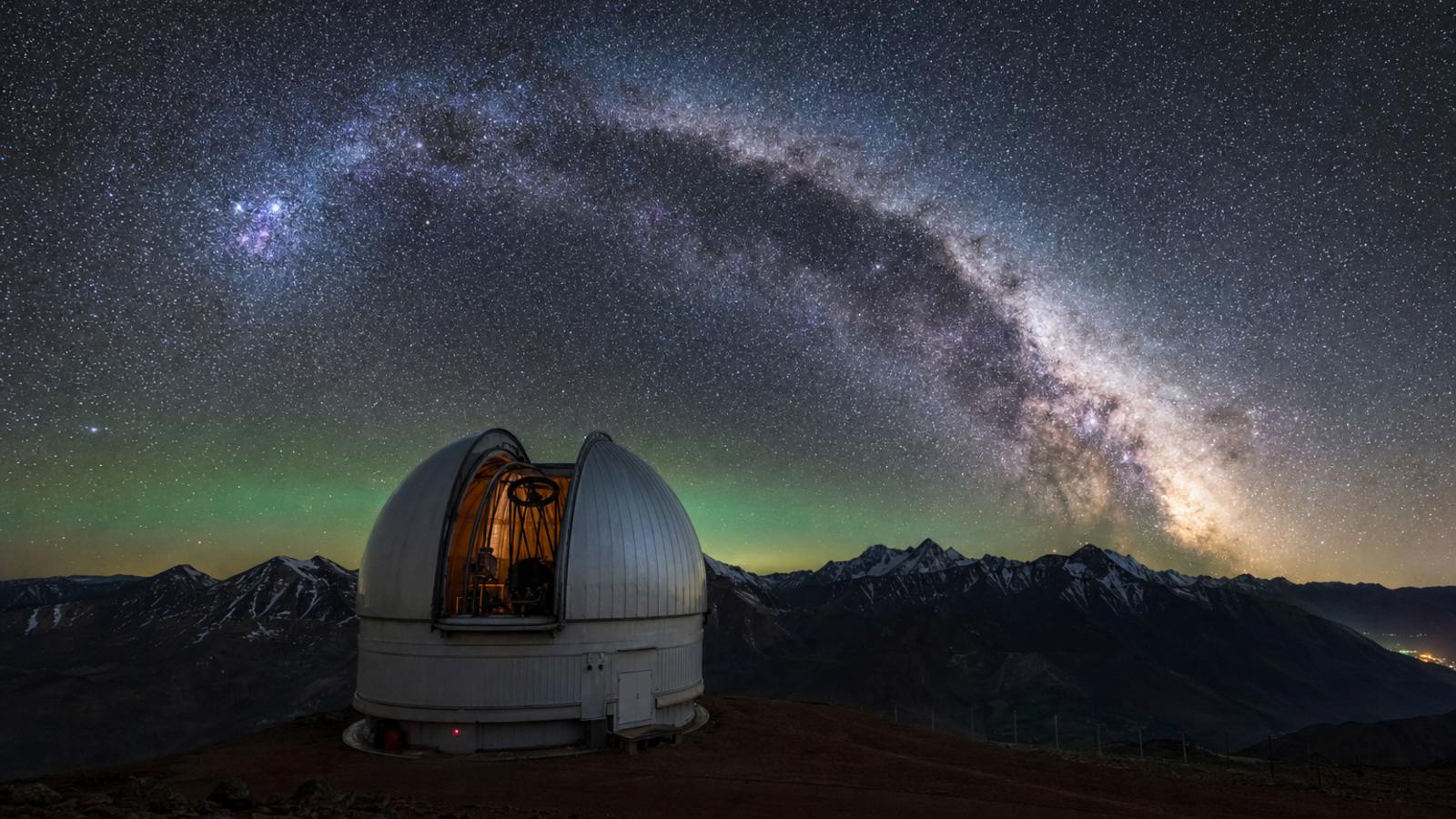
On 30 June 2026, the Vera C. Rubin Observatory officially began its ten-year survey, the Legacy Survey of Space and Time (LSST). From a mountaintop in Chile, the telescope will photograph the entire southern sky in just a few nights — and then do it again, and again, for ten years.
At the heart of the observatory is a 3,200-megapixel camera, the largest digital camera ever built. Each night it takes around 1,000 images, produces roughly 10 terabytes of data, and issues up to 7 million alerts about objects that have changed since the last time the same patch of sky was imaged. It is a flood of information without precedent in the history of astronomy.
The power of the method was obvious even before the official start. From only about a month and a half of early data, Rubin discovered more than 11,000 previously unknown asteroids, including 33 near-Earth objects and around 380 trans-Neptunian objects far out in the solar system. It was the single largest batch of asteroid discoveries submitted to the Minor Planet Center in a year. Now that the telescope is running at full tilt, that number will only grow.
Artemis II: humans around the Moon for the first time since 1972
While the robots mapped the sky, humans once again ventured into the great dark. Between 1 and 11 April 2026, NASA's Artemis II crew flew around the Moon — the first crewed lunar mission since the Apollo era ended in 1972.
Astronauts Reid Wiseman, Victor Glover, Christina Koch and Jeremy Hansen travelled a path that carried them 406,000 kilometres (252,756 miles) from Earth. That is the farthest distance humans have ever travelled from their home world — a record that beats the Apollo missions. The Orion capsule splashed down safely off the coast of California on 10 April.
Artemis II did not land on the Moon; it was a round trip, a test of the capsule, its life-support systems and the crew before the next step. But symbolically the journey marked that humanity has once again left low Earth orbit — and that a new race to the Moon is under way.
James Webb rewrites the early universe
The James Webb Space Telescope continued in 2026 to deliver discoveries that force new textbooks. Astronomers used Webb to build the largest and sharpest dark-matter map made with the telescope so far, in the constellation Sextans. The map contains about ten times more galaxies than ground-based maps and twice as many as Hubble managed over the same patch of sky, tracing how invisible dark matter has shaped the distribution of galaxies.
Webb also looked further back in time than almost anything else. The telescope caught an unexpected collision of at least five galaxies just around 800 million years after the Big Bang — far earlier than models predicted galaxies would merge. And the record-holder MoM-z14, Webb's most distant confirmed galaxy, sits at a redshift of z=14.44, seen just about 280 million years after the Big Bang.
Dark energy: physics' biggest puzzle right now
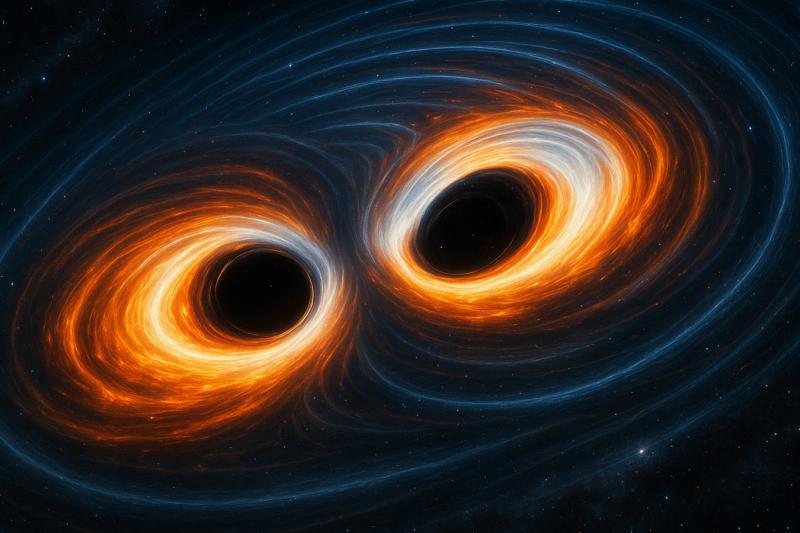
The most startling story of 2026 is not about a single object, but about the fate of the universe itself. Data from the Dark Energy Spectroscopic Instrument (DESI), combined with supernova catalogues and the cosmic microwave background, continue to suggest that dark energy may be weakening over cosmic time — rather than being the constant force that standard cosmology is built on.
If confirmed, it would be one of the biggest upheavals in modern physics. Dark energy is the dominant component of the cosmos, and our entire model of the universe's evolution — and its future — rests on the assumption that it is constant. A dark energy that fades would mean the universe expands differently than we thought, and that the distant future may look nothing like today's textbooks say.
If the weakening is confirmed by DESI's next major data release, DR3, later in 2026, standard cosmology will have to be rewritten. At the same time, some researchers urge caution: consistency checks in 2026 are a reminder that the signal could still turn out to be a statistical mirage.
Andøya: Europe's gateway to space
Norway has landed a leading role in European spaceflight. Andøya Spaceport is the first orbital launch base on the European mainland — the place where Europe can finally send satellites into orbit from its own mainland, without depending solely on foreign launch sites and rockets.
But Andøya also illustrates just how brutally hard it is to reach orbit. The German rocket maker Isar Aerospace, which launches from Andøya, saw its second launch postponed again and again through the first half of 2026 — from January all the way to June. A rocket launch is an exercise in patience, where weather, engineering and safety must all align at once. For Norway the stakes are high: a working base at Andøya gives the country a seat in a space race long reserved for the great powers.
A busy autumn: Roman, BepiColombo, Hera and Starship
Autumn 2026 is unusually packed. Among the highlights:
- The Nancy Grace Roman Space Telescope — NASA's next flagship observatory arrived at Kennedy Space Center on 21 June and is scheduled to launch on a SpaceX Falcon Heavy around 30 August, roughly eight months ahead of its original deadline. Its 288-megapixel camera produces images about 200 times larger than Hubble's at comparable sharpness.
- Hera — ESA's spacecraft is on its way to the Didymos-Dimorphos binary asteroid in November, about a month ahead of schedule, to turn NASA's 2022 DART impact into a fully characterised planetary-defence technique.
- BepiColombo — the joint ESA-JAXA probe will finally enter orbit around Mercury on 30 November, after a thruster fault in 2024 added about eleven months to the journey.
- Starship — SpaceX launched Flight 12 on 22 May, the debut of the taller and more powerful V3 version with Raptor 3 engines. The company is still aiming for a first uncrewed Starship flight to Mars in the late-2026 window — something Elon Musk himself calls ambitious.
3I/ATLAS: the third guest from another star
From the depths of space came a rare visitor as well. Comet 3I/ATLAS is only the third interstellar object ever observed — after 1I/’Oumuamua in 2017 and 2I/Borisov in 2019 — an object born around another star that is merely passing through our solar system.
The Subaru Telescope studied the comet on 7 January 2026 to measure its carbon-dioxide-to-water ratio, and 3I/ATLAS became the first interstellar comet ever detected in X-ray light, using the XRISM and XMM-Newton space telescopes. Despite speculation about something more exotic, the object behaves as a completely natural comet. That makes it no less valuable: every interstellar guest is a sample from an alien planetary system, delivered free to our own backyard.
Toward 2030: the survey era and the new race to the Moon
What ties 2026 together is the transition to a new epoch — the survey era, in which telescopes like Rubin and Roman no longer study one object at a time but the whole sky at once. 2026 is expected to become the busiest year in spaceflight history, with more than 250 orbital launches globally.
Cosmology's verdict could come quickly: if the weakening of dark energy holds up, a revision of the standard model could arrive as early as 2028–2029. The crewed race to the Moon, by contrast, is moving more slowly than the grand visions promised. Artemis III has been redefined as a low-Earth-orbit demonstration in late 2027, while the first crewed lunar landing has slipped to Artemis IV in early 2028. Meanwhile China is aiming resolutely for its own crewed Moon landing by 2030.
Whoever lands first, the middle of 2026 marked that humanity is once again lifting its gaze toward the Moon — while, with a flood of data from mountaintops and space telescopes, we can finally begin to ask the very biggest questions about the universe itself.