Northern lights season 2026/27: why the next two winters could be the best in over 20 years – and how to see the aurora, even from southern Norway
Solar cycle 25 peaked in autumn 2024 – and it is the winters after the peak that bring the most aurora nights. Last season had more storm days than any since 2003. Here are the numbers, the forecasts, the best dates, places, apps and photo tips.
Norway's biggest daily, VG, summed up the winter in January in one line: "Not in 22 years have we had as much aurora as now." The numbers behind the headline are remarkable: in the season just ended, September 2025 to April 2026, the Earth had 52 days of geomagnetic storm – nights when the northern lights reached far south of northern Norway – against 35 in the best season of the previous solar cycle. That is the most since the winter of 2003/04. And according to the solar physicists, it is precisely now, one to two years after solar maximum, that it gets best. Here is why, what the last two years have actually delivered, how to read the forecasts, the best dates this winter – and how to see the aurora even from Oslo.
The Sun has passed its peak – and that is good news
NASA and NOAA declared on 15 October 2024 that the Sun was in the solar maximum of cycle 25. In hindsight the peak has been fixed at October 2024, with a smoothed sunspot number of 161 – well above the 105–125 the expert panel had forecast in 2019. Activity is now on the way down: September 2026 was the quietest month since January 2022, and NOAA's prediction points further down towards a minimum around 2030.
So why do scientists expect more aurora? Because the two phenomena that produce it follow different calendars. The violent storms come from solar eruptions (coronal mass ejections) and track the sunspots. The many steady aurora nights come instead from coronal holes – openings in the Sun's magnetic field that release high-speed wind – and these are at their most effective in the years after maximum. A 2022 study in the Journal of Geophysical Research confirms the pattern for recent cycles: large and moderate coronal-hole storms cluster in "the early declining phase". The classic example is the Halloween storms of 2003, which came three years after the 2000 peak and produced aurora over Texas and the Mediterranean.
"A year ago we passed the peak of this cycle. It is one to two years after solar maximum that we usually get the strongest aurora. Both this season and the next will probably be even better." – Pål Brekke, Norwegian Space Agency, to ABC Nyheter, 31 October 2025
One caveat belongs here: the cycle's strongest storm, on 10–11 May 2024, came five months before the peak. What the next winters promise is more nights with aurora – not necessarily a repeat of May 2024.
What the last two years have delivered
- 10–11 May 2024, G5: the cycle's biggest storm and the strongest since 2003. Aurora over Kristiansand, Tønsberg and Oslo on Norway's south coast – and as far south as Portugal and Sardinia.
- 10–11 October 2024, G4: aurora over Oslo, Bergen and Rogaland.
- 1 January 2025, G4: "Tonight the whole country could see the northern lights," Brekke told NRK.
- 12–13 November 2025, G4: the peak hit in Norwegian daylight under cloud, but the following night the aurora was seen across the whole country – and as far south as Italy. Brekke: "The Sun is very active, and we have to go almost 20 years back to find similar activity."
- 19–20 January 2026, G4: just below the G5 threshold, with aurora from Brittany to Romania and, at the same time, the largest radiation storm in more than 20 years.
- 20–22 March 2026, G3: the equinox storm, seen across southern Norway.
There has been no G4 storm since 20 January, and autumn 2026 has started quietly: three storm days in September and early October, against ten in the same period last year. That is normal variation – a quiet Sun can wake up within a week – and NOAA's 27-day outlook already flags 21–22 and 31 October for a recurring coronal hole.
How to read an aurora forecast
Everything revolves around the Kp index, a 0-to-9 measure of how disturbed the Earth's magnetic field is. The auroral oval moves roughly two degrees of latitude southward for each step, and you see the lights low in the north long before the oval is overhead. Rules of thumb for Norway:
- Tromsø, Alta, Lofoten: Kp 0–2 is enough. Here there is aurora on most clear nights in season.
- Trondheim: Kp 3–4.
- Oslo, Bergen, the south coast: Kp 5 and up – what NOAA calls a G1 storm.
- Central and southern Europe: Kp 7 and up.
Forecasts come in three steps. The 27-day outlook catches the coronal holes, which rotate with the Sun and return every four weeks – "coronal holes are the aurora tourist's best friend," Brekke says, "then you have seven, eight, nine days to book a trip north." The three-day forecast gives Kp hour by hour. And the 30-minute forecast is based on the solar wind measured by satellites 1.6 million kilometres out in space – the time the wind takes from there to Earth. The decisive number there is Bz: when the solar wind's magnetic field points south (negative Bz), it couples to the Earth's field and the sky lights up. The best hours are between 22:00 and 02:00, and the equinoxes are the best season – a magnetic-geometry effect first noticed in 1856; March has nearly twice as many storm days as June or July.
The best dates this winter
The aurora does not care about the Moon, but your eyes do: a full moon washes out everything but the strongest displays. Plan around the new moon, give or take five days:
- New moons: 10 October, 9 November, 9 December 2026; 7 January, 6 February, 8 March and 6 April 2027.
- Best combined window: 3–13 March 2027 – new moon, equinox and still fully dark nights in Tromsø. Runner-up: 2–12 February 2027.
- Polar night in Tromsø: the Sun stays below the horizon from 28 November to 14 January. The aurora can then be seen from early afternoon. From early April Tromsø no longer gets astronomically dark, so the season effectively runs from September to late March.
- Clouds: Tromsø is on the coast, and in December the sky is overcast or mostly cloudy about 80 percent of the time. That is why the inland – Alta, Lyngen, inner Troms – is so often recommended as the fallback when the forecast is good but the clouds hang on.
Where in northern Norway?
Tromsø remains the hub – airport, hotels, guides, and the city sits right under the oval. But it has become crowded: more than 1.3 million commercial overnight stays in 2025, nearly 2.9 million airport passengers and around 4,000 Airbnb units. In June the municipal council adopted a plan for a three percent visitor levy on overnight stays from 1 January 2027, now awaiting ministry approval. The hospitality association NHO Reiseliv says it will mean "lost revenue, fewer jobs and lower value creation"; the municipality replies that tourists who stay longer are "more sustainable, environmentally and economically". Visit Norway itself now steers visitors towards autumn and towards Alta, Lyngen and Senja.
Alta has the history: it was here that Kristian Birkeland had the Haldde observatory built at 904 metres in 1899, the world's first northern lights observatory. Lyngen and Senja offer alpine peaks and dark beaches two to three hours from Tromsø. Lofoten and Vesterålen are often combined with whale watching, Narvik with alpine skiing, and Bodø is an up-and-coming destination with its own international airport – the town sits right on the southern edge of the oval on a quiet night. Kirkenes offers calm and little light pollution. And Svalbard is the only inhabited place where you can see the aurora at midday: during the polar night from mid-November to late January it never gets light.
Traffic is at record levels. Northern Norway had 5.6 million guest nights in 2025, up six percent, and February 2026 was the best February ever with 418,516 overnight stays – 15 percent more than the year before, and 29 percent more foreign guests. The foreign aurora tourist spends, according to Innovation Norway, 2,780 kroner a day, stays nine nights and leaves 25,000 kroner per trip; nearly four in ten come from outside Europe.
Aurora from southern Norway – it can be done
If you live in Oslo or Bergen you need Kp 5 or more – and that happened on more than 50 nights last season. Then three things matter: get away from city lights, find a horizon that is dark to the north, and be patient. Brekke's own Oslo tips are Bogstad golf course, Sørkedalen, Maridalen and Sognsvann and Ingierstrand; nordlysvarsel.no adds Nordmarka, Holmenkollen and Hurum. His test is simple: if you can see the faint stars, you are somewhere dark enough to see the aurora too. On the strongest nights not even that is needed: last December the northern lights were photographed from Voldsløkka in central Oslo.
What you are actually looking at
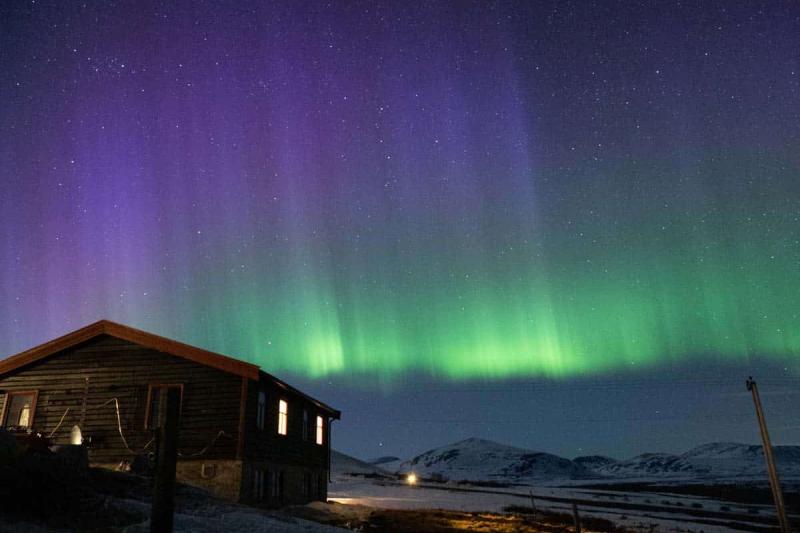
The colours tell you the altitude. The green light, the most common, comes from oxygen atoms 100–200 kilometres up. The red comes from oxygen above 200 kilometres, where the air is so thin that atoms get up to two minutes to glow before colliding with anything. Blue and purple come from nitrogen, often at the lower edge of the curtains. A geomagnetic storm expands the whole oval – which is why the south coast sees aurora when the Sun is noisy. And the mauve streaks many people have photographed far south in recent years? That is STEVE, which scientists established in 2019 is not aurora but a 25-kilometre-wide ribbon of plasma at 3,000 degrees streaming past at an altitude of 450 kilometres.
How to photograph it
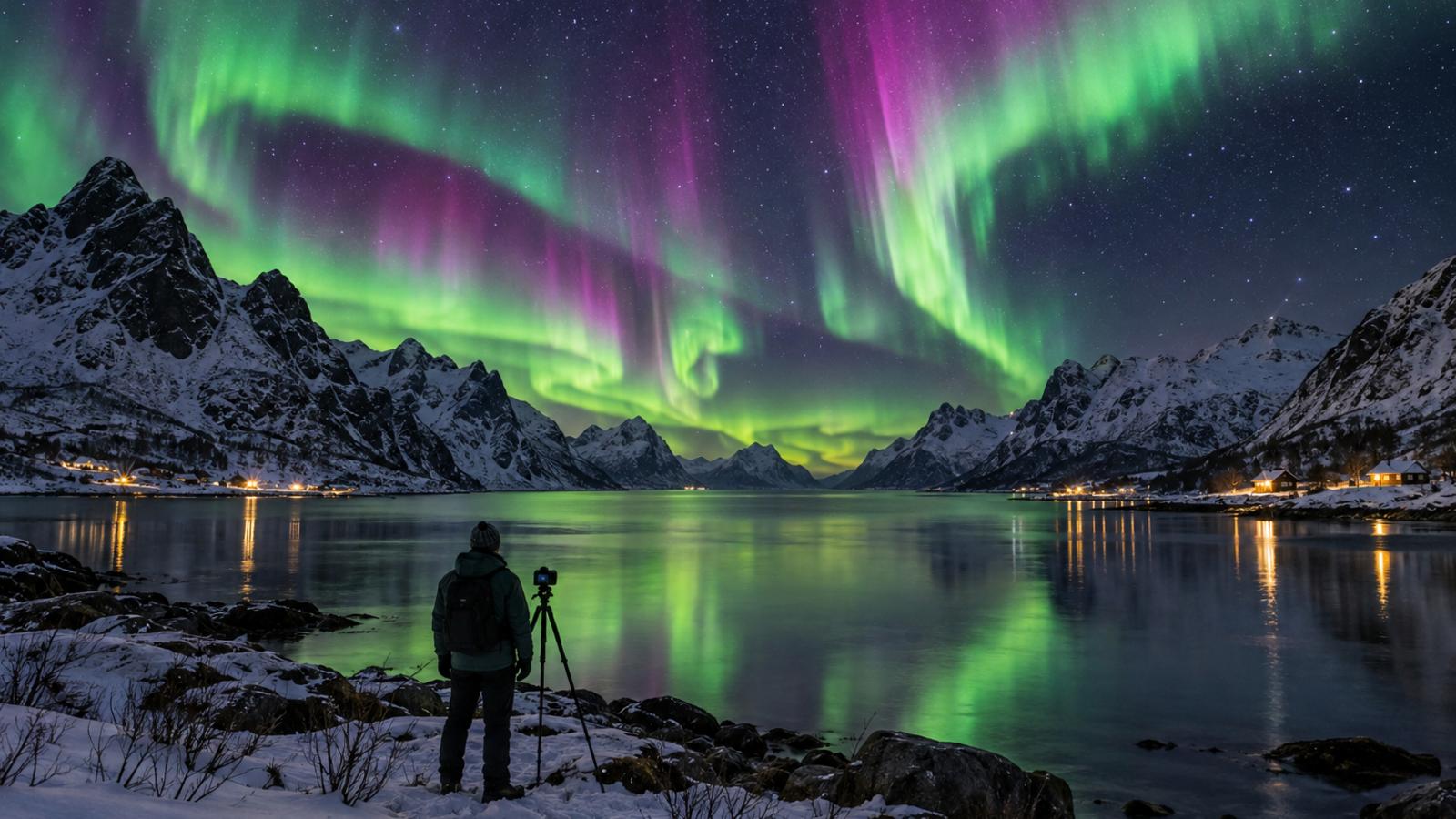
NRK's aurora photographer Ole Walter Sundlo uses ISO 5000, f/2.8, a shutter speed of several seconds, a sturdy tripod with self-timer, manual focus on a star, a wide-angle lens and RAW – and points the camera north. But: "You don't really need professional gear. A smartphone can take great pictures of the northern lights." Your phone's night mode on a tripod, 10–30 seconds, does the job. Bring a power bank; the cold drains batteries.
The apps and sites that work
- Yr, the Norwegian weather service, has an aurora page for every place, with activity, Kp and cloud cover.
- SpaceWeatherLive, Aurora Forecast 3D and Aurora Alerts – Brekke's own picks.
- Glendale App – free alerts based on magnetometers, including the one in Tromsø.
- UiT Tromsø Geophysical Observatory – forecasts for Svalbard, Tromsø, Trondheim, Bergen and Oslo, plus the Skibotn all-sky camera.
- NOAA SWPC – the source all the others build on.
- NorwayLights from Visit Norway, nordlysvarsel.no and aurora-norway.no for Norwegian overviews.
Frequently asked questions
Are 2026 and 2027 good years for the northern lights?
Yes. Solar maximum was in October 2024, and the one to two years after it typically give the most aurora nights. Last season had the most storm days since 2003/04, and scientists expect at least as much this winter and next.
Can you see the northern lights in Oslo?
Yes, at Kp 5 and above – which happened on more than 50 nights last season. Find a dark spot with a clear view to the north.
What is the best month in Tromsø?
March, closely followed by September–October and February: the equinoxes bring the most storms, and the nights are still fully dark. December has the polar night but also the most cloud.
How many nights should I stay?
At least three, preferably four or five. In northern Norway it is the clouds, not the Sun, that decide.
What time of night?
Between 22:00 and 02:00 the odds are best, but during the polar night it can start before noon.
If you want to prepare for the rest of the sky as well, we have gathered the space year 2026 – and Astronomen takes you further out than 200 kilometres.