Planetkort – A fun game about the solar system | Astronomen
Planetkort is an entertaining game that sparks curiosity and gives a sense of mastery, where whoever learns the most about the solar system has the best chance of winning.
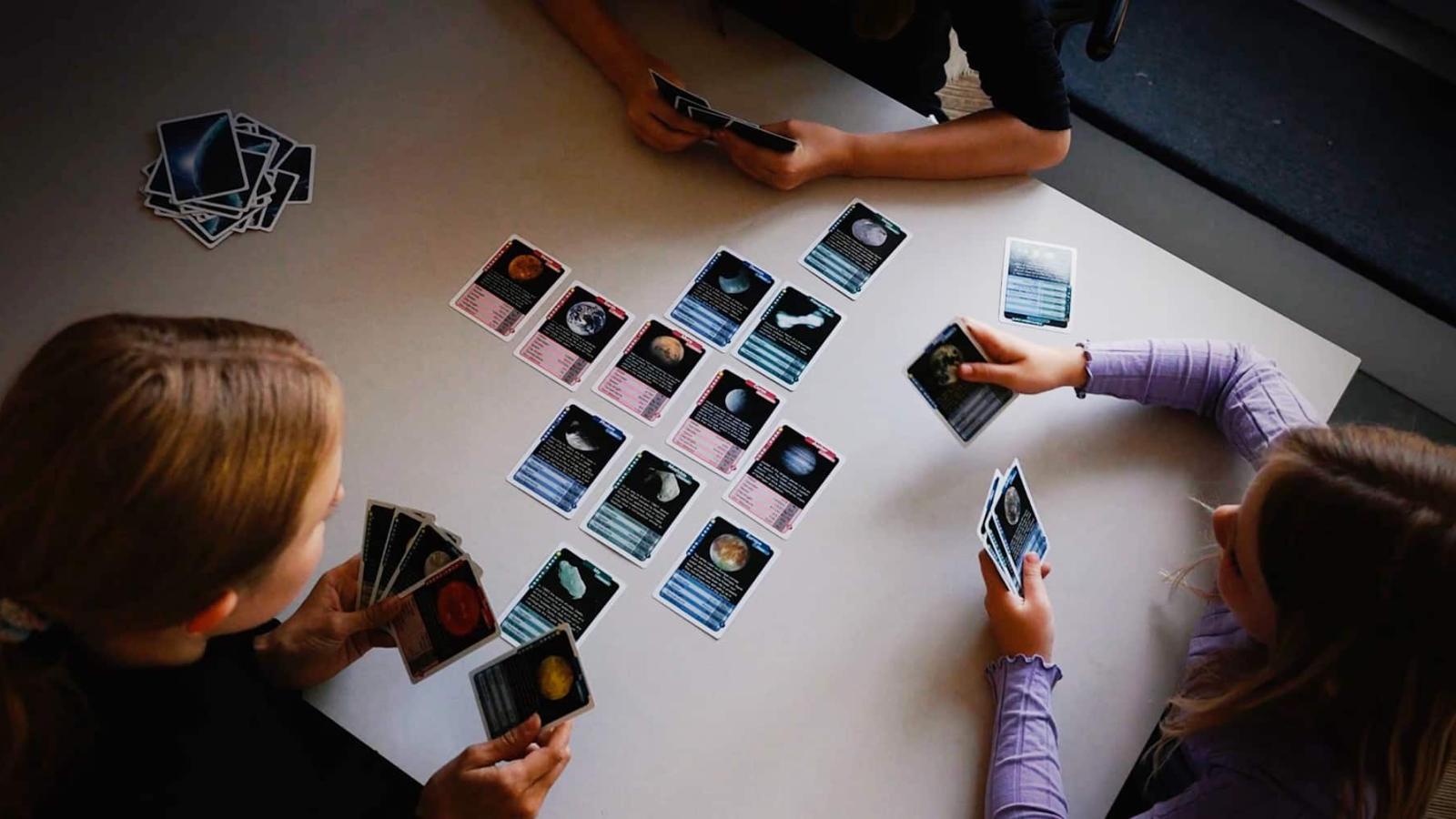
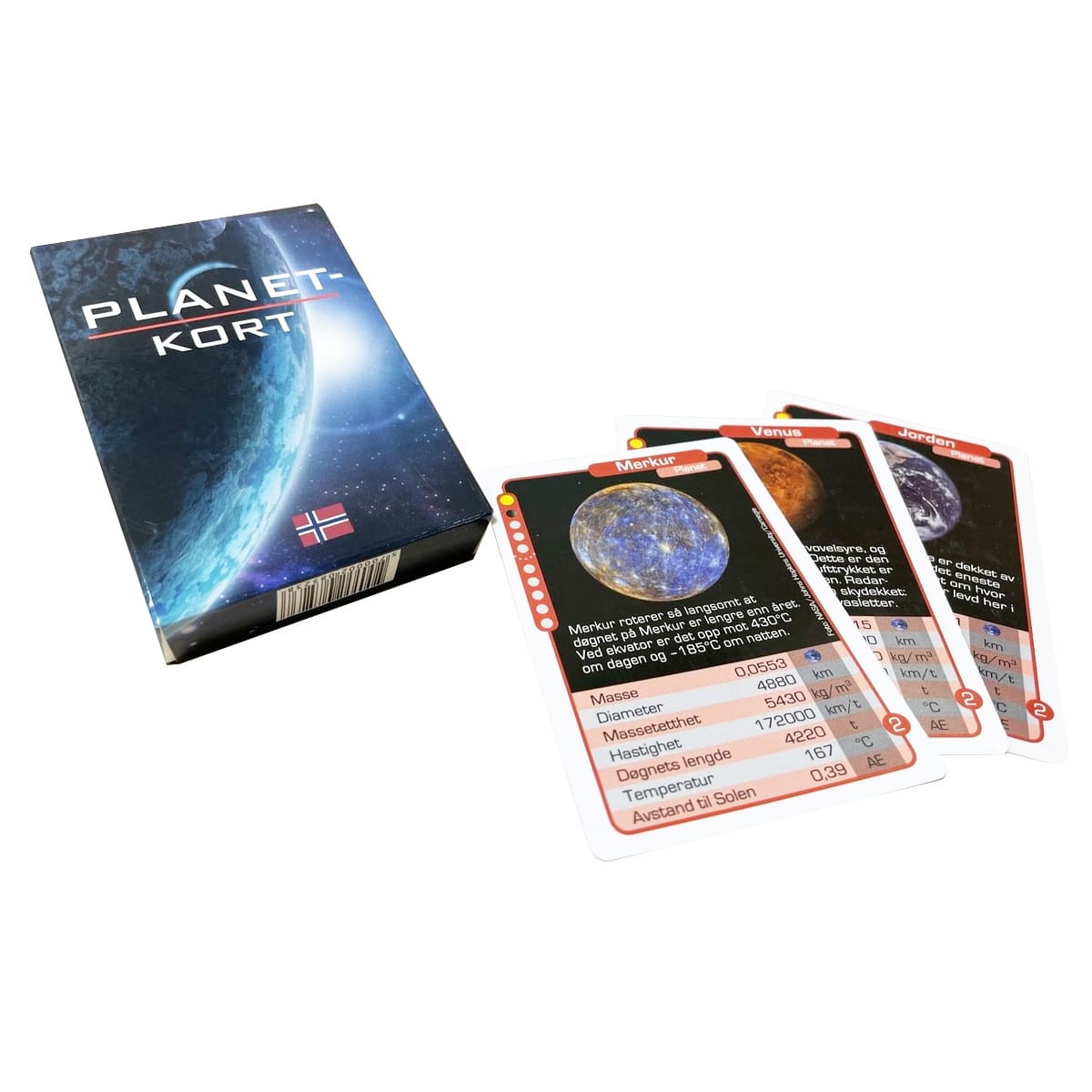
Planetkort
This year's Christmas gift! The new ASTRONOMICAL family game
Rules OFFER! -20% discount, buy PlanetkortPlanetkort is an entertaining game that sparks curiosity and gives a sense of mastery, where whoever learns the most about the solar system has the best chance of winning.
It is both educational and entertaining for children and adults alike, and has quickly become a favourite among families and groups of friends looking for a fun and knowledge-rich gaming experience.
Rummy
In Rummy, the aim is to put together tricks consisting of planets and their moons. Comets, which have a habit of travelling from the outermost to the innermost part of the solar system, are of course jokers and can be used wherever you need them most.
RulesClash of the Worlds
A variant of War, but where you choose the attribute you will battle with. Whoever best understands which objects have the highest speeds, the largest masses or the greatest distances, and knows how to use it, wins the game.
RulesBuild the Solar System
Similar to dominoes, where you place cards together in rows and columns the way they actually belong together in the solar system. Because how did it go again? Was Titan a moon of Jupiter? Or was it Saturn? And what was the order of the planets again.
RulesAbout the Planetkort cards
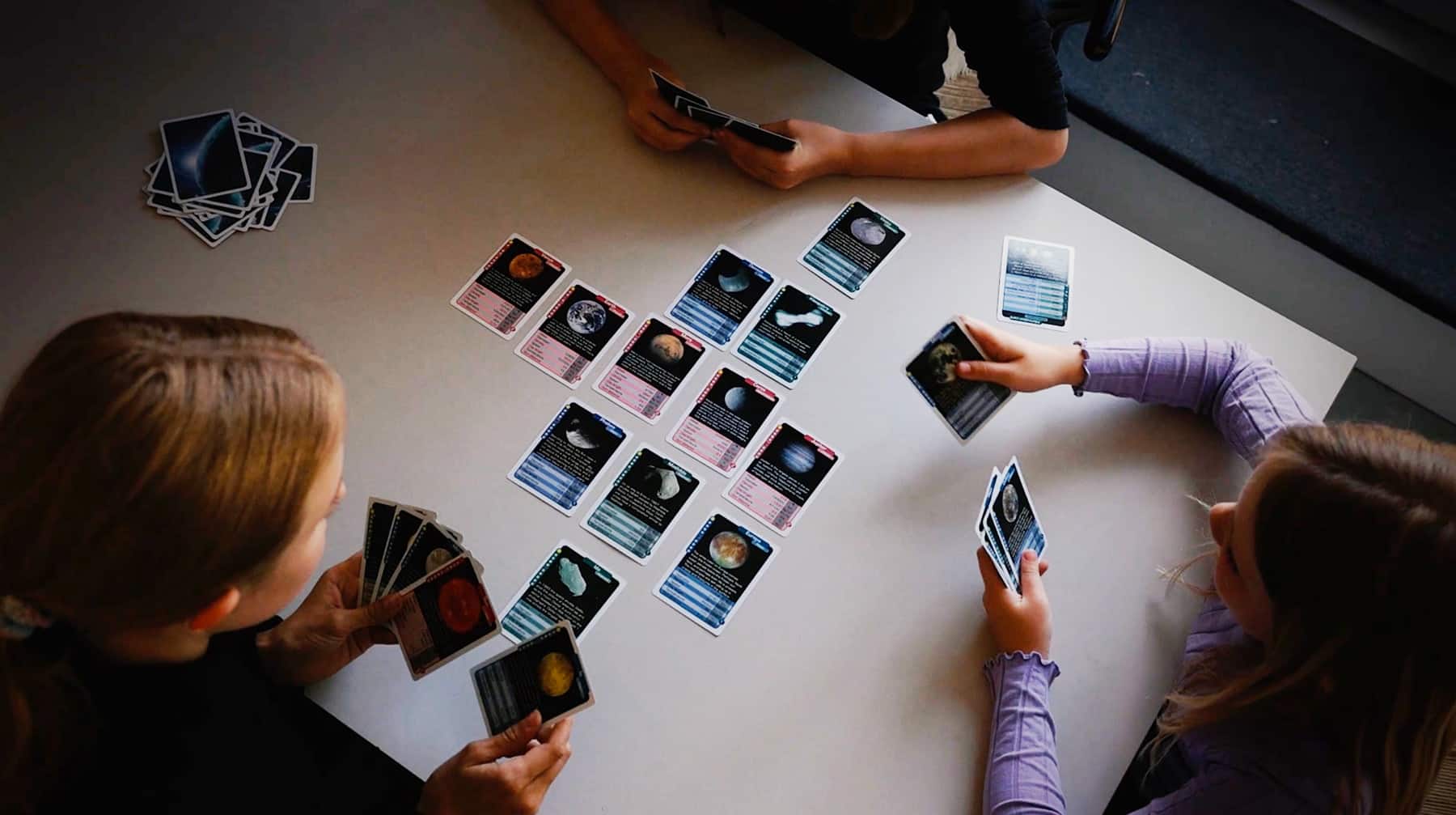
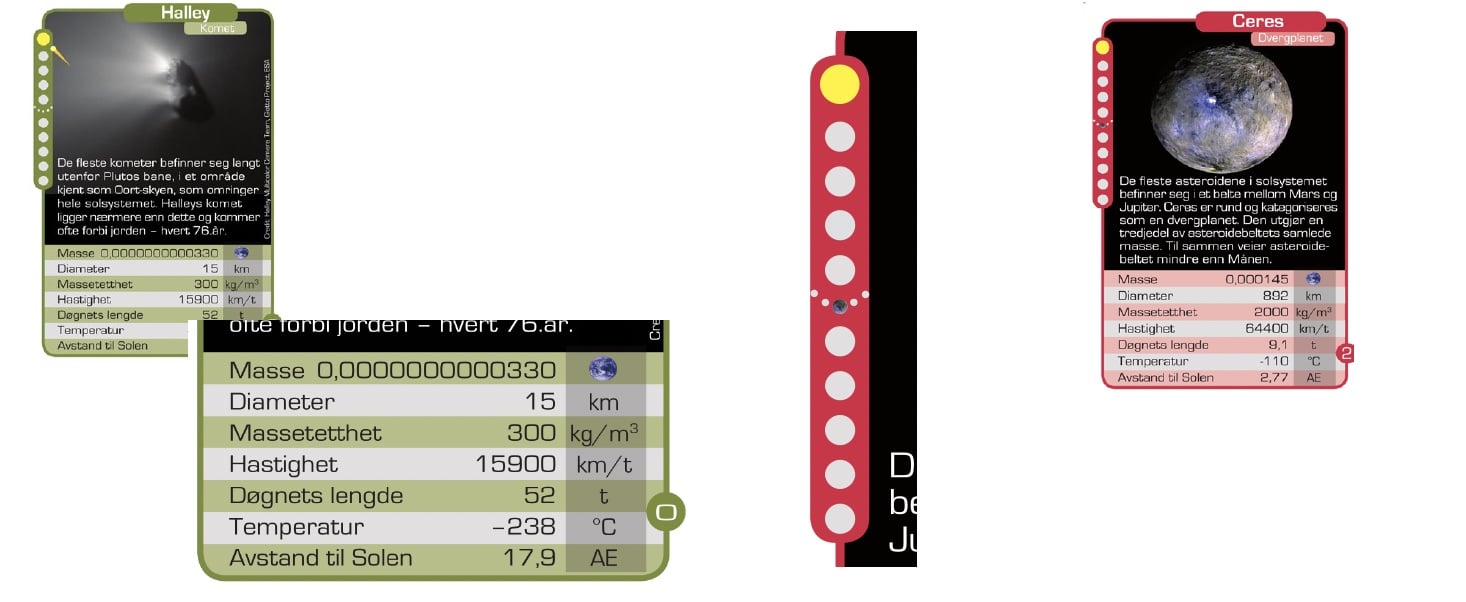
The game consists of 42 cards, each with a picture and facts about one celestial body. Facts such as that Saturn has a lower density than water, even though it is 95 times more massive than Earth. And that Venus is 687 degrees hotter than Pluto! In addition, you will find cards describing the rules for the three variants of the game, and an overview of where all the objects are located in the Solar System
This year's Christmas gift!
Planetkort is now on offer until 1 December 2024.
Buy PlanetkortRules: Rummy
Preparation
The cards are shuffled and 6 cards are dealt to each player. The remaining cards are placed on the table in a pile, face down. The top card of the pile is turned over and placed beside it, face up.
Rules
- The youngest player draws a card from one of the two piles on the table.
- The player checks whether they have three or more cards that go together. Cards that go together are:
- 3 planets in a row, e.g. Venus, Earth and Mars.
- 1 planet and 2 of its moons, e.g. Saturn, Titan and Mimas.
- 3 moons from the same planet, e.g. Io, Europa and Calisto.
- 3 asteroids, e.g. Kleopatra, Mathilde and Vesta.
- If the player has three cards that go together, they must lay them out on the table.
- Finally, the player discards one of their cards onto the pile, face up.
- Play continues to the next player, and the game proceeds in the same way until a player has no cards left in hand.
Tip: The planetary row can be seen on the left of each card, so you can see where your world is located in the solar system.
Special rules
- You are allowed to add cards from your hand to the cards you have already laid out yourself. You may not add to the other players' cards.
- When a player draws a card from the face-up pile, the player must also take all the cards in that same pile. If the player cannot lay out at least three cards immediately after this, the player gets 10 penalty points.
- The comets (Halley's, Hale-Bopp, Tempel-1 and Shoemaker-Levy 9) are jokers and can replace any other card.
Points
In the bottom right-hand corner of each card, it states how many points the card is worth. When a round ends, the points are added up for the cards each player has laid on the table. The cards the player still holds in hand are subtracted from the total score. The game ends when a player reaches a set total, e.g. 50 points.
Buy Planetkort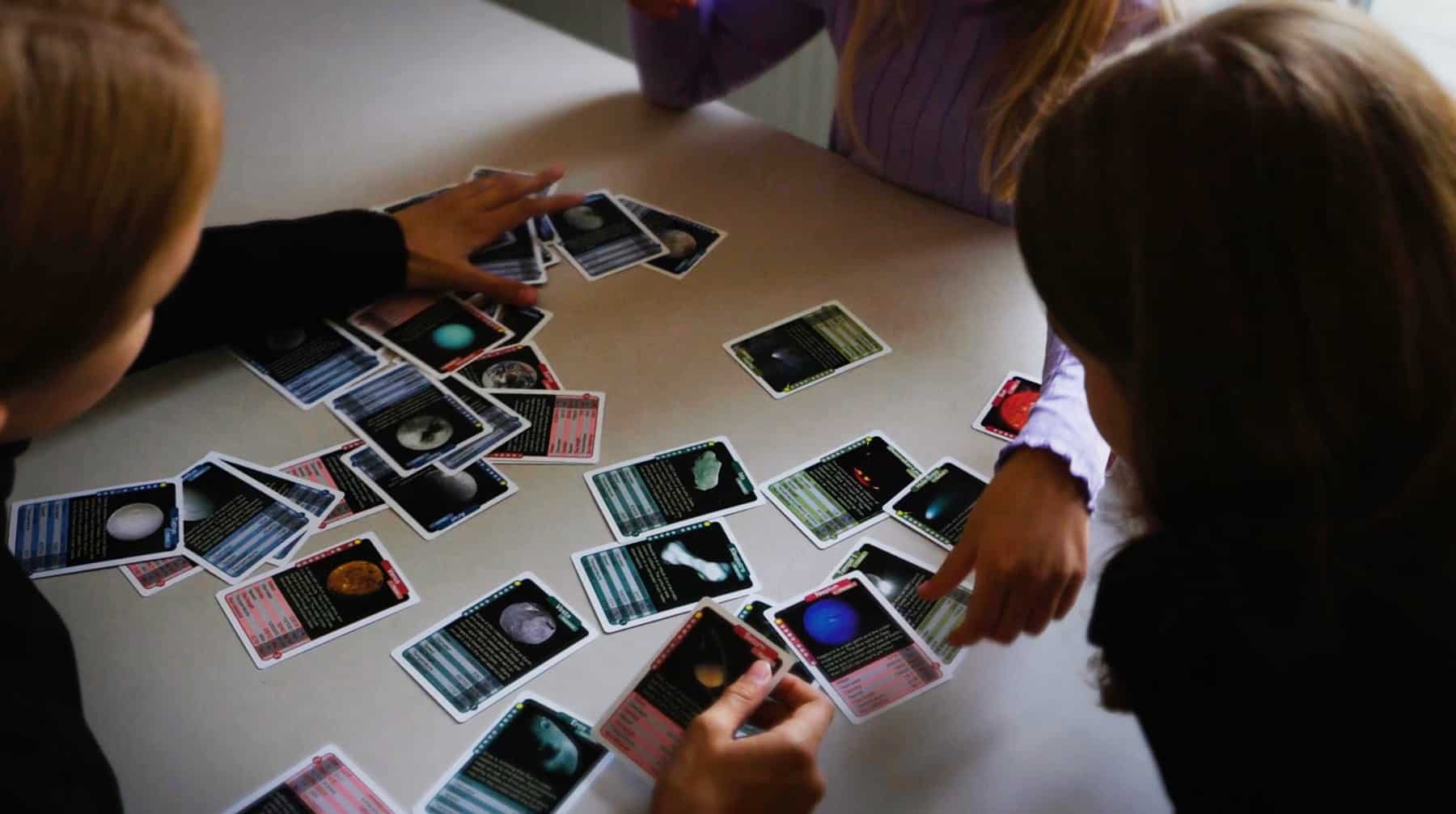
Rules: Clash of the Worlds
Shuffle the planet cards and deal them into piles, with an equal number of cards in each pile. Each player holds their cards in hand, so only they can see the top card.
The youngest player starts. They announce an attribute and a value from their top card, e.g. "temperature, 137 degrees!".
All players place their top card on the table. The player whose object has the highest value for that same attribute wins all the cards placed on the table. The winner puts the cards at the back of their pile and gets to choose the attribute in the next round.
The attributes that can be announced are mass, diameter, density, speed, length of day, temperature and distance to the sun. It is always the card with the highest value that wins.
If a round ends in a tie, i.e. several players play cards with the same value, a "clash of the worlds" occurs. Each player places two cards on the table face down and a third card face up. The player with the highest value on the third card wins all the cards.
The game continues until one player has lost all their cards. The winner is the player with the most cards when the game ends.
Buy Planetkort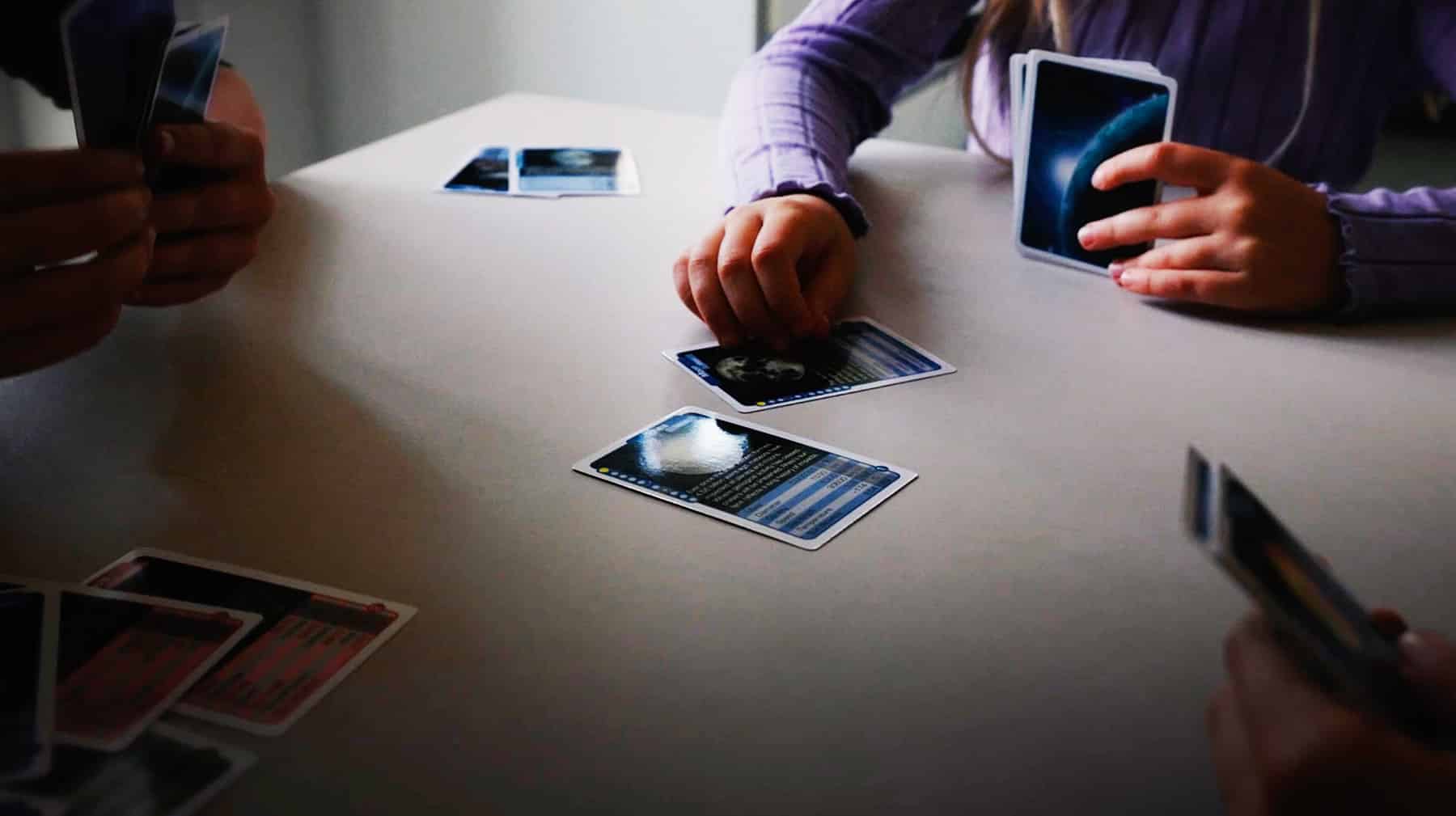
Rules: Build the Solar System
Preparation
This game must be played on a large table. The cards are shuffled and 3 cards are dealt to each player. The rest of the cards are placed in a pile on the table, face down.
Rules
The aim of the game is to "build" our solar system. The planets are to be placed next to each other in a line. The moons can be placed above or below the planets they belong to.
The youngest player starts by drawing a card from the pile, and then placing one of their cards in the middle of the table. The next player around the table (clockwise) checks whether they have a card that fits the card placed on the table.
A card that fits is, for example, a neighbouring planet or a moon of a planet card already on the table. You can look at the planetary row on the left of each card and on the Info card to see where in the order your card fits in.
Here are some examples:
- Earth can be placed next to Mars, since they come after each other in the planetary row.
- Titan can be placed above or below Saturn, since Titan is one of Saturn's moons.
- Io can be placed above/below Europa, as they are both moons of Jupiter.
- Kleopatra can be placed next to Mathilde, since both are asteroids.
- Comets are jokers and can be placed in place of any other card.
- The Sun can be placed next to Mercury.
- Ceres counts as a planet and is placed between Mars and Jupiter.
- Pluto counts as a planet and is placed beyond Neptune.
Be careful not to lay out cards that do not already have a "neighbour" on the table.
If a player cannot place a card on the table, they must say "pass" and draw a card. Play then continues to the next player.
The winner of the game is the player who is first to get rid of all their cards.
Buy Planetkort