The physicists’ cacio e pepe recipe: the starch rule that stops the lumps – for World Pasta Day
The physicists behind the 2025 Ig Nobel Prize in Physics worked out why cacio e pepe goes lumpy – and exactly how much starch it takes to keep the sauce glossy. We explain the “Mozzarella Phase” and share their recipe for World Pasta Day on 25 October.
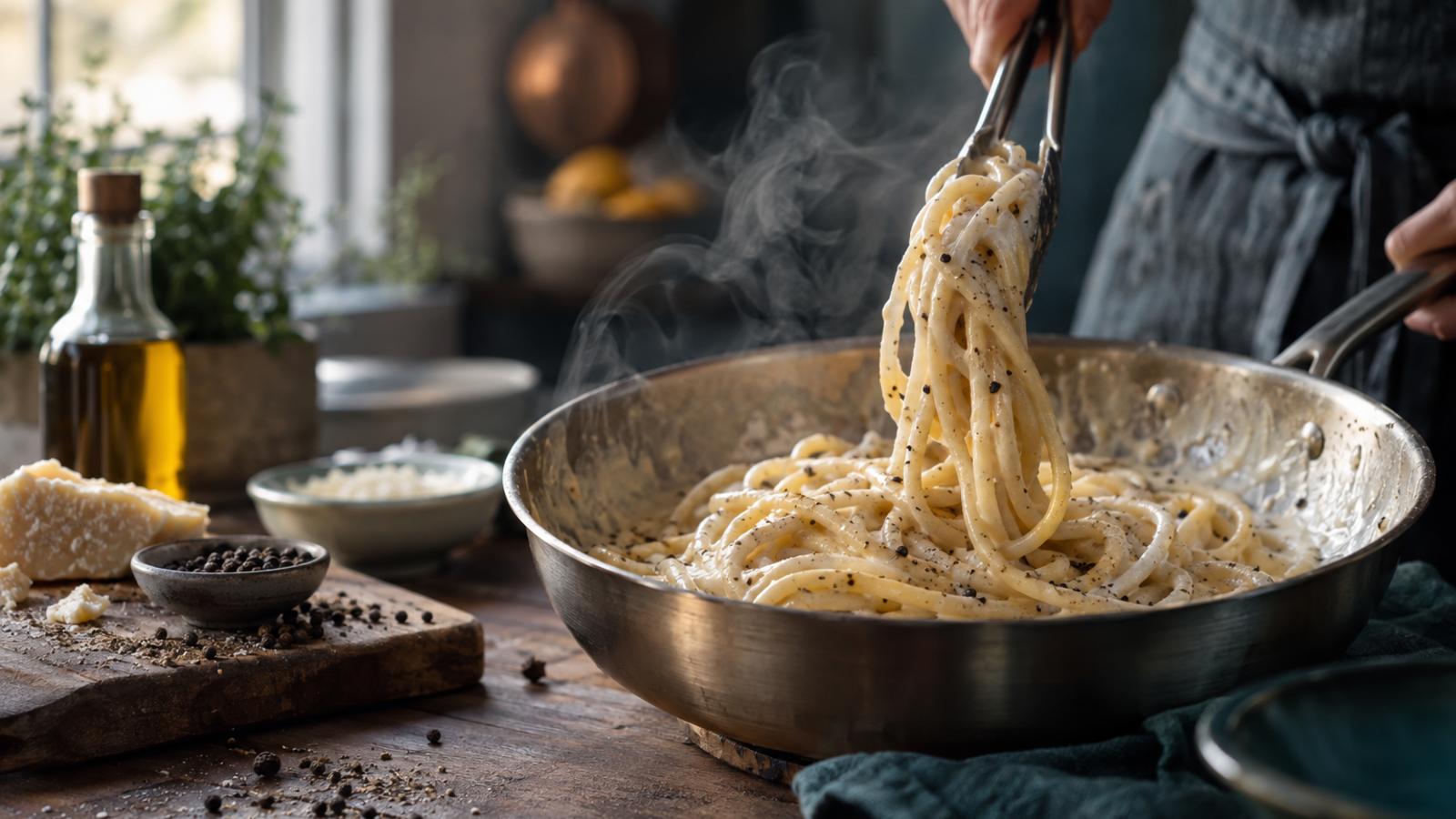
Cacio e pepe sauce turns lumpy because the proteins in pecorino clump together as they heat up. The physicists who won the 2025 Ig Nobel Prize in Physics found the fix: measured starch at 2–3 per cent of the cheese weight – 5 grams of potato or corn starch per 200 grams of cheese. Here is their recipe, in time for World Pasta Day on 25 October.
- The study: “Phase behavior of Cacio e Pepe sauce”, Physics of Fluids, published in April 2025 by eight Italian physicists.
- The prize: the 2025 Ig Nobel Prize in Physics, awarded in Boston on 18 September 2025.
- The problem: without starch, pecorino in hot water forms large clumps at around 65°C.
- The rule: below 1 per cent starch (by cheese weight) the sauce separates; 2–3 per cent keeps it smooth; above 4 per cent it turns stiff.
- The recipe for two: 300 g pasta, 200 g Pecorino Romano, 5 g starch and 150 g water.
What did the Ig Nobel-winning cacio e pepe study find?
Cacio e pepe is a Roman pasta dish made from just three ingredients: pasta, grated pecorino and black pepper. It is notoriously tricky, because the cheese easily seizes into rubbery lumps.
Giacomo Bartolucci, Daniel Maria Busiello, Matteo Ciarchi, Alberto Corticelli, Ivan Di Terlizzi, Fabrizio Olmeda, Davide Revignas and Vincenzo Maria Schimmenti treated the sauce as a physical system. Their institutions include the University of Barcelona, the Max Planck Institute for the Physics of Complex Systems in Dresden and ISTA in Austria. The work appeared as a preprint on arXiv on 31 December 2024 and was published in Physics of Fluids (volume 37, article 044122) in April 2025. The abstract puts it plainly: “We identify starch concentration as the key factor influencing sauce stability.”
According to Improbable Research, which runs the Ig Nobel Prizes, the team won the 2025 physics prize “for discoveries about the physics of pasta sauce, especially the phase transition that can lead to clumping, which can be a cause of unpleasantness.” The Ig Nobels honour research that makes people laugh, then think – not to be confused with the 2026 Nobel Prizes, which we explained on 10 October.
Why does cacio e pepe sauce go lumpy?
Cheese is largely casein, proteins packed into tiny spheres called micelles together with calcium phosphate, plus a small share of whey proteins. As it warms, the whey proteins unfold and stick to each other and to the casein, and the micelles clump too.
The “Mozzarella Phase” is the researchers’ name for the state in which the whole sauce has separated into stringy cheese and water. Without starch, they write, cheese in hot water forms huge clumps at around 65°C.
In physics terms, the mixture has a lower critical solution temperature: it separates when heated, not when cooled. That is why piping-hot pasta, rather than cold cheese, is the usual culprit.
Starch dampens the clumping, pushes it to higher temperatures and keeps the lumps smaller, making the sauce less sensitive to temperature-control errors, the study says.
How much starch does the sauce need?
Using digital scales, a stick blender and a sous vide water bath, the team heated samples in 5-degree steps from 50 to 95°C and sized the clumps with image analysis. The findings:
- Below 1 per cent starch relative to the cheese: the Mozzarella Phase, and a split sauce.
- 2–3 per cent: the sweet spot, confirmed by the researchers’ own taste and texture tests.
- Above 4 per cent: a sauce that becomes stiff and unappetising as it cools.
“The pasta water alone does not contain enough starch to stabilize the sauce effectively,” the authors write. Reduced pasta water works better but offers little control over the amount.
As Ivan Di Terlizzi put it in the American Institute of Physics press release (29 April 2025), “what we suggest is to use an amount of starch which is precisely measured.”
The physicists’ cacio e pepe recipe, step by step
The recipe serves “two hungry people”. Five grams of starch to 200 grams of cheese is 2.5 per cent – mid-window.
- Whisk 5 g potato or corn starch into 50 g water. Heat gently until it thickens and turns from cloudy to almost clear.
- Add 100 g water to cool the gel and make it easier to blend.
- Add 200 g Pecorino Romano and blitz with a stick blender into a smooth cream. Hand-grated cheese alone leaves uneven bits.
- Cook 300 g pasta al dente in lightly salted water. The authors favour tonnarelli, but spaghetti or rigatoni will do. Keep some cooking water.
- Let the drained pasta cool for up to a minute so excess heat does not wreck the sauce.
- Combine pasta and sauce, loosen with cooking water and stir in black pepper toasted in a pan.
The stabilised sauce holds its texture even at 80–90°C, according to the study, and can be reheated, ideally in a pan. Those figures come from lab conditions, not a frying pan.
The authors are refreshingly modest: “A true Italian grandmother or a skilled home chef from Rome would never need a scientific recipe for Cacio e pepe,” they write.
Can you use parmesan, another cheese or sodium citrate?
Pecorino Romano PDO is made from fresh whole sheep’s milk and aged for at least eight months when sold for grating, according to the Pecorino Romano consortium. It is the only cheese used in the experiments.
Purists insist on pecorino alone, though the researchers note that some accept up to 30 per cent Parmigiano Reggiano – “a point of debate”. The measured-starch principle is not tied to a particular cheese, but the numbers were only tested with Pecorino Romano.
For cooks in Norway, the practical takeaway is simple: scales that weigh to the gram and a packet of potato or corn starch.
Sodium citrate as an alternative
The study also tested sodium citrate, a salt used in processed cheese that binds calcium. Five grams of citrate per 200 grams of cheese gave excellent stability. The catch: it is not a traditional ingredient, and the authors say it slightly blunts the cheese’s flavour.
When is World Pasta Day?
World Pasta Day is celebrated every year on 25 October, which falls on a Sunday in 2026. According to the Italian news agency Teleborsa (11 May 2026), this is its 28th edition. This year it becomes a pasta week in Parma for the first time, run by Unione Italiana Food and the International Pasta Organisation, with an industry event on 27–28 October.
More food and drink stories are in our Food & Drink section.
Frequently asked questions
Why does cacio e pepe go lumpy, and how do I stop it?
The cheese proteins clump when heated – without starch, at around 65°C. Use starch at 2–3 per cent of the cheese weight, cooked into a gel, and let the pasta cool for up to a minute before mixing.
What is the perfect cacio e pepe according to physicists?
For two: 300 g pasta, 200 g Pecorino Romano, 5 g potato or corn starch and 150 g water, blended into a cream. Toasted black pepper goes in at the end.
When is World Pasta Day?
World Pasta Day falls on 25 October every year. In 2026 it is a Sunday, and the pasta industry gathers in Parma on 27–28 October.

