The 2026 Nobel Prizes: brains switched on by light, neutrinos from the deep – and a Peace Prize that provokes
Optogenetics, IceCube and life's mirror images took this year's science prizes, Anne Carson the literature prize, and Navi Pillay the Peace Prize in an Oslo where no one could reach her. Here is what the laureates actually discovered – and why it matters.
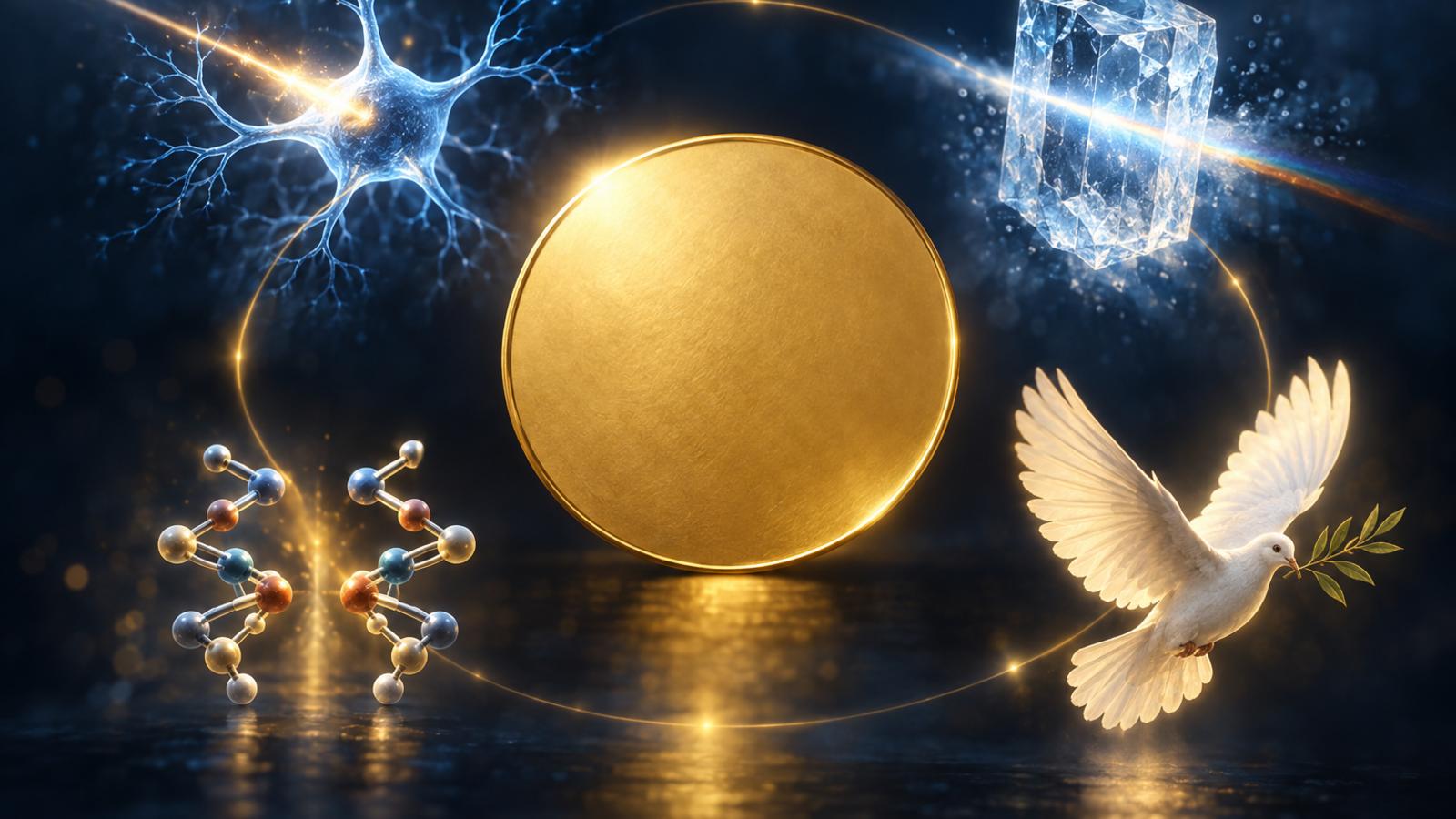
Nobel week 2026 is almost over. Five of the six prizes have been announced, seven people have received the call from Stockholm or Oslo – or, in one case, failed to – and the economics prize follows on Monday. The prize money has been raised to 12 million Swedish kronor per prize, one million more than last year. Here is what this year's laureates actually discovered, why it matters outside the laboratory, and why the Peace Prize has already triggered a diplomatic storm.
Medicine: the alga that gave us a switch for nerve cells
On Monday the prize in physiology or medicine went to the American Karl Deisseroth (54, Stanford) and the Germans Peter Hegemann (71, Humboldt University of Berlin) and Georg Nagel (73, University of Würzburg) "for their discoveries concerning light-gated ion channels and optogenetics".
The story begins with a single-celled alga. In the early 1990s Hegemann wondered how the alga Chlamydomonas manages to react to light within half a millisecond, and guessed that one protein both captures the light and works as a channel for charged particles. Nagel expressed the algal genes in frog eggs and showed in 2002 and 2003 that the guess was right: the protein channelrhodopsin-2 opens within 0.2 milliseconds when hit by blue light. Then came the decisive move. Deisseroth wrote to Nagel asking for the DNA, inserted it into cultured rat neurons – and could trigger nerve signals with a flash of light. The method was named optogenetics in 2006. A year later his group made living mice move their whiskers by shining light into the brain through an optical fibre, and in 2012 they reactivated a fear memory in a mouse by illuminating the cells that stored it.
"Optogenetics provides opportunities for mapping the brain in a way that we could once only dream of." – Per Svenningsson, chair of the Nobel Committee for Physiology or Medicine
The point is precision: researchers can switch exactly the cells they want on or off, at exactly the moment they want, in a living brain. That has produced new knowledge about depression, anxiety, schizophrenia, Alzheimer's and Parkinson's disease. The first patient exists too: in an ongoing clinical trial, a person blinded by the retinal disease retinitis pigmentosa had a channelrhodopsin-like protein inserted into the retina and, wearing special light-emitting glasses, could once again discern and grasp objects on a table. Nagel himself was sober in the Nobel Foundation's telephone interview: "So far I know of one patient who profited from optogenetics. So it's not like with the malaria medicaments." And on the prize: "I didn't expect this, really."
As always, someone is left outside. Ed Boyden of MIT was first author of the 2005 paper as a Stanford graduate student, and when the Brain Prize went to optogenetics in 2013, it was shared among six people. A Nobel Prize can be shared by at most three.
Physics: the man who turned a cubic kilometre of ice into a telescope
On Tuesday the Belgian-born American Francis Halzen (82, University of Wisconsin–Madison) received the physics prize alone – the first unshared physics prize since 1992 – "for decisive contributions to the IceCube Neutrino Observatory and the discovery of high-energy neutrinos of astrophysical origin".
Neutrinos are the universe's most elusive particles: 65 billion of them from the Sun pass through your fingernail every second without leaving a trace. In 1988 Halzen presented an idea few believed in: drill cables fitted with light sensors deep into the ice at the South Pole and use the ice itself as the detector. On the rare occasion a neutrino collides with an atom in the ice, a faint blue flash appears that the sensors can catch. The first cable went in on Christmas Eve 1993. The completed IceCube, with 5,160 sensors on 86 cables between 1,450 and 2,450 metres down, reached full size in 2011 at a cost of 279 million dollars.
Then came the results: in 2013 the first evidence of neutrinos from outer space, in 2017 a neutrino traced back to an active galaxy – the blazar TXS 0506+056 – almost four billion light years away, in 2022 neutrinos from the galaxy NGC 1068, and in 2023 from the disc of the Milky Way itself. Together with gravitational waves, which we wrote about this summer, neutrinos have given astronomers an entirely new way of "seeing" the universe, independent of light.
"His tenacity and scientific vision has paved the way for a new kind of astronomy." – Mark Pearce, chair of the Nobel Committee for Physics
Halzen took the call in Italy. "It was a great surprise, and I obviously didn't expect it," he said – before adding that he is working on a proposal for the next, eight-times-larger IceCube-Gen2 and "hope[s] that this prize will help getting it approved".
Chemistry: why life uses only one mirror image
Wednesday's chemistry prize went to the Frenchman Henri B. Kagan (95, Université Paris-Sud) and the Japanese chemist Kenso Soai (Tokyo University of Science) "for the discovery of non-linear effects and autocatalysis in asymmetric organic synthesis". Kagan is thereby among the oldest science laureates ever.
The puzzle they solved is more than a century old. Many molecules exist in two mirror-image forms, like a right and a left hand, and ordinary chemistry makes equal amounts of each. Life does not: every amino acid in your proteins is "left-handed", the sugar in DNA is "right-handed". In 1986 Kagan showed that reactions can be steered to produce a far larger excess of one form than anyone had thought possible. Soai went all the way: in 1995 he described a reaction that amplifies itself, from 2 to 87 percent excess of one form, and in 2003 a reaction in which only one mirror image is formed – something nothing but life itself had achieved before. Which form wins is decided by chance, and the final product can be 99.99 percent pure.
There are two consequences. The practical one: medicines often have to be pure mirror-image forms – the thalidomide scandal of the early 1960s showed what happens when they are not – and Kagan's and Soai's methods are used today by chemists designing such reactions. The big one: the Soai reaction, which the Nobel Committee calls "one of the most elegant chemical experiments ever conducted", shows how life's one-sidedness could have emerged on its own.
Literature: Anne Carson, "listening to the wind" when the phone rang
On Thursday the Canadian poet and classicist Anne Carson (76) received the literature prize "for her bold and inventive oeuvre that, in playful dialogue with the classical tradition, has created new forms for contemporary literature". Carson, who disclosed in 2024 that she lives with Parkinson's disease, is best known for Autobiography of Red (1998), a novel in verse about the red monster Geryon from Greek myth, and Nox (2010), an elegy in a box for her brother, who died in Denmark. When the Swedish Academy's permanent secretary called, Carson was, according to the Academy, "listening to the wind". She told the Icelandic broadcaster RÚV: "Crazy. I think they're all crazy." Bookmakers had her as joint favourite with Can Xue; Karl Ove Knausgård was at 22 to 1.
Peace: "If you see a Norwegian number calling, please pick up"
At 11 o'clock on Friday, Jørgen Watne Frydnes stood in the Norwegian Nobel Institute and announced that the Nobel Peace Prize for 2026 goes to Navanethem "Navi" Pillay "for her efforts to promote peace and international law". Then he admitted the committee had not managed to reach her: if she saw a Norwegian number calling, he asked, please pick up.
Pillay (85) was at that moment sitting in Courtroom 600 of the Nuremberg Palace of Justice – the room where the Nazi leadership was tried in 1946 – at a seminar on the Nuremberg principles. Her first reaction: it must be a joke. Later she called it the greatest award she had ever received and said she would dedicate it to all survivors of international crimes.
Her biography explains the choice. Born in Durban in 1941 to a family of Indian Tamil descent, she started her own law practice in 1967 as the first non-white woman to do so in Natal, defended anti-apartheid activists and fought for the rights of prisoners on Robben Island. After apartheid she became a High Court judge, then judge and president of the UN tribunal for Rwanda, where she helped establish that rape and hate propaganda can amount to genocide. She went on to serve as a judge at the International Criminal Court, as UN High Commissioner for Human Rights from 2008 to 2014, and from 2021 to 2025 as chair of the UN commission of inquiry on the occupied Palestinian territory – which in September 2025 concluded that Israel has committed genocide in Gaza.
"The system of international law is under tremendous pressure, and its institutions are under attack. (…) Peace requires justice." – The Norwegian Nobel Committee
The reactions came faster than Pillay could answer her phone. Norway's prime minister Jonas Gahr Støre called it a highly topical prize "at a time when the international legal order is under serious pressure" and stressed that the committee is independent of the government. UN Secretary-General António Guterres said Pillay has shown "that the force of law must prevail over the law of force". Israel's foreign ministry called the award "the grotesque weaponisation of an award to legitimise anti-Israel hatred and prejudice", and prime minister Benjamin Netanyahu said the committee had "lost its moral compass". Donald Trump, himself a nominee, told a rally that the decision left "an indelible stain on the country of Norway" and that he had never heard of her – on the same day Secretary of State Marco Rubio announced further US sanctions against the International Criminal Court. Pillay's own comment, amid the applause in Nuremberg, was dry: "If you clap a little bit more, I may share this prize with Trump."
The Norwegian connection is Erik Møse, the judge who sat alongside Pillay at the Rwanda tribunal and who described to NRK a colleague with a sense of humour. The prize will be presented in Oslo City Hall on 10 December. There were 287 nominees.
Monday: the economics prize
The Sveriges Riksbank Prize in Economic Sciences is announced on Monday 12 October at 11:45 CEST. The analytics firm Clarivate, whose "citation laureates" have gone on to win 89 times, this year points to Susan Athey and Hal Varian for the economics of information technology, Michael Woodford for monetary policy and Sidney Winter for evolutionary theories of the firm. Prediction markets favour the Harvard economist Ariel Pakes at around 20 percent – but they trade so little that the numbers mean little.
The 2026 Nobel Prizes at a glance
- Medicine: Karl Deisseroth, Peter Hegemann and Georg Nagel – optogenetics.
- Physics: Francis Halzen – IceCube and astrophysical neutrinos.
- Chemistry: Henri B. Kagan and Kenso Soai – asymmetric autocatalysis and homochirality.
- Literature: Anne Carson.
- Peace: Navi Pillay.
- Economics: announced Monday 12 October.
- Prize money: 12 million Swedish kronor per prize, shared equally between the laureates of the same prize.
- Ceremonies: 10 December 2026 in Stockholm and in Oslo City Hall.