Winter depression in Norway: what a 10,000-lux lamp really does – and how fast the daylight is going
Light therapy is the first-line treatment for winter depression, though the evidence shows a moderate effect. Here is the dose, what to look for in a lamp, when to see a GP – and sunrise times for four Norwegian cities to 22 November.
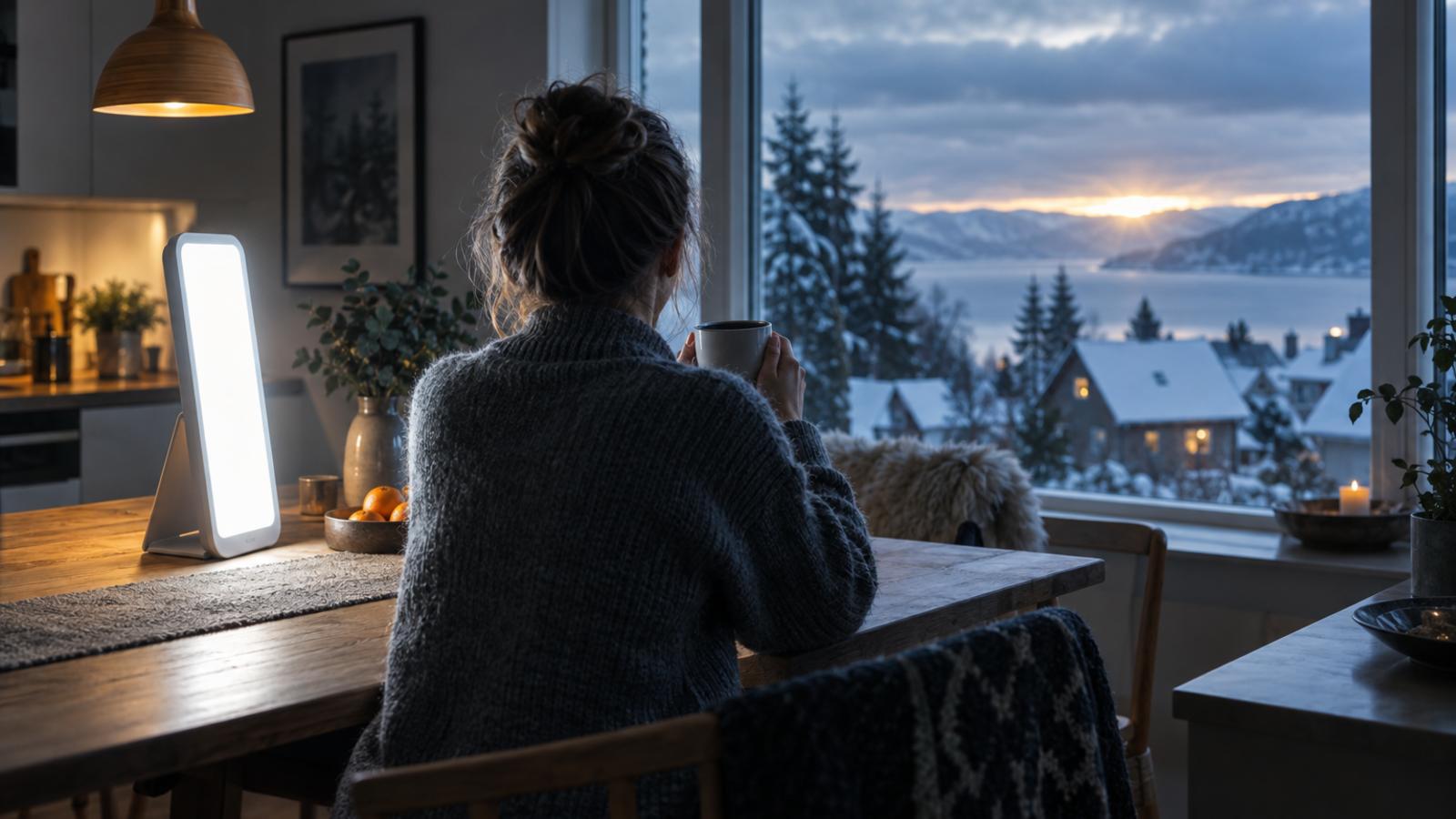
A 10,000-lux light therapy lamp, used for at least 30 minutes each morning, is the first-line treatment for winter depression according to Norway's medical handbook NHI.no, and trials show a moderate benefit. Daylight is draining fast: between Monday 9 and Sunday 22 November, Oslo loses almost an hour of it, and Tromsø sees its last sunrise of the year on Friday 27 November, according to MET Norway.
- Dose: 10,000 lux for at least 30 minutes a day, ideally in the morning, for one to two weeks (NHI.no, updated 10 February 2022).
- Evidence: a meta-analysis of 19 randomised trials found a 42 per cent higher chance of improvement with a bright lamp than with placebo light (Pjrek et al., 2020). The trials were small.
- When to get help: if low mood lasts more than two weeks, and immediately if you have thoughts of harming yourself (Helsenorge, 23 March 2026).
- Polar night: last sunrise in Tromsø on 27 November 2026, first sunrise again on 15 January 2027 (MET Norway, flat horizon).
- 24-hour helplines in Norway: Mental Helse 116 123 and Kirkens SOS 22 40 00 40.
Winter blues or winter depression – what is the difference?
Seasonal affective disorder (SAD), often called winter depression, is described by NHI as a mental disorder that typically appears during the dark season. To meet the definition, depressive episodes must begin and lift at roughly the same time of year for at least three years running.
NHI lists the typical symptoms as low energy, a greater need for sleep, low mood, increased appetite (especially for sweet things), weight gain, social withdrawal and reduced sex drive. The common thread is that they “begin in autumn and disappear in spring”. NHI calls milder versions “winter tiredness” and notes that researchers disagree on whether SAD is a distinct condition at all.
Estimates of how common it is vary. NHI puts it at 5–10 per cent of the population “to a greater or lesser degree”, while a 2019 Cochrane review gives 1.5–9 per cent depending on latitude. The Norwegian health portal Helsenorge draws the line at ordinary depression like this: feeling sad most of the time for at least two weeks, with less energy and lost interest in things you usually enjoy.
Does a 10,000-lux lamp help, and how long should you use it?
NHI recommends at least 30 minutes a day at 10,000 lux for one to two weeks, taken in the morning by most people, and says many notice improvement within a couple of days. Possible side effects are mild eye irritation and headaches during the first days.
The US National Institute of Mental Health (2023) advises 30–45 minutes, usually first thing in the morning, from autumn to spring. NIMH says such a light box is about 20 times brighter than ordinary indoor lighting and filters out UV rays.
What does the research show?
The most recent robust meta-analysis, by Pjrek and colleagues in Psychotherapy and Psychosomatics (2020), pooled 19 randomised, blinded trials in adults and found light therapy outperformed placebo. The chance of responding was 1.42 times higher with a bright lamp, though the authors flagged a moderate-to-high risk of bias.
Others are more cautious. The UK's NICE guideline NG222 says patients should be told the evidence for light therapy is “uncertain”, which is why the NHS does not usually offer it. For prevention the evidence is thinner still: Cochrane found just one small trial, with 46 participants. The fair summary is a documented but moderate effect, built on small studies.
How close to the lamp do you need to sit?
The lux figure only holds at a specific distance. Professor Bjørn Bjorvatn, head of Norway's National Centre for Sleep Medicine, told NHI (24 October 2024) that cheap lamps can deliver 10,000 lux at around ten centimetres. Check how far away the lamp still gives 10,000 lux, not just the number on the box.
The NHS advises choosing a lamp that is UV-free and carries a safety mark; in Norway and the rest of the EEA that means CE marking. If you have an eye condition or take medicine that makes you sensitive to light, talk to a doctor before you start, both the NHS and NIMH advise.
Sunbeds do not help, according to NHI, and NIMH says vitamin D for SAD has produced “mixed results”. We have explained why the winter sun no longer gives you vitamin D.
Do exercise and talking therapy work as well as light?
NIMH points to trials in which cognitive behavioural therapy adapted for SAD and light therapy were “equally effective”. Some symptoms eased faster with light, but one study that followed patients over two winters found the benefits of therapy seemed to last longer.
The Norwegian Directorate of Health (updated 11 June 2025) says that in mild to moderate depression, exercise works as well on symptoms as medication or psychological treatment. It singles out walks, preferably outdoors, as something many people benefit from.
How fast is the daylight shrinking where you live?
We pulled sunrise and sunset times from MET Norway's sunrise API and worked out day length. Times are for city centres with a flat horizon, from Monday 9 to Sunday 22 November 2026:
- Oslo: 07:59–16:01 becomes 08:31–15:34, a drop from 8 h 2 min to 7 h 3 min (59 minutes).
- Bergen: 08:23–16:20 becomes 08:56–15:52, 61 minutes less daylight.
- Trondheim: 08:22–15:41 becomes 09:02–15:06, from 7 h 19 min to 6 h 4 min.
- Tromsø: 08:51–14:03 becomes 10:14–12:45, from 5 h 12 min to 2 h 31 min – roughly 12 minutes lost every day.
Since Norway switched to winter time on 25 October, light arrives earlier in the morning and fades earlier in the afternoon, which makes the late morning the best time to get outside.
When does the polar night start in Tromsø?
The Norwegian encyclopedia Store norske leksikon defines the polar night as the period when the centre of the sun does not rise above the horizon for a whole day. MET Norway calculates that Tromsø's last sunrise is on Friday 27 November, at 11:21, with sunset at 11:41. The next sunrise is on Friday 15 January 2027. In much of the city, mountains hide the sun several days earlier.
Are people in the far north more depressed in winter?
Not necessarily. In the Tromsø Study, 8,951 adults filled in questionnaires continuously from October 2007 to December 2008. Researchers at UiT The Arctic University of Norway found no significant seasonal difference in mental distress, only more sleep problems in winter. Their conclusion (BMC Psychiatry, 2012): some people are clearly affected, but the case that winter harms adults' mental health is not conclusive.
A simple plan for the dark weeks
- Get up at about the same time every day and eat regular meals, as Helsenorge recommends.
- If you use a lamp, do your 30 minutes over breakfast, at the distance the maker gives for 10,000 lux.
- Get daylight every day, preferably before lunch. In Oslo the sun rises between 07:59 and 08:31 over these two weeks.
- Go for a walk or train. A single session can lift your mood, says the Directorate of Health.
- Stay in touch with someone you trust, and give yourself a reason to be out in the evening: the 2026/27 northern lights season could be one of the best in years.
When should you see a GP?
Helsenorge advises seeking help if symptoms last more than two weeks, if you struggle to cope with daily life, or if you keep getting worse – and to seek help straight away if you have thoughts of harming yourself or do not want to live. Your GP (fastlege) can refer you on. Municipalities offering “rask psykisk helsehjelp” (rapid mental health care) do not require a referral, and several hospitals offer guided online treatment. Mental Helse (116 123) and Kirkens SOS (22 40 00 40) answer around the clock.
Frequently asked questions
Does a 10,000-lux lamp help with winter depression in Norway?
Trials show it helps, but the effect is moderate and the studies are small. NHI recommends 10,000 lux; check the distance at which your lamp reaches that level.
What time of day should I use light therapy, and for how long?
In the morning, for at least 30 minutes a day, according to NHI. NIMH suggests 30–45 minutes.
When does the polar night start in Tromsø in 2026?
MET Norway calculates the last sunrise on 27 November 2026 and the sun's return on 15 January 2027. That assumes a flat horizon, so in much of the city the sun disappears behind the mountains earlier.
Do I need a referral to get help in Norway?
Not for rapid mental health care in municipalities that offer it, says Helsenorge. Otherwise your GP can refer you.