Should Norwegian Hydropower Run the World's Chatbots?
Artificial intelligence has become so power-hungry that megawatts, not microchips, now set the ceiling on how fast the technology can grow. The world has discovered northern Norway's cheap hydropower — and the fight over who gets to use it has begun.
Last year, the race for artificial intelligence was about chips. This year it is about electricity. The most advanced AI models demand vast amounts of power to train and run, and for the first time it is not the supply of Nvidia chips but the supply of megawatts that decides how fast the industry can grow. That has turned clean, cheap power into one of the world's most coveted resources — and trained a spotlight on a country that has more of it than almost anywhere else: Norway.
When Nscale, Aker and OpenAI announced "Stargate Norway" outside Narvik in the summer of 2025, the global energy squeeze suddenly became a Norwegian affair. Should clean Norwegian hydropower be used to run foreign chatbots? Who profits from it — and what happens to ordinary households' electricity bills?
Power has become the ceiling for AI
The AI story has long been about silicon. Now it is about electricity. According to the International Energy Agency (IEA), global data-centre electricity demand grew 17 percent in 2025, while the AI-driven share alone rose around 50 percent. In the United States, data-centre expansion is expected to account for roughly half of all growth in electricity demand through 2030. The question is no longer how many accelerators a company can buy, but where it will find enough firm power to switch them on. Megawatts have become the scarce resource — and therefore the new bottleneck for the entire industry.
The numbers behind the hunger: from 415 to 945 TWh
The scale is formidable. The IEA's "Energy and AI" analysis estimates that the world's data centres used around 415 TWh in 2024 — about 1.5 percent of global electricity — and that consumption will nearly double to around 945 TWh by 2030. AI-specialised "accelerated servers," growing roughly 30 percent a year, account for almost half of that increase. Behind the hunger lies an unprecedented investment surge: the big four — Amazon, Google, Meta and Microsoft — spent a record roughly 388 billion dollars in 2025 and are guiding toward as much as 630 billion in 2026 — a 62 percent jump, most of it for AI infrastructure, chips and power. The money exists. The question is whether the electricity does.
The hunt for firm, clean power: nuclear and fusion
The tech giants' answer is to lock up their own generation. In January 2026, Meta signed deals with three nuclear companies — Vistra, Oklo and TerraPower — for more than 6 gigawatts of power. Capital is pouring into fusion too: Commonwealth Fusion Systems raised 3.85 billion dollars in the largest funding round in fusion history, and Google has already signed a deal to buy 200 megawatts of fusion power. The catch is timing. No US small modular reactor is yet operating; Oklo's plants target 2030, TerraPower's 2032. Nuclear and fusion may become the backbone of the AI age — but that power arrives late in the decade. The demand is here now.
Gas fills the gap, and the bill grows
With reactors years away, natural gas becomes the bridge fuel — and the bottleneck. Turbine maker GE Vernova's order book has passed 110 gigawatts and is effectively sold out through 2029. The bill lands on ordinary people. In the US, average residential electricity prices have risen about 42 percent in five years, and data-centre demand in the vast PJM region is estimated to have added 13.8 billion dollars to consumers' bills. The footprint is environmental too: Microsoft's own sustainability accounts show energy use up 168 percent and emissions up 23.4 percent since 2020. More than 230 environmental groups have called for a national pause on data-centre construction. Resistance to the "AI bill" has become an American grassroots movement.
The world is not short of money for artificial intelligence. It is short of firm, clean power — and that is where Norway comes in.
Stargate Norway: the world wants Norwegian hydropower
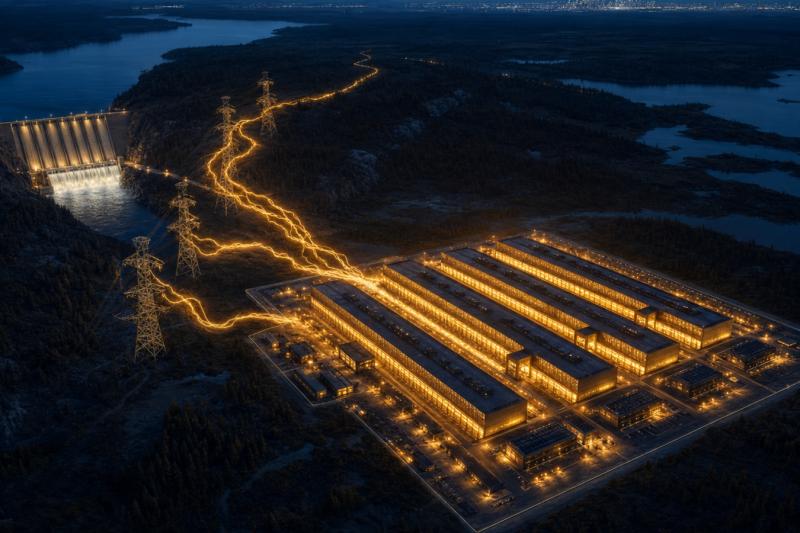
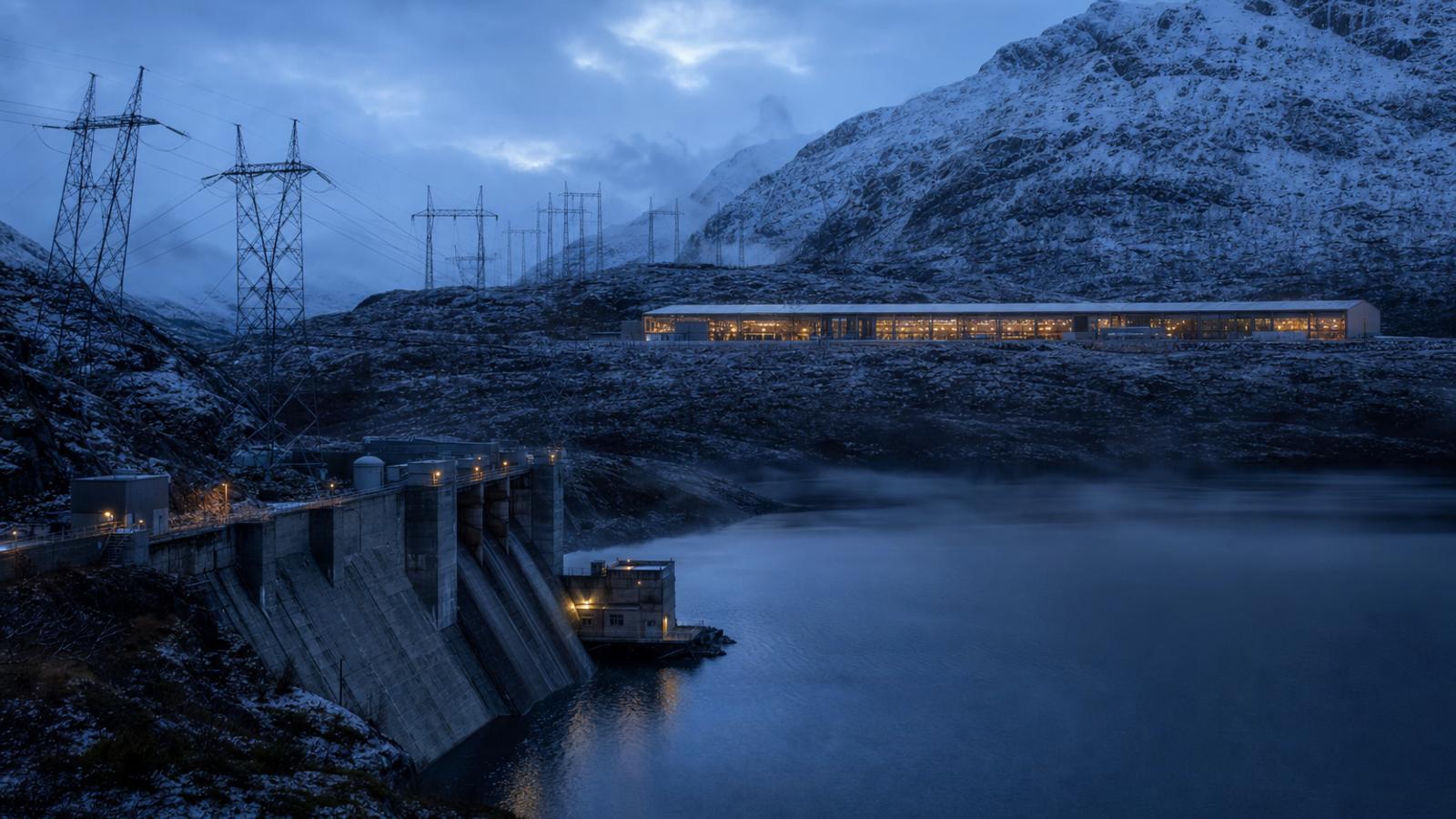
In the summer of 2025, "Stargate Norway" was announced as a 50/50 venture between Nscale and Norway's Aker, with OpenAI as the first customer and Nvidia as chip supplier. The project is a 230-megawatt AI "gigafactory" in Kvandal near Narvik, aiming for 100,000 Nvidia GPUs by the end of 2026 and scalable toward around 520 megawatts — all run on hydropower, with closed-loop liquid cooling and waste heat reused by local industry. The draw is the price: Nscale secured Norwegian power at around 4–5 cents per kilowatt-hour, against a European average near 10. But the project quickly turned dramatic. In April 2026, OpenAI pulled out of the Narvik plan after failing to reach terms with Nscale — and Microsoft stepped in to take the capacity, with 30,000 Nvidia Rubin chips due in 2027. The players changed; the appetite for Norwegian power did not.
Should Norwegian hydropower run chatbots?
That is exactly the question now dividing Norway. Norwegian data-centre demand is expected to climb from 1.6 TWh in 2024 to 18 TWh by 2040, and around 3.5 gigawatts of grid capacity is already reserved, with a queue of more than 5 gigawatts at grid operator Statnett. The left-wing party Rødt wants a total ban on new data centres; others would bar crypto mining but allow cloud services. Meanwhile the government has extended a fixed-price scheme of 50 øre per kilowatt-hour for households through 2026, precisely because many fear the AI load will push power prices up. Statnett has warned that Norway could face an electricity deficit as early as 2026–2027. What looks from the outside like pure symbiosis — surplus power meets data hunger — could, on the inside, become a fight over who pays for the green electricity.
Sovereignty or renting out watts?
So who actually profits from the boom? Aker is recycling energy money into computing: in 2026 Nscale raised a 2-billion-dollar Series C led by Aker itself, a 1.4-billion-dollar term loan and a further 790 million in bank financing from lenders including DNB, Nordea and the export-finance agency Eksfin. And in June 2026 came the largest exit in Norwegian tech history: France's Schneider Electric agreed to buy Oslo-founded Cognite for 3.1 billion dollars, with Aker expecting around 1.48 billion. Norwegian capital, then, is doing very well. But the models, the chips and the cloud platforms remain American. Norway supplies the water, the land and the megawatts; the value creation on top — the AI models and the GPUs — is owned elsewhere. Is this digital sovereignty, or simply renting out watts at less than half the European price?
Toward 2030: power becomes politics
The physics is unforgiving: as long as AI demand grows faster than new, firm, clean power can be built, every single megawatt will be contested. And then "who pays and who profits" matters as much as the engineering. For Norway, the choice is not only technical but political. Cheap, clean power is a competitive advantage few countries can match — but also a finite common resource. The coming years will decide whether the country becomes a compute superpower that refines its energy into high-value industry and jobs, or simply exports its cheapest kilowatt-hours to the world's chatbots. Narvik is only the first chapter.