Full moon October 2026: the Hunter’s Moon rises tonight, Svalbard loses the sun – and Taurid fireballs are due
October’s Hunter’s Moon was full at 05:12 Norwegian time this morning and rises at 15:52 in Oslo tonight. Longyearbyen sees its last sun until 16 February, and the Taurids peak on 4–5 November with a chance of fireballs. Here is the week’s sky, with local times.
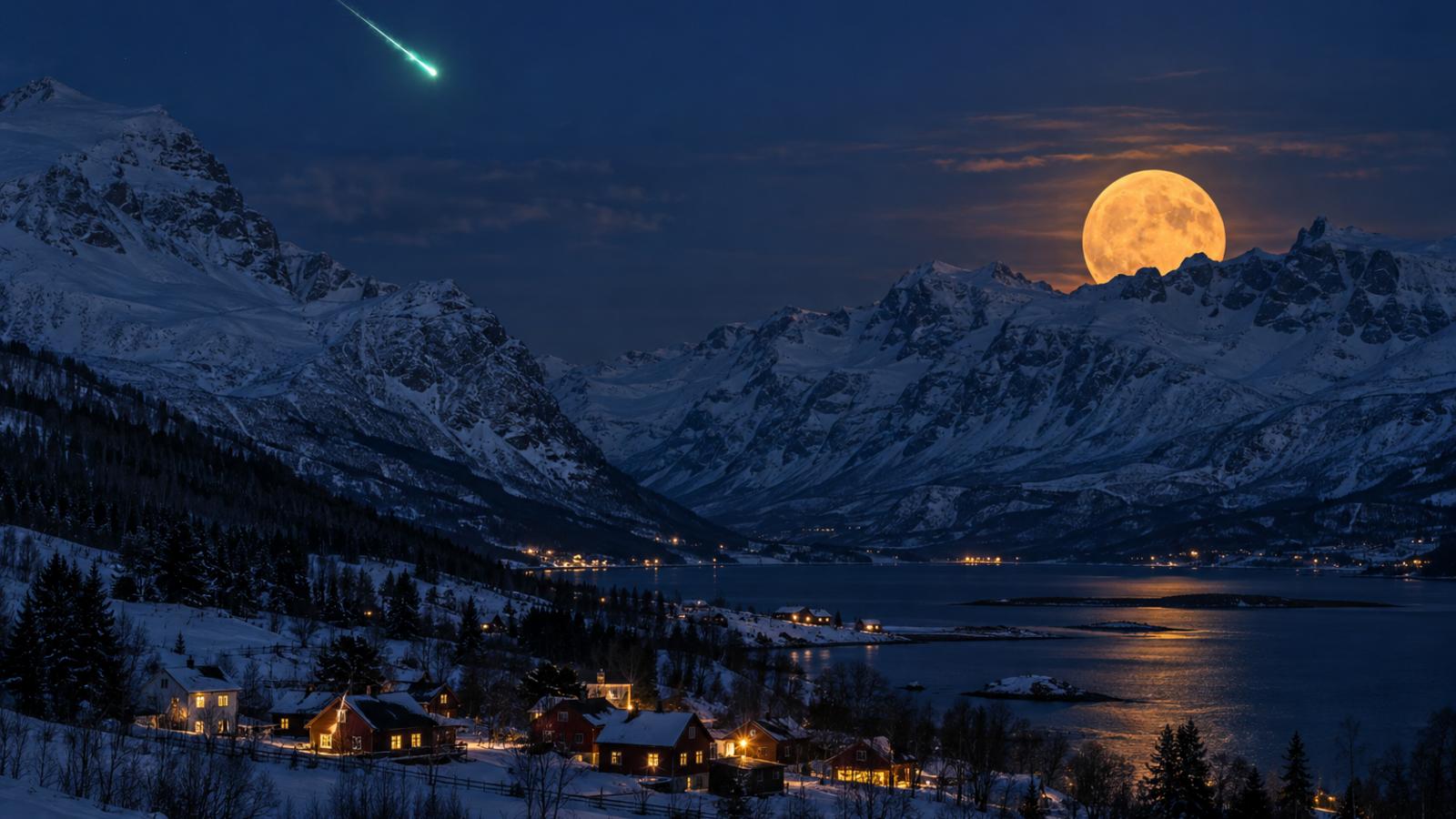
October’s full moon – the Hunter’s Moon – was exactly full early this morning, Monday 26 October 2026, at 04:12 UTC (05:12 in Norway), and it rises again this afternoon at 15:52 in Oslo. Today is also the last day the sun clears the horizon in Longyearbyen until 16 February 2027, and the Taurids could deliver bright fireballs until 5 November.
Here is the week’s sky calendar with local Norwegian times. All times are Norwegian winter time (UTC+1), in force since the clocks went back early on Sunday. Sun and moon times come from the Norwegian Meteorological Institute’s sunrise service and assume a flat, sea-level horizon.
Key facts: the sky this week
- Full moon: Monday 26 October at 04:12 UTC (05:12 Norwegian time). Not a supermoon.
- Moonrise tonight: Oslo 15:52, Bergen 16:11, Trondheim 15:26, Tromsø 13:24.
- Last sun in Longyearbyen: today, from 11:12 to 12:08 – just 56 minutes. It returns above a flat horizon on 16 February 2027.
- Last sunrise in Tromsø: 27 November, with only 20 minutes of sun.
- Southern Taurids: peak on the night of 4–5 November, with the moon 25 per cent lit.
- Orionids: still active until 7 November.
When is the full moon in October 2026, and why is it called the Hunter’s Moon?
The moon reached full phase on Monday 26 October 2026 at 04:12 UTC, according to the Farmers’ Almanac. To the naked eye it will look full on both Monday and Tuesday evening.
The Hunter’s Moon is defined by its place in the calendar rather than by a fixed month: it is the first full moon after the Harvest Moon, which is the full moon closest to the autumn equinox. This year the Harvest Moon fell on 26 September. The name belongs to English and North American almanac tradition; the Norwegian “jegermånen” is simply a translation, not an old Norse name.
The Farmers’ Almanac links the name to game being fat after the harvest and easy to spot on stubble fields by moonlight. This year’s October moon is not classed as a supermoon. That honour goes to November’s Beaver Moon, which opens a run of three supermoons in a row.
What time does the full moon rise tonight?
According to the Norwegian Meteorological Institute (MET Norway), the full moon rises at these times on Monday 26 October:
- Oslo: 15:52, in the north-east. On Tuesday, 15:59.
- Bergen: 16:11.
- Trondheim: 15:26.
- Tromsø: 13:24, almost due north-north-east.
Early risers can also catch the moon low in the sky this morning before it sets at 08:10 in Oslo and 09:23 in Tromsø. MET Norway counts moonrise from the moment the moon’s upper edge clears the horizon, so hills or buildings to the north-east will delay the view a little.
In Svalbard the full moon does not set at all today. In Longyearbyen it stays about five degrees above the horizon even at its lowest point, at 11:49.
When does the polar night begin in Svalbard and Tromsø?
The polar night – “mørketid” in Norwegian – is the period when the sun does not rise above the horizon for an entire day. According to the Norwegian encyclopaedia Store norske leksikon, its southern limit at the winter solstice lies at 67°8′ N – slightly north of the Arctic Circle, because atmospheric refraction lifts the sun.
Longyearbyen: the last sun is today
MET Norway’s data show the sun rising in Longyearbyen at 11:12 and setting at 12:08 today. On Tuesday 27 October it stays below the horizon, sitting 1.1 degrees under it at solar noon.
The sun returns above a flat horizon on 16 February 2027. The darkness deepens through the autumn, too: from around 13 November the sun is more than six degrees below the horizon even at midday, according to the same data. For more from the archipelago, read our story on the Svalbard seed vault passing 1.4 million samples.
Tromsø: last sunrise on 27 November
Tromsø has sun from 07:42 to 15:12 today, seven and a half hours. Its last sunrise before the polar night comes on Friday 27 November, with sun from 11:21 to 11:41, according to MET Norway. The sun does not rise from 28 November to 14 January, and is back on 15 January 2027.
Further south the days are shrinking fast as well. In Oslo, daylight falls from 9 hours 14 minutes today to 8 hours 43 minutes on Sunday 1 November.
Why do sources give different dates?
It comes down to definitions. MET Norway counts sunrise from the sun’s upper edge over a flat horizon, while Store norske leksikon uses the centre of the sun and gives 26 October–16 February for Longyearbyen and 26 November–17 January for Tromsø. It also notes that the dates can shift by a day from year to year. Where mountains block the southern sky, as in Longyearbyen, the sun in practice disappears earlier and returns later.
When can I see Taurid fireballs from Norway?
The Taurids are a meteor shower known for bright fireballs in October and November. According to the American Meteor Society, the Southern Taurids are active from 20 September to 20 November 2026. The shower has two components: the annual peak came on 14 October, while the fireball-rich component peaks on the night of 4–5 November.
NASA identifies Comet Encke as the parent of the Taurid stream and notes that it “exhibits fireballs on or around Halloween”. The meteors hit the atmosphere at roughly 104,600 kilometres per hour.
Halloween or 4 November?
On Halloween, Saturday 31 October, a waning moon rises at 20:07 in Oslo. Its light brightens the sky and swamps faint meteors, although fireballs are bright enough to show through moonlight.
The better bet is the evening of Wednesday 4 November. The moon is then only 25 per cent lit and does not rise in Oslo until 02:46 on Thursday morning. Don’t expect a storm: this is a chance of the odd fireball, not a shower of them.
Can I still see the Orionids?
Yes, though the peak has passed. The AMS lists the Orionids as active until 7 November, after peaking on 21–22 October. Our guide to the 2026 Orionids has the background.
What is a fireball – and what should you do if you see one?
According to the Norwegian Meteor Network, a fireball is a meteor that shines brighter than Venus at its most brilliant. Those brighter than the full moon are often called bolides. A fireball usually glows for just a few seconds.
Many observers believe a fireball was only a few hundred metres away, but it is almost always tens of kilometres off. If you see one, note the time and direction and use the “Meld fra om ildkule” (report a fireball) form at norskmeteornettverk.no. The network runs its own monitoring cameras and uses them to confirm what the public reports.
What’s next in the sky?
- 11–12 November: peak of the Northern Taurids, with the moon just 4 per cent lit, according to the AMS. When both Taurid branches are active at once, fireball activity sometimes rises noticeably.
- November’s full moon: the first of three consecutive supermoons, according to the Farmers’ Almanac.
- 27 November: last sunrise in Tromsø.
- 15 January and 16 February 2027: the sun returns above a flat horizon in Tromsø and Longyearbyen respectively.
The dark season is also aurora season. Bright moonlight makes faint aurora harder to see, so over the next few evenings the strong outbursts will make the biggest impression. Our guide to the 2026/27 northern lights season has tips on where and when to look.
Frequently asked questions
When is the full moon in October 2026?
Monday 26 October 2026 at 04:12 UTC (05:12 in Norway). It looks full on both Monday and Tuesday evening and rises at 15:52 in Oslo on Monday.
Why is October’s full moon called the Hunter’s Moon?
It is the first full moon after the Harvest Moon. The name refers to hunting by moonlight after the harvest, in English and North American tradition.
When does the polar night start in Svalbard in 2026?
In Longyearbyen the sun is above the horizon for the last time on Monday 26 October, according to MET Norway. From 27 October to 15 February 2027 it does not rise above a flat horizon.
When is the polar night in Tromsø?
The last sunrise is on 27 November 2026. The sun stays below the horizon from 28 November to 14 January and returns on 15 January 2027, according to MET Norway.
When can I see Taurid fireballs?
Fireballs can appear at any point until mid-November. The best chance is the evening of 4 November, when the Southern Taurids peak and the moon does not rise until 02:46.