Orionids 2026: how to see Halley's Comet's meteor shower from Norway – best before dawn on 22 October
The Orionids peak on Wednesday and Thursday morning, but a bright waxing Moon spoils the evenings. We pulled moonset times for four Norwegian cities from the Met Institute – here is how to find the dark window before dawn, and what else is up this week.
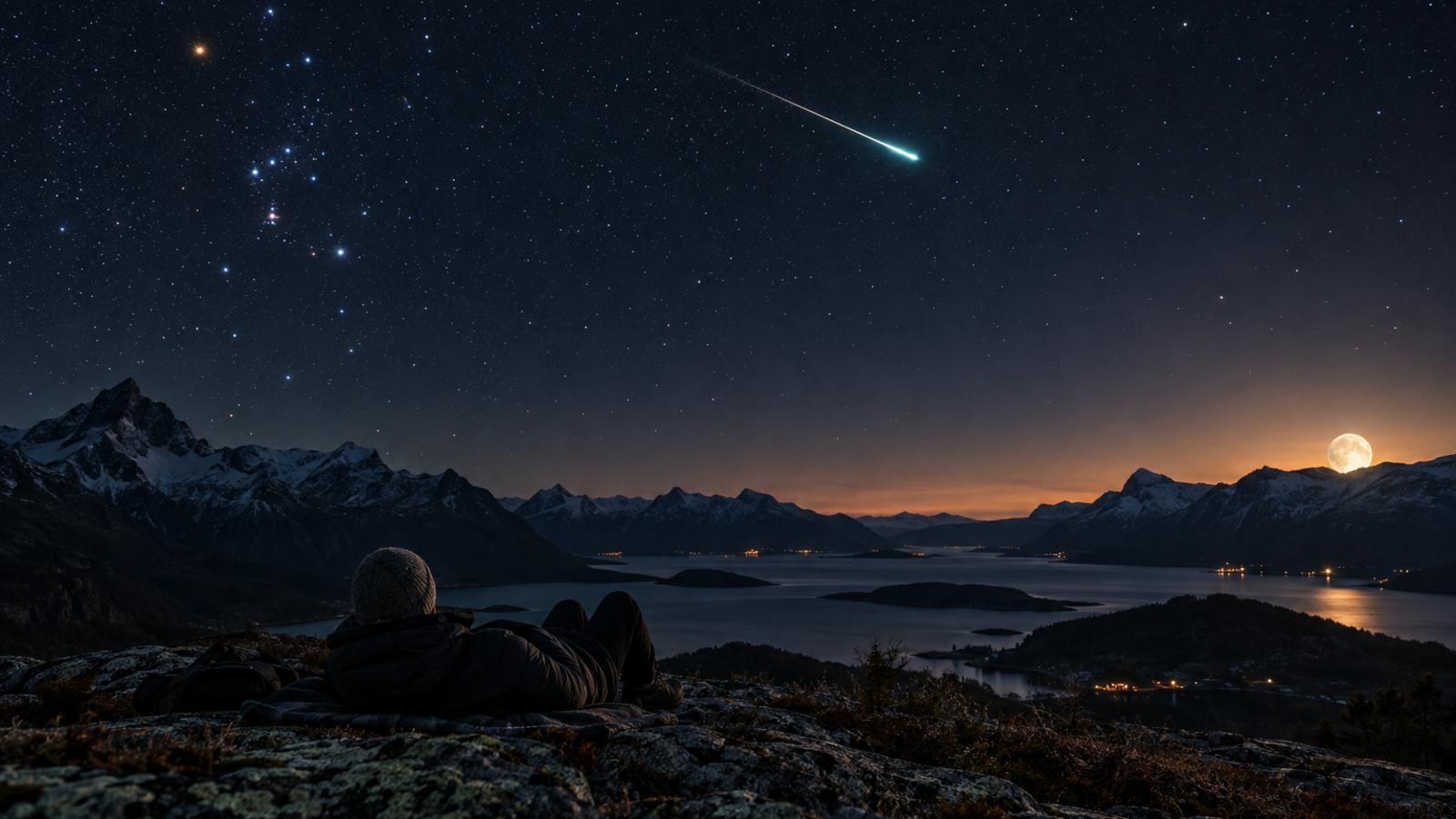
The Orionids 2026 – the meteor shower left behind by Halley's Comet – peak on the nights of 20–21 and 21–22 October. A bright Moon washes out the evenings, so from Norway the best window runs from moonset, at 02:46 in Oslo on Thursday 22 October, until the sky starts to brighten at around 06:00.
- What: the Orionids are an annual meteor shower made of dust from Halley's Comet, active from 2 October to 7 November 2026.
- Peak nights: the night into Wednesday 21 October and the night into Thursday 22 October.
- Rates: typically 10–20 meteors an hour under dark skies.
- Moon: 74 per cent illuminated; on Thursday morning it sets at 02:46 in Oslo, 03:08 in Bergen, 02:37 in Trondheim and 01:32 in Tromsø.
- Speed: around 66 kilometres per second.
- Where to look: lie back with your feet pointing south-east.
When is the best time to see the Orionids from Norway?
According to the American Meteor Society (AMS), the Orionids are active from 2 October to 7 November 2026, with maximum activity on the night of 21–22 October. NASA agrees.
EarthSky cites a predicted peak at 18:00 UTC on Wednesday 21 October – 20:00 in Norway, when the Moon is riding high. The Orionids have a broad maximum spread over several nights, though, so the first dark window after the peak, the small hours of Thursday 22 October, is the one to aim for in Scandinavia.
The night before is a decent fallback: the Moon sets even earlier, at 01:16 in Oslo on Wednesday morning.
What time does the Moon set on 22 October?
The Moon is a waxing gibbous, 74 per cent lit, on the peak night. The AMS warns of significant interference while it is above the horizon, although brighter meteors can still get through. We took moonset times from the Norwegian Meteorological Institute's Sunrise service (Central European Summer Time, calculated for city centres):
- Tromsø: moonset at 01:32
- Trondheim: 02:37
- Oslo: 02:46
- Bergen: 03:08
The Moon goes down in the west-south-west, on the opposite side of the sky from Orion. Hills on your horizon may hide it a few minutes sooner.
Each night the Moon sets roughly an hour and a half later. In Oslo it sets at 04:16 on Friday morning and 05:48 on Saturday morning, so the dark window closes quickly after the peak. Check the cloud forecast the evening before – nobody can promise clear skies yet.
How many meteors will you see, and where should you look?
“In a normal year, the Orionids produce 10–20 shower members at maximum,” says the AMS. Between 2006 and 2009 rates rivalled the Perseids at 50–75 an hour, but recent displays have been low to average. Expect fewer from a light-polluted town or as dawn approaches.
NASA advises northern-hemisphere observers to lie flat on their backs with their feet facing south-east. Give your eyes less than 30 minutes to adjust to the dark and the meteors will start to appear. You do not need binoculars or a telescope.
The radiant – the point the meteors seem to stream from – sits just north of Betelgeuse, the reddish shoulder star of Orion. In the early hours Orion stands in the south-east to south. Don't stare straight at it, though: NASA recommends looking 45–90 degrees away from the radiant, where the trails appear longer and more dramatic.
Orionids are fast and often leave glowing trains that can linger for several seconds. If you are in northern Norway, the same dark night may also bring the aurora – see our guide to the 2026/27 northern lights season.
What do the Orionids have to do with Halley's Comet?
A meteor shower is a spike in the number of meteors appearing over the same period, and each shower is named after the constellation its radiant lies in – hence the Orionids.
The dust comes from Halley's Comet. According to NASA, the comet takes about 76 years to orbit the Sun. It was last seen by casual skywatchers in 1986 and will not return to the inner Solar System until 2061 – yet the debris it shed reaches us every October, and the same stream produces the Eta Aquariids in May.
A typical shooting star is a grain of dust weighing less than a gram that hits the atmosphere at high speed and glows about 100 kilometres up, according to the Norwegian encyclopaedia Store norske leksikon. EarthSky explains that the Orionids meet Earth almost head-on, which is why they are so quick.
What else is happening in the sky this week?
Monday 19 October: Japan launches MMX to the Martian moon Phobos
According to ESA, the Japanese space agency JAXA is scheduled to launch MMX (Martian Moons eXploration) at 21:41 CEST. It will be the first mission to collect samples from Phobos, aiming to bring at least ten grams back to a landing site in Australia in 2031. If the launch slips, the backup window runs from 21 October to 7 November. For the bigger picture, read about the space year 2026.
All week: the Taurids and slow fireballs
Both the Southern and Northern Taurids are active in late October. When the two overlap, the AMS notes, there is sometimes a marked increase in fireballs – slow, exceptionally bright meteors.
Sunday 25 October: clocks go back, then a full Moon
Norway's clocks go back from 03:00 to 02:00 in the early hours of Sunday 25 October – see when the clocks change. All times in this article are summer time. The Moon is full the following night, at 05:12 Norwegian time on Monday 26 October. More sky events are on our astronomy page.
Frequently asked questions
When is the best time to see the Orionid meteor shower in October 2026 from Scandinavia?
The mornings of Wednesday 21 and Thursday 22 October, between moonset – roughly 01:30 to 03:10 depending on where you are in Norway – and the first light of dawn at around 06:00.
Will the Moon spoil the Orionids this year?
In the evening, yes: a 74 per cent lit Moon drowns out the fainter meteors. Once it has set, the sky is dark again.
Do I need binoculars or a telescope?
No. Meteors are best seen with the naked eye. Allow around 30 minutes for your eyes to adapt.
Can I still see the Orionids after the peak?
Yes, until 7 November, but rates drop and the Moon sets later each night.
What is a shooting star?
A shooting star is a meteor: the streak of light produced when a small grain of space dust burns up in the atmosphere, around 100 kilometres above the ground.