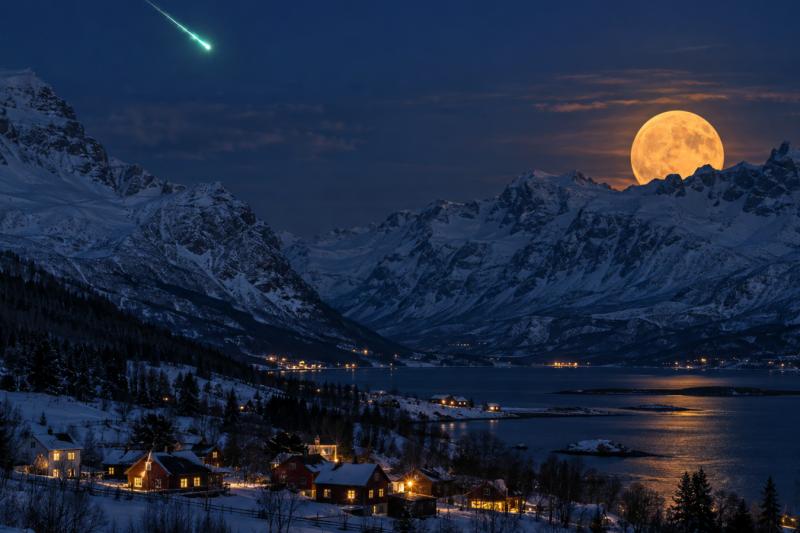
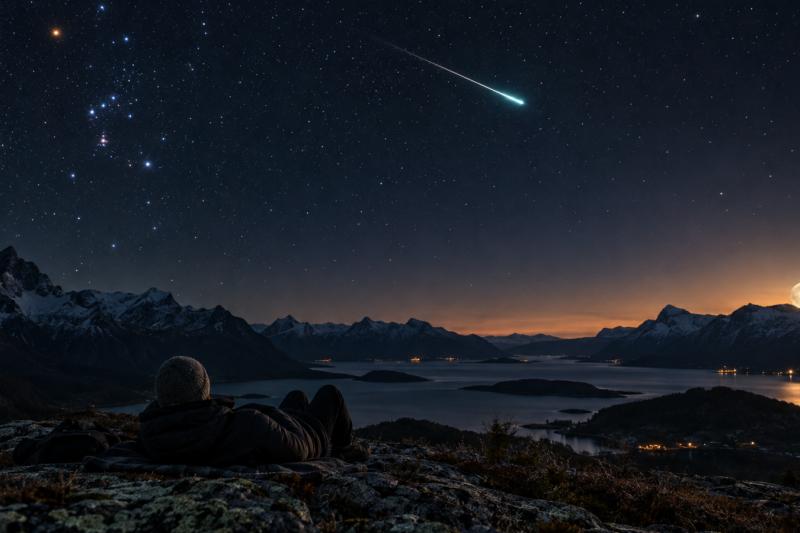
Taurids 2026 peak on 4–5 November: fireballs, moonrise not until 02:46 – and dark nights before the new moon
The Southern Taurids peak on the night of 4–5 November, and the Moon does not rise until 02:46 in Oslo. Here are the times for Oslo, Bergen, Trondheim and Tromsø, what makes a fireball – and the week’s sky up to Monday’s new moon on 9 November.
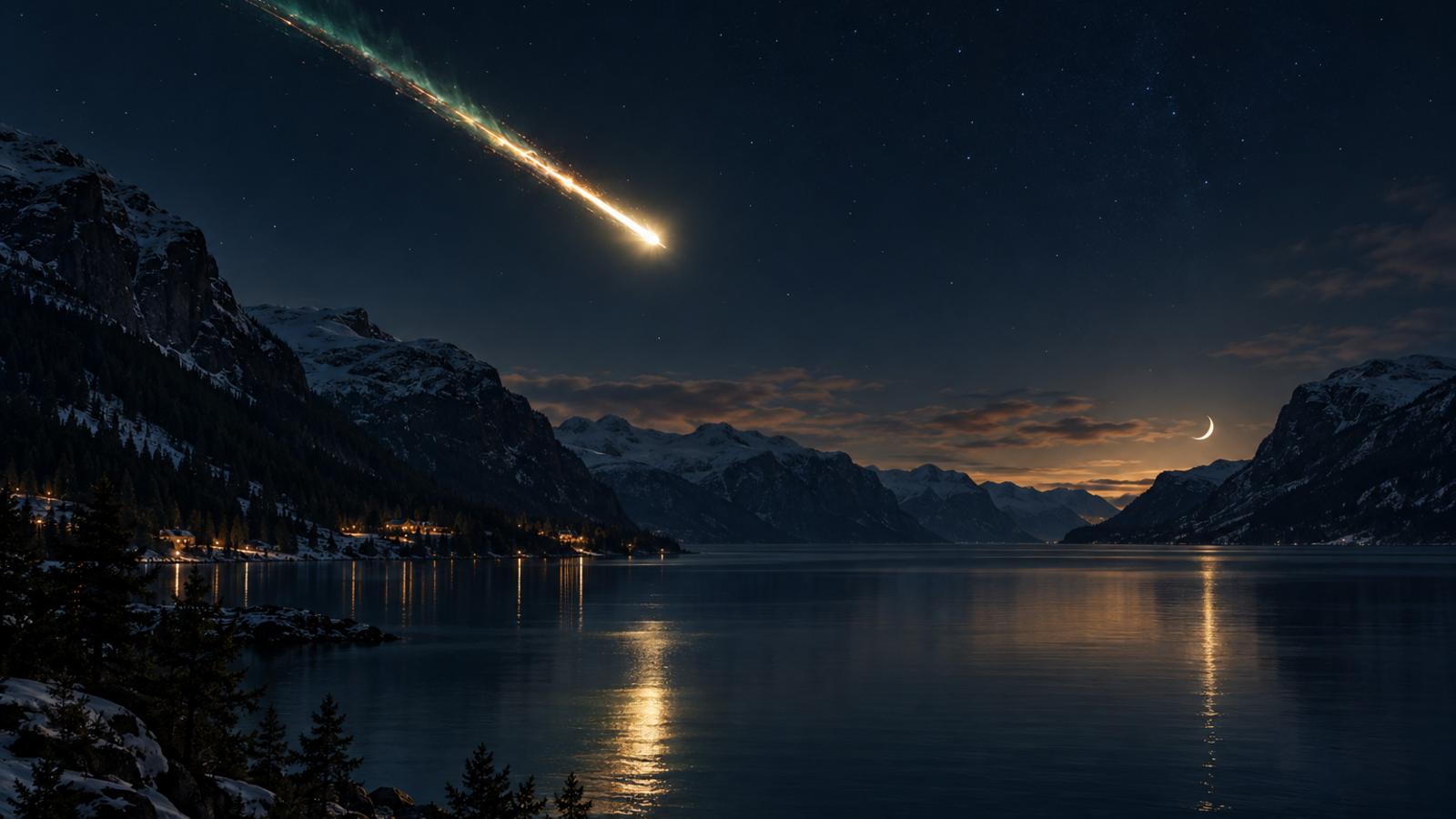
The Southern Taurids peak on the night of Wednesday 4 to Thursday 5 November 2026. The Moon is only 25 per cent lit and does not rise until 02:46 in Oslo, so the evening and the first half of the night stay dark. Expect only around five meteors an hour in good conditions – but the Taurids are known for fireballs, meteors brighter than Venus.
The peak date comes from the meteor shower calendar of the American Meteor Society (AMS), which matches the figures published by the International Meteor Organization (IMO). We flagged the peak in last week’s sky guide; below are local times for four Norwegian cities, an explanation of fireballs and the rest of the week’s sky. All times are Norwegian standard time (UTC+1).
Key facts: the Taurids in 2026
- Peak: the night of 4–5 November – the fireball swarm of the Southern Taurids.
- Moon: waning crescent, 25 per cent illuminated. Rises at 02:46 in Oslo and Trondheim, 03:09 in Bergen and 02:07 in Tromsø.
- Rate: ZHR 5 – about five meteors an hour under ideal skies, usually fewer in practice.
- Speed: around 28 km/s – less than half the Leonids’ 69.7 km/s.
- Parent body: Comet 2P/Encke.
- Northern Taurids: peak on the night of 11–12 November.
- New moon: Monday 9 November at 08:02 Norwegian time.
When do the Taurids peak in 2026?
According to the AMS, the Southern Taurids are active from 20 September to 20 November 2026, with the peak night falling on 4–5 November. The shower has two parts: an annual component that peaked on 14 October and a fireball swarm that peaks on 5 November. It is the second that makes this week worth looking up for.
The peak is broad. Fireballs can turn up on several nights either side, and the Northern Taurids are active from 20 October to 10 December. The AMS notes that when both branches are active at once, in late October and early November, fireball numbers sometimes rise noticeably – which is exactly where we are now.
What time does the Moon rise in Oslo, Bergen, Trondheim and Tromsø?
These times come from the Norwegian Meteorological Institute’s sun and moon service for each city centre and assume a flat horizon. Your dark window runs from full darkness on Wednesday evening until moonrise.
- Oslo: sunset Wednesday 16:13, moonrise Thursday 02:46, sunrise 07:48.
- Bergen: sunset 16:33, moonrise 03:09, sunrise 08:12.
- Trondheim: sunset 15:56, moonrise 02:46, sunrise 08:09.
- Tromsø: sunset 14:28, moonrise 02:07, sunrise 08:30.
Hills or buildings to the east will delay the moment the Moon actually appears. The AMS describes lunar conditions at the peak as generally favourable, with limited interference from moonlight.
Tromsø still gets a few hours of daylight around midday, but its evenings are long and dark. The same night could bring the aurora as well – see our guide to the 2026–27 northern lights season.
Where should I look from Norway?
Meteor showers are named after the constellation they appear to radiate from, as the Norwegian Meteor Network explains. The Taurids come from Taurus, the Bull. According to the AMS, the radiant – the point the meteors seem to stream from – is best placed around midnight.
You do not need to find Taurus, though: meteors can appear anywhere in the sky. Get away from street lights, face the darkest part of the sky and give your eyes time to adjust. Check the cloud forecast before heading out, because cloud cover matters more than anything else. There are more practical tips in our Orionids viewing guide.
What is a fireball?
A fireball is a meteor that shines brighter than Venus at its brightest, often leaving an afterglow, according to the Norwegian Meteor Network. Particularly powerful fireballs are called bolides.
The AMS draws the line at magnitude −4, roughly the brightness of Venus in the morning or evening sky. It defines a bolide as a fireball that ends in a bright terminal flash, often with visible fragmentation.
How high up do they glow?
The Norwegian Meteor Network says meteors start to glow about 100 km up and usually burn out before reaching 50 km. Ordinary shooting stars range from a few millimetres to a few centimetres across. Big bolides can weigh several kilos and stay lit down to 20–30 km above the ground.
Can you hear a fireball?
Very rarely. According to the AMS, a sonic boom usually requires a fireball brighter than magnitude −8 that penetrates below about 50 km and explodes.
Why do the Taurids bring few but bright meteors?
The Taurids come from Comet 2P/Encke, which takes 3.30 years to orbit the Sun – the shortest period of any known comet, according to NASA. NASA describes the Taurid stream as known for its fireballs.
It is a minor shower. The AMS lists a ZHR of 5 for both the Southern and Northern Taurids. ZHR, the zenithal hourly rate, is the number of meteors one observer would see in an hour under a perfectly dark sky with the radiant directly overhead, so real-world counts are lower. In return, the Southern Taurids are “rich in fireballs”, says the AMS, and often account for a rise in fireball reports between September and November.
They are also slow. At around 28 km/s they hit the atmosphere at less than half the speed of the Leonids.
I saw a fireball – how do I report it?
The Norwegian Meteor Network collects reports of fireballs seen over Norway and has an online meteor report form (in Norwegian). Note the time as precisely as you can. The form asks you to mark where you stood on a map and where the trail began and ended in the sky.
What else is happening in the sky?
- Friday 6 November: the Leonids begin. They run until 30 November and peak on the night of 16–17 November with a ZHR of 15, according to the AMS. The Moon will then be 39 per cent lit.
- Monday 9 November: new moon at 07:02 UT (08:02 in Norway), according to the US Naval Observatory. The surrounding nights will be the darkest of the week.
- Night of 11–12 November: the Northern Taurids peak under a Moon just 4 per cent lit – “very favourable” conditions, says the AMS.
Do not expect a spectacular Leonid display this year. The AMS says Earth is not expected to meet any dense debris clouds from Comet 55P/Tempel-Tuttle until 2099, although the comet’s returns in 2031 and 2064 could bring several good displays exceeding 100 meteors an hour.
Hera closes in on a double asteroid
ESA says its Hera spacecraft will rendezvous with the asteroids Didymos and Dimorphos in November 2026, but the agency has not given an exact date. After braking manoeuvres in October, the probe is drifting in at just 20 metres per second relative to the pair, some 197 million km from Earth.
Didymos is 780 metres across and Dimorphos 151 metres. Dimorphos is the asteroid NASA’s DART spacecraft struck on 26 September 2022, changing its orbital period by around 33 minutes. “We will unveil the first detailed images of Dimorphos … on 25 November,” mission manager Ian Carnelli said in ESA’s update of 27 October.
Frequently asked questions
When do the Taurids peak in 2026?
The Southern Taurids peak on the night of 4–5 November and the Northern Taurids on 11–12 November, according to the AMS. Fireballs can appear throughout that period.
Where should I look from Norway?
Anywhere dark: the meteors radiate from Taurus, which is best placed around midnight, but they can cross any part of the sky. Look before the Moon rises – 02:46 in Oslo.
What is a fireball?
A fireball is a meteor brighter than Venus at its brightest. The most powerful ones, which end in a bright flash, are called bolides.
How many meteors will I see?
Around five an hour in ideal conditions, often fewer. The Taurids are a minor shower, but they are known for fireballs.
When is the new moon in November 2026?
Monday 9 November at 07:02 UT, which is 08:02 Norwegian time, according to the US Naval Observatory.