Beaujolais Nouveau 2026 in Norway tomorrow: 33 wines from NOK 194 – and the chemistry of a wine drunk young
Vinmonopolet releases this year’s Beaujolais Nouveau on Thursday 19 November – 08:00 online, 10:00 in shops. We go through the 33 wines, prices and vintage, and explain how fermentation inside whole grapes brings cherry, strawberry – and sometimes banana.
Beaujolais Nouveau 2026 goes on sale in Norway tomorrow, Thursday 19 November: from 08:00 in Vinmonopolet’s online shop and from 10:00 in its stores. The release list has 33 wines priced from NOK 194.40 to NOK 299 a bottle, though each shop stocks its own selection. Made from Gamay grapes picked in August, it is a wine meant to be drunk young.
Key facts: Beaujolais Nouveau 2026 in Norway
- Release: Thursday 19 November 2026 – 08:00 online, 10:00 in shops (Norwegian time, CET).
- Range: 33 wines on the release list as of 15 November – 32 reds and one rosé, all in Vinmonopolet’s supplementary range.
- Price: NOK 194.40 (Trénel) to NOK 299 for a 75cl bottle; the median is NOK 244.90 (Nettsak’s calculation).
- Grape: always Gamay, made with partial carbonic maceration.
- Vintage: hot and dry, with yields around 35 per cent below normal.
When is Beaujolais Nouveau 2026 released in Norway?
According to Vinmonopolet’s release page (updated 11 November 2026), the wines can be ordered online from 08:00 on Thursday 19 November and bought in stores from 10:00 the same day. The state retailer published its release list on 13 November.
Vinmonopolet notes that the nouveau release sits outside its usual new-product launches. In stores, look in the Burgundy section – or for cases stacked on the floor on release day. The monopoly has sold Beaujolais Nouveau since 1983.
What is Beaujolais Nouveau, and why the third Thursday of November?
Beaujolais Nouveau is the first wine of the year from Beaujolais, the wine district in Burgundy, France. “Nouveau” simply means “new”, as opposed to last year’s wine. According to the trade body Inter Beaujolais (October 2026), only six to eight weeks pass between harvest and bottling.
The date has history. In 1951 the Beaujolais wine rules were changed so the wine could go on sale as early as 15 November in the year of harvest, which sparked a race to get the first bottles to Paris. In 1985 the date moved to the third Thursday of November, and the phenomenon went international, Vinmonopolet writes.
Inter Beaujolais stresses that bottles may only be sold and served from that date. By its own figures, around 14 million bottles are made each year – roughly 20 per cent of all Beaujolais wine – and more than a third is drunk outside France.
Why doesn’t my local shop have every wine?
All 33 wines sit in the supplementary range, which means they are not stocked permanently in every store. Vinmonopolet explains that each shop orders what it wants from whatever the importers have chosen to bring in this year, so selections vary from store to store.
If your shop does not have the bottle you are after, the online shop is the alternative. Vinmonopolet releases seasonal products on fixed dates through the autumn – see our piece on Norwegian Christmas beer, released on 4 November, and the science behind its strength.
How much does Beaujolais Nouveau cost in Norway this year?
Nettsak went through the release list. Prices include the bottle deposit, and seven wines cost NOK 210 or less:
- Trénel Beaujolais Nouveau 2026 – NOK 194.40
- Georges Duboeuf Beaujolais Nouveau 2026 – NOK 199.90
- Trénel Beaujolais-Villages Nouveau 2026 – NOK 199.90
- Joseph Drouhin Beaujolais Nouveau 2026 – NOK 205
- Bulliat Bouquet Final 2026 – NOK 205.90
- Domaine de Colette Beaujolais-Villages Nouveau 2026 – NOK 209
- Joseph Drouhin Beaujolais-Villages Nouveau 2026 – NOK 210
The most expensive is Philippe Viet’s “Bojo Le Clown” at NOK 299. The only magnum (1.5 litres) is Joseph Drouhin Beaujolais-Villages Nouveau at NOK 435, and the only rosé is Ferraud Beaujolais Rosé Nouveau at NOK 244.90.
Twelve of the 33 are Beaujolais-Villages Nouveau, which Vinmonopolet’s guide describes as coming from villages regarded as especially good. Three are labelled as made without added sulphites. Alcohol ranges from 12.0 to 14.7 per cent, and the list covers 23 producers through 14 importers.
What was the 2026 vintage like?
Vinmonopolet calls 2026 a very hot and dry vintage in Beaujolais. Drought and hail cut yields by as much as 35 per cent, and picking began on 13 August – almost a month earlier than usual.
Small berries delivered plenty of fruit, colour and concentration, but high sugar and low acidity made freshness hard to keep. Vinmonopolet therefore expects more variation than usual between areas and producers. The ten crus, including Morgon and Fleurie, cannot make nouveau at all.
What is carbonic maceration?
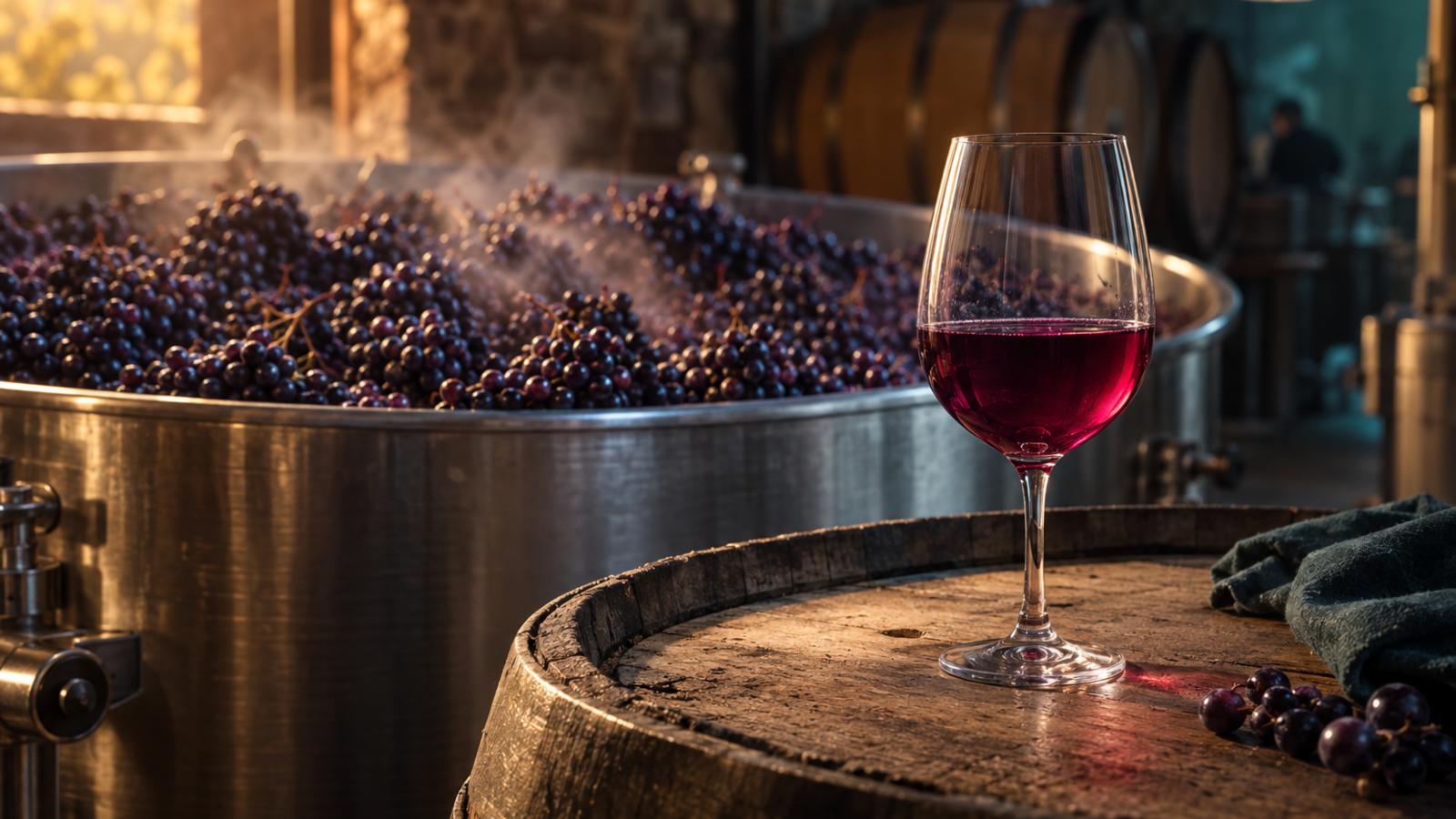
Carbonic maceration is a method in which whole, uncrushed bunches of grapes are sealed in a tank filled with carbon dioxide, so fermentation begins inside each berry. According to the Australian Wine Research Institute (AWRI, 2018), the reactions are driven by the grapes’ own enzymes, with no oxygen and no yeast involved. The technique was developed by Michel Flanzy in 1934.
Most Beaujolais Nouveau uses a partial version: whole bunches go into the tank under a blanket of CO₂, and after one to three weeks they are pressed and ferment on as normal wine, Vinmonopolet explains. The result is little colour and tannin, but a clearly fruity, fresh taste.
What happens inside the grape?
The AWRI says carbon dioxide fills about half the berry’s volume. The still-living berry switches from normal respiration to anaerobic metabolism – life without oxygen. Only 0.5–2.2 per cent alcohol forms inside the berry, probably because at that point the alcohol starts to damage its cells.
Meanwhile the enzyme malate dehydrogenase breaks down malic acid. Acidity falls and pH rises, one reason the wine feels soft. The AWRI puts the ideal at 30–32°C for five to eight days.
Where do the cherry and strawberry aromas come from?
Inside the berry, shikimic acid builds up and breaks down into three key aroma compounds, the AWRI writes: benzaldehyde, which smells of cherry and almond; ethyl cinnamate, reminiscent of cinnamon, strawberry and honey; and styrene, which can come across as plasticky. The AWRI describes the aroma as strawberry, raspberry and cherry, “particularly in Beaujolais wines”. We have also looked at how acids and aromas shape the taste of fruit in our piece on clementine season.
And the banana?
The banana note many people associate with nouveau is the hallmark of the ester isoamyl acetate, which PubChem describes as having an “intense, but pleasant banana-like odor”. The AWRI does not list banana among the compounds produced by maceration itself. Vinmonopolet reports that more and more producers now make nouveau with wild-yeast fermentation and older vines – and without the banana-and-sweets character.
How long does Beaujolais Nouveau keep?
Not long – and that is the point. Vinmonopolet’s product page for Georges Duboeuf Beaujolais Nouveau 2026, for example, says it is ready to drink and not suitable for cellaring.
The reason is chemical. The AWRI notes that carbonic-maceration wines are lower in tannin and acidity and are reported to mature faster than conventionally fermented wines.
Fruity esters also fade in the bottle. A study of white wine stored for a year, published in Food Chemistry (2012), found that acetate esters and other fruity esters broke down – faster at 18°C than at 5°C. It looked at white wine, not Beaujolais, but it explains why a fruit-led style fades over time.
So buy nouveau to drink this winter, not to lay down. Like a carved pumpkin, it has a short season.
What food goes with Beaujolais Nouveau?
Vinmonopolet describes the Duboeuf wine as fresh and fruity and suggests light dishes such as pasta, pizza, tacos and tapas, as well as fish, cheese and pork. Pasta is on the list, then – a cacio e pepe made the physicists’ way, for instance.
Frequently asked questions
When is Beaujolais Nouveau 2026 released in Norway?
On Thursday 19 November 2026. Vinmonopolet’s online shop opens for sales at 08:00 and its stores at 10:00 Norwegian time.
Why is Beaujolais Nouveau released on the third Thursday of November?
The date was set in 1985. Before that, the release date was 15 November, following a rule change in 1951.
What is the cheapest Beaujolais Nouveau at Vinmonopolet this year?
Trénel Beaujolais Nouveau 2026 at NOK 194.40, according to the release list as of 15 November.
What is carbonic maceration?
It is the fermentation of whole, uncrushed grapes under carbon dioxide. The grapes’ own enzymes produce a little alcohol and fruity aroma compounds before yeast takes over.
How long can I keep Beaujolais Nouveau?
It is made to be drunk young, and Vinmonopolet labels it as not suitable for cellaring. Drink it over the winter.