BepiColombo is due to enter orbit around Mercury today: eight years, nine flybys and heat above 350 °C
After eight years, nine planetary flybys and 10.2 billion kilometres, the European–Japanese probe BepiColombo is scheduled to brake into orbit around Mercury today. Here is why the trip took so long, why arrival was delayed – and what happens before science starts in April 2027.
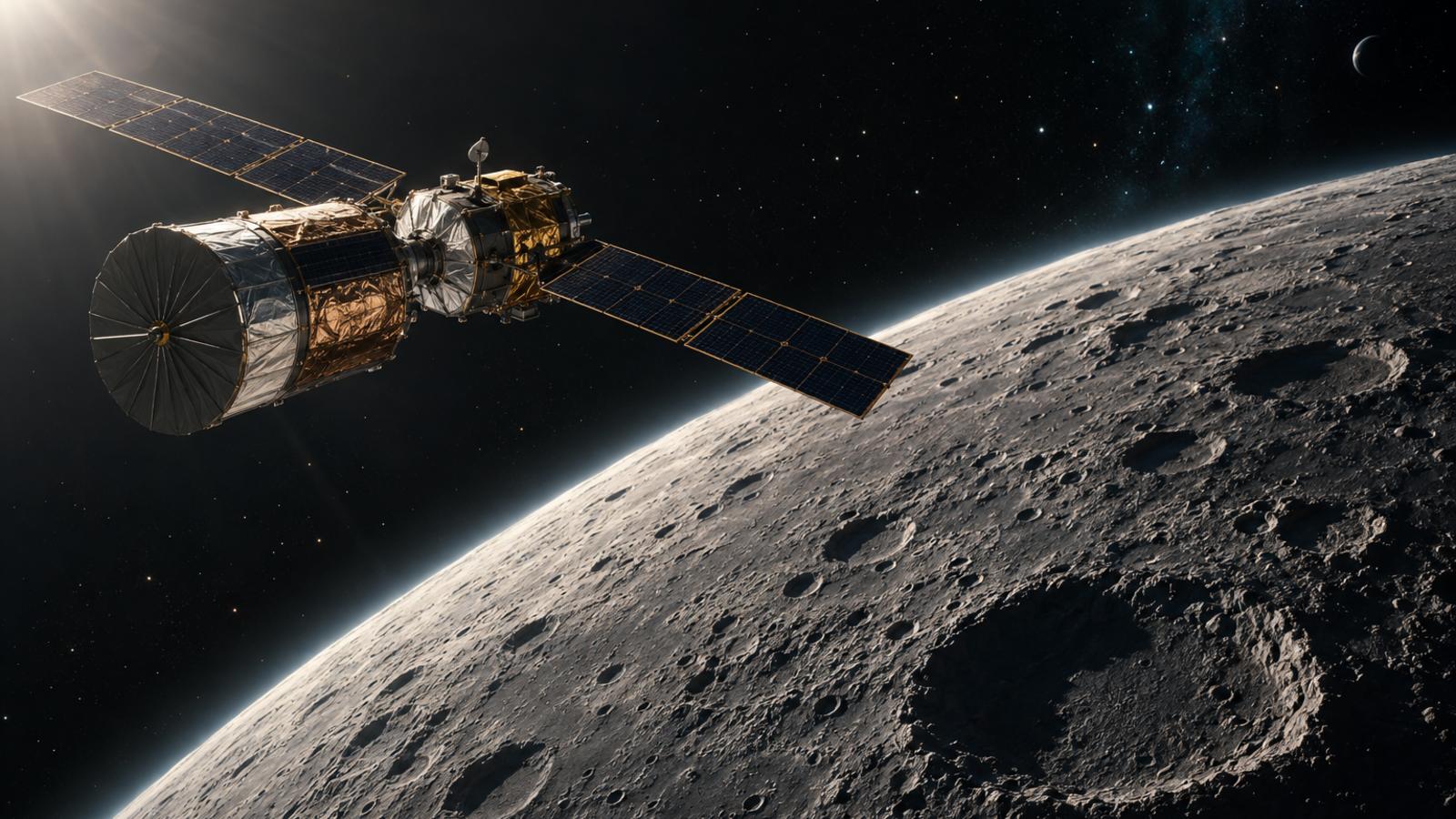
BepiColombo, the joint European–Japanese mission, is scheduled to be captured into orbit around Mercury today, Saturday 21 November 2026, just over eight years after launch. According to ESA, its two orbiters, still attached to each other, will first settle into a long polar orbit of 674 x 178,000 kilometres. They separate on 9–10 December and begin science operations in April 2027.
- What: BepiColombo is a joint mission of the European Space Agency (ESA) and Japan’s JAXA, carrying two orbiters: ESA’s MPO and JAXA’s Mio.
- Orbit insertion: 21 November 2026, according to ESA (as of October 2026). ESA has not published a time.
- Launch: 20 October 2018 on an Ariane 5 from Europe’s Spaceport in Kourou, French Guiana.
- The journey: 10.2 billion kilometres, 22 laps of the Sun and nine planetary flybys: one of Earth, two of Venus and six of Mercury.
- Heat: the spacecraft has to cope with more than 350 °C. Mercury’s surface ranges from –180 °C to +450 °C.
- Next milestones: Mio is released on 9–10 December 2026 and the science phase starts on 6 April 2027.
When does BepiColombo arrive at Mercury, and what happens today?
ESA’s live arrival updates, last revised on 6 October 2026, say the combined spacecraft will enter orbit around Mercury on 21 November. ESA calls this “the critical Mercury orbit insertion manoeuvre”. The work is done by MPO’s own chemical thrusters, because the mission’s four ion engines were switched off for the last time on 15 June.
According to ESA’s arrival media kit (July 2026), MPO and Mio will be captured by Mercury’s gravity while still joined together. When this article was published, the manoeuvre had not been confirmed, and ESA had not said when it would take place. Signals take up to 13 minutes to travel one way between the spacecraft and Earth.
The arrival sequence actually began on 3 September. At around 16:00 CEST, ESA’s ground stations at Cebreros in Spain and Malargüe in Argentina confirmed that the Mercury Transfer Module (MTM) had separated, from 200 million kilometres away. On 24 September, MPO fired its thrusters for 8 minutes and 42 seconds, a course correction of 11.4 metres per second.
Some ESA pages give the arrival as “December 2026”, but there is no contradiction. ESA describes arrival as a six-month sequence of manoeuvres. In December, BepiColombo becomes the first mission to place two spacecraft in separate orbits around Mercury.
Why did it take eight years to reach Mercury?
The short answer is braking. ESA’s explainer (June 2020) says a probe falling towards the Sun picks up speed “like a car driving downhill”. Unless it sheds that energy, it flies straight past Mercury. Braking with engines alone would need so much fuel that the spacecraft would be too heavy to launch.
The media kit puts it starkly: entering a stable orbit around Mercury takes more energy than sending a mission to Pluto. So BepiColombo used planetary flybys to bleed off speed, and the closest-approach distances show how precise the flying has been:
- Earth, 10 April 2020: 12,685 km
- Venus, 15 October 2020 and 10 August 2021: 10,631 km and 552 km
- Mercury, 1 October 2021 and 23 June 2022: 199 km both times
- Mercury, 19 June 2023 and 4 September 2024: 236 km and 165 km
- Mercury, 1 December 2024 and 8 January 2025: 40,000 km and 295 km
By contrast, NASA’s Mariner 10 reached Mercury in just 147 days in the 1970s. It only flew past and never entered orbit.
Why was the arrival delayed to 2026?
In April 2024 the MTM’s ion engines could no longer run at full power. ESA said in September 2024 that the cause was “unexpected electric currents” between the solar array and the unit that draws power from it.
BepiColombo had originally been due at Mercury in December 2025. Space.com reported (3 September 2024) that ESA mission manager Santa Martínez said the thrust would be too low for orbit insertion on that date. The fix was a new trajectory, including a pass just 165 kilometres above Mercury on 4 September 2024. The delay came to roughly eleven months.
What are MPO and Mio?
MPO, the Mercury Planetary Orbiter, is ESA’s spacecraft. It weighs about 1,200 kg and carries 11 instruments to map Mercury’s surface and interior. Mio is JAXA’s spacecraft. It weighs around 255 kg, carries five instruments and spins 15 times a minute to avoid overheating.
According to JAXA, Mio will study the magnetic field and magnetosphere because “Japan excels in the study of magnetic fields and magnetospheres”. The agency has other planetary missions on the go too, including the MMX sample-return mission to the Martian moon Phobos.
The mission is named after Giuseppe “Bepi” Colombo (1920–1984) of the University of Padua, who worked out that Mercury rotates three times for every two orbits of the Sun.
How hot does it get, and how does the spacecraft survive?
ESA’s fact sheet says BepiColombo must endure temperatures above 350 °C. At Mercury, sunlight is at times more than ten times as intense as at Earth. According to ESA, more than 80 per cent of the materials used had never been tested in such an extreme environment.
Until it is released, Mio sits behind its own sunshield, known as MOSIF. The 350 °C figure refers to the spacecraft. The 450 °C figure is the highest temperature on the planet’s surface.
What will BepiColombo find out about Mercury?
ESA’s top five Mercury mysteries show a planet full of contradictions. Its core is about 4,000 km across inside a planet less than 5,000 km wide, which means it takes up over 55 per cent of Mercury’s volume. There also seems to be water ice in craters near the poles, even though the surface can reach 450 °C.
Scientists also want to know whether Mercury is still geologically active. If the small depressions known as hollows turn out to be changing, “that would be one of the most fantastic results we could get with BepiColombo”, says ESA project scientist Johannes Benkhoff. The mission will also test Einstein’s general theory of relativity.
Why does Mercury’s magnetic field matter?
According to ESA, Mercury and Earth are the only rocky planets in the inner Solar System that have a magnetic field today. Mercury’s field is a hundred times weaker than Earth’s, and MPO and Mio will measure how the powerful solar wind shapes it.
The same interplay between the Sun and a planet’s magnetic field produces the northern lights over Norway. We have found no record of Norwegian instruments on board.
What happens next?
ESA’s plan, which may change for operational reasons, is as follows:
- 9–10 December 2026: MPO releases Mio into Mio’s final orbit of 590 x 11,640 km.
- 16 December 2026: MPO jettisons the MOSIF sunshield and starts lowering its own orbit.
- 10 March 2027: MPO reaches its final orbit of 480 x 1,500 km.
- 6 April 2027: the science phase begins.
The nominal mission lasts one Earth year, equal to four Mercury years, and may be extended by a year. ESA has not given a date for the first images from orbit. The SIMBIO-SYS camera system took its first image in space after all the instruments were switched on on 15 September. BepiColombo is one of the highlights of a busy space year in 2026.
Frequently asked questions
When does BepiColombo enter orbit around Mercury?
According to ESA, the spacecraft is due to be captured into orbit on 21 November 2026. MPO and Mio separate on 9–10 December, and science operations start on 6 April 2027.
Why did the journey take eight years?
The spacecraft had to brake against the Sun’s gravity, which takes more energy than a trip to Pluto. Instead of carrying huge amounts of fuel, BepiColombo used nine planetary flybys.
Has anything orbited Mercury before?
Yes, once. BepiColombo will be the second mission to do so, after NASA’s MESSENGER, which entered orbit on 18 March 2011 and crashed into the surface on 30 April 2015. BepiColombo is the first to bring two orbiters.
Why was BepiColombo delayed?
In April 2024 its ion engines lost full power because of unexpected electric currents in the power supply. A new trajectory moved arrival from December 2025 to November 2026.