Supermoon November 2026: full Moon on Tuesday 24 November – moonrise times in Norway and why it looks bigger
Tuesday’s full Moon is a supermoon, and it rises before the Sun sets. Here are moonrise times for Oslo, Bergen, Trondheim and Tromsø, what “14 per cent bigger” really means – and why the Christmas Eve Moon will be closer still.
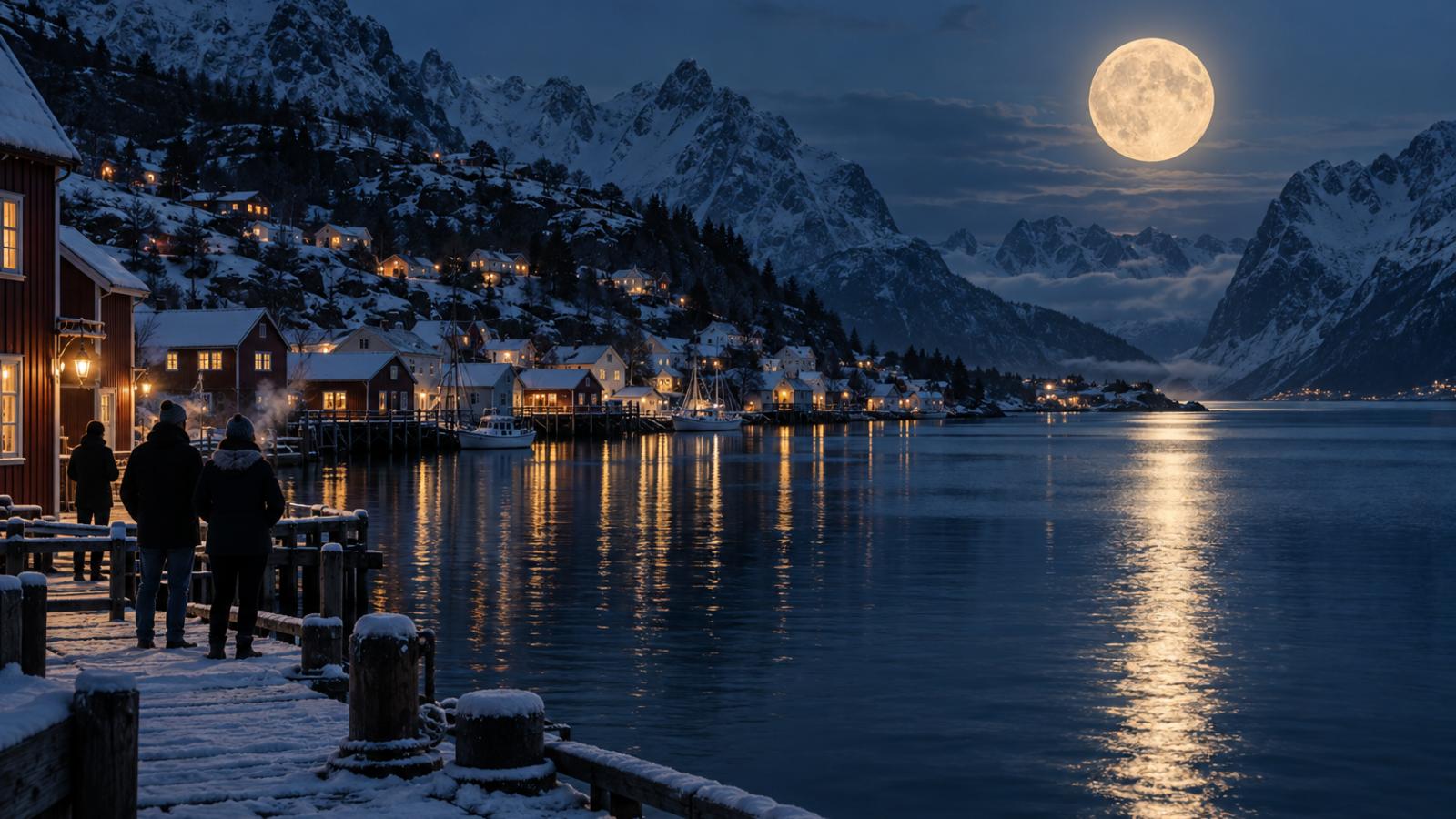
The full Moon on Tuesday 24 November 2026 is a supermoon. According to NASA, it is full at 14:54 UTC – 15:54 in Norway – by which time it is already above the horizon: MET Norway puts moonrise at 14:19 in Oslo, 14:35 in Bergen and 13:19 in Trondheim, while in Tromsø the Moon does not set at all.
Key facts: the 24 November supermoon
- Full Moon: Tuesday 24 November at 15:54 Norwegian time (14:54 UTC, according to NASA).
- Moonrise on Tuesday, flat horizon: Oslo 14:19, Bergen 14:35, Trondheim 13:19. In Tromsø the Moon stays up all day and night (MET Norway).
- Where to look: low in the north-north-east as it rises, high in the south around midnight.
- Closest approach: 359,347 km on Wednesday 25 November at 22:00, about 30 hours after full Moon (Time and Date).
- Next supermoon: Christmas Eve, full at 02:28 Norwegian time (NASA).
- “14 per cent bigger” is measured against the smallest full Moon of the year – not an ordinary one.
When is the November 2026 supermoon?
NASA gives the moment of full Moon as 14:54 UTC on 24 November, which is 15:54 Central European Time. Space.com lists 14:53 GMT. The one-minute gap is down to rounding and makes no difference to anyone outside looking up. Space.com also uses the name Beaver Moon, which it describes as a North American tradition.
Full Moon is an instant in the Moon’s orbit rather than something you can see. What matters is that the disc looks almost completely lit on the evening before and the evening after: Space.com notes that it will appear full to the casual observer on both 23 and 24 November.
Tonight or tomorrow?
Either works. On Monday 23 November the Moon rises at 14:07 in Oslo and 14:24 in Bergen, according to MET Norway. On Tuesday it turns full in the afternoon and shines all night. Cloud cover will matter far more than the date, so check the local forecast.
Moonrise times in Oslo, Bergen, Trondheim and Tromsø
These figures come from MET Norway’s sunrise and moon API, queried on 22 November, and apply to Tuesday 24 November over a flat horizon in each city centre. Mountains and buildings can delay the visible moonrise considerably, especially in Bergen and Tromsø.
- Oslo: moonrise 14:19, sunset 15:30. The Moon reaches its highest point at 00:21 on Wednesday, 56 degrees above the horizon.
- Bergen: moonrise 14:35, sunset 15:48. Highest at 00:43, 55 degrees.
- Trondheim: moonrise 13:19, sunset 15:01. Highest at 00:22, 52 degrees.
- Tromsø: no moonrise or moonset. Lowest at 11:14, 3.5 degrees up; highest at 23:46, 46 degrees.
By our calculation, that puts the Moon above Oslo’s horizon 1 hour 11 minutes before sunset. A 15:30 sunset is also a reminder of how short the days have become – we have covered light therapy lamps and the Norwegian winter dark before.
Why does the Moon ride so high?
A full Moon sits on the opposite side of Earth from the Sun. With the November Sun hugging the southern horizon, the full Moon climbs correspondingly high – hence MET Norway’s figures of 52 to 56 degrees at midnight across southern and central Norway.
Why doesn’t the Moon set in Tromsø?
MET Norway has the Moon above Tromsø’s horizon around the clock on 23, 24 and 25 November, while on Tuesday the Sun is up only from 10:32 to 12:28. The calculation is for the city’s coordinates; among the fjords and peaks, mountains can still hide it. As we reported in our piece on the Leonids and the polar night, Tromsø loses the Sun altogether on 27 November.
What is a supermoon?
A supermoon is a full Moon that coincides with the Moon being near perigee – the point in its elliptical orbit where it comes closest to Earth. NASA stresses that “supermoon” is not an official astronomical term, but it is usually applied to a full Moon within at least 90 per cent of perigee. They happen three or four times a year, always in a row.
The Norwegian encyclopaedia Store norske leksikon defines it in similar terms: an extra-large full Moon occurring when the Moon is at its shortest distance from Earth, at perigee. The previous full Moon we wrote about was October’s Hunter’s Moon.
How much bigger is a supermoon than a normal full Moon?
NASA says that at its closest the full Moon can look up to 14 per cent bigger and 30 per cent brighter than the faintest full Moon of the year, which comes when the Moon is farthest away. So the comparison is with the year’s smallest full Moon – the micromoon – not an average one. NASA adds that 14 per cent does not make a big difference in visible size.
The distance table from Time and Date explains the numbers. This year’s greatest distance is 406,419 km (11 December) and the shortest 356,650 km (24 December). By our calculation the ratio is 1.14 – 14 per cent in diameter. Squared, it becomes 1.30: 30 per cent more disc area, and therefore more light.
November’s Moon is not the year’s biggest. Perigee arrives only at 22:00 on Wednesday, at 359,347 km – roughly 46,000 km closer than at apogee on 13 November, by our reckoning.
Why does the Moon look huge near the horizon?
That is the Moon illusion, and it has nothing to do with supermoons. NASA/JPL’s November skywatching guide points out that the Moon may look even bigger near the horizon, but that this is a common effect with any full Moon.
The Moon’s angular size is the same whether it is low or high. One widely cited explanation comes from Lloyd and James H. Kaufman in PNAS (2000): experiments with artificial moons showed that the brain treats the horizon Moon as farther away, and therefore perceives it as larger. The illusion is still not considered fully solved.
Does a supermoon cause higher tides?
Somewhat. NASA says a supermoon can bring higher tides than usual. The Norwegian Mapping Authority’s tide prediction for Bergen, retrieved on 22 November (public view at Kartverket’s sea-level service), gives 168.6 cm above chart datum at 22:32 on Tuesday, and the highest value for November–December at 11:45 on Thursday 26 November: 170.4 cm. For comparison, the table shows 141.5 cm at 19:19 on 20 November.
These are astronomical tides only. Wind and air pressure come on top and can shift sea levels considerably.
Will the full Moon spoil the northern lights?
Strong moonlight makes faint aurora harder to see. In northern Norway, where the Moon is in the sky all night this week, it can pay to face north, away from the Moon. Our guide to the 2026–27 northern lights season has more.
When is the next supermoon?
According to NASA, the Christmas Eve full Moon is also a supermoon, full at 01:28 UTC on 24 December – 02:28 in Norway. It will be closer than November’s: Time and Date puts perigee at 09:31 that day, at 356,650 km, the shortest distance of the year. NASA/JPL counts January 2027 as the third in a run of three, and Space.com gives that full Moon as 12:17 GMT on 22 January 2027. NASA’s own supermoon page currently lists only November and December.
Frequently asked questions
When is the supermoon in November 2026 in Norway?
The Moon is full on Tuesday 24 November at 15:54 Norwegian time, according to NASA. It rises in the early afternoon and is easy to see once darkness falls on both Monday and Tuesday evening.
What is a supermoon?
A full Moon that coincides with the Moon being near perigee, the closest point of its orbit to Earth. The term is not official, but is generally used for full Moons within 90 per cent of perigee distance.
How much bigger does a supermoon look?
Up to 14 per cent bigger and 30 per cent brighter than the year’s smallest full Moon, says NASA. Compared with an ordinary full Moon the difference is smaller and hard to spot with the naked eye.
Which direction should I look?
Low in the north-north-east at moonrise, according to MET Norway’s figures, and high in the south around midnight.
When is the next supermoon after November 2026?
Christmas Eve, 24 December 2026, full at 01:28 UTC (02:28 in Norway). NASA/JPL also counts the January 2027 full Moon in the series.